Credit: Sandia National Laboratories
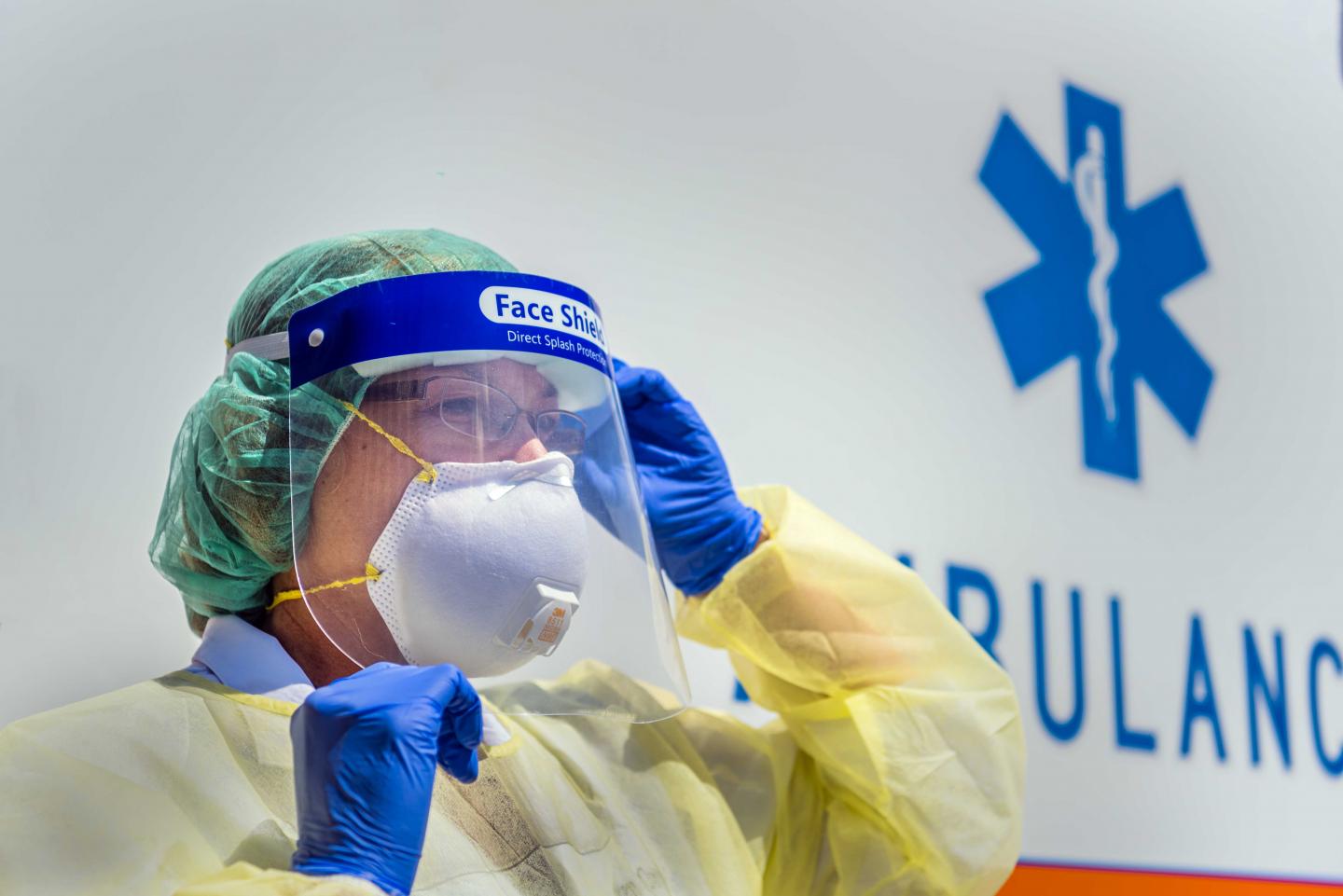
ALBUQUERQUE, N.M. — Sandia National Laboratories is teaming with local hospitals and medical device manufacturers to increase the availability of respirator masks for health care workers.
“We’re helping local medical device manufacturers test materials they are using to make medical-grade masks, and we’re helping local hospitals by evaluating methods they’ve developed to clean N95 masks for reuse.” said Sandia Fellow Gil Herrera. “We’re providing them information they need to make decisions regarding the reuse of sterilized N95 masks and the use of alternatives to N95 masks to protect health care workers and patients.”
N95 respirator masks are certified to block 95% of extremely small particles without restricting breathing. Sandia is conducting tests for manufacturers to show how new mask designs measure up to these industry standards. Sandia also is studying disinfection methods that could enable hospitals to reuse masks, lessening the need for new ones.
Assistance has been provided at no cost to partners through a combination of internal funds and funding from the Department of Energy Office of Science.
Testing unconventional materials
When respirators ran low in hospitals, Albuquerque companies Marpac, Sierra Peaks and Sew-EZ approached Sandia for help testing materials outside the typical supply chain that could be used to manufacture more. Examples included materials used for heating and air conditioning systems, and vacuum bags.
Sandia principal investigator Michael Omana leads a team that modified existing aerosol and filtration systems used for nuclear nonproliferation work to conduct tests and comparison studies for the projects. One of the test systems included an automated filter tester commonly found in industry and intended for material certification.
Through these tests, the researchers identified the most promising filter media, comparable to N95 filtration, to use for respirator production.
“Sandia isn’t a certification lab, but we were able to use the systems to provide quantitative results,” Omana said. “We’ve been able to utilize two independent systems to validate a robust data set.”
Evaluating reuse technologies
Sandia is collaborating with the University of New Mexico Hospital to assess how to safely decontaminate and reuse respirators.
The team is assessing a hydrogen-peroxide vapor method currently being used by UNM Hospital, as well as less specialized techniques that could be used at smaller hospitals. Sandia’s technical breadth and experimental capabilities, including aerosol testing labs, are enabling this project supporting hospitals’ efforts to address shortages in critical personal protective equipment.
The study examines the impact of repeated decontamination cycles on N95 masks’ respirator filtration, fit and mechanical integrity. Sandia and UNM Hospital are seeking to understand degradation mechanisms and explore differences due to the make and model of the respirators and decontamination methods.
Advancing sterilization techniques
Supercritical carbon dioxide — a solvent that has properties of both a liquid and a gas — is becoming increasingly popular as an eco-friendly alternative in the dry-cleaning industry. It might also safely and reliably sterilize N95 respirators and other critical medical supplies for reuse on the front lines of the COVID-19 pandemic.
A Sandia team in Livermore, California, is investigating. If found to be appropriate and effective, the sterilization process could be rapidly deployed at hospitals nationwide because it is already used in commercial dry-cleaning.
Many conventional sterilization methods cannot be used because they degrade mask performance, but supercritical carbon dioxide is gentler than other chemical disinfectants and works at relatively low temperatures.
“Hospitals have different resources and different needs,” Gil said, “so Sandia is working with medical practitioners on a wide range of approaches to help keep health care professionals protected. Together, we can find enduring solutions.”
###
Sandia National Laboratories is a multimission laboratory operated by National Technology and Engineering Solutions of Sandia LLC, a wholly owned subsidiary of Honeywell International Inc., for the U.S. Department of Energy’s National Nuclear Security Administration. Sandia Labs has major research and development responsibilities in nuclear deterrence, global security, defense, energy technologies and economic competitiveness, with main facilities in Albuquerque, New Mexico, and Livermore, California.
Media Contact
Troy Rummler
[email protected]
Original Source
https:/