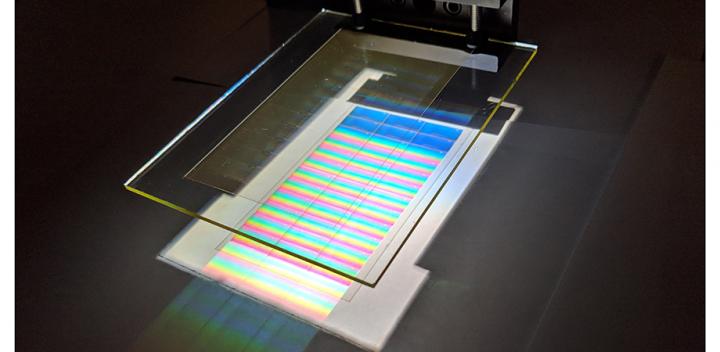
A newly developed holographic light collector boosts solar panel efficiency for an energy conversion increase of approximately five percent over the course of a year
Credit: R.K. Kostuk, University of Arizona
The energy available from sunlight is 10,000 times more than what is needed to supply the world’s energy demands. Sunlight has two main properties that are useful in the design of renewable energy systems. The first is the amount power falling on a fixed area, like the ground or a person’s roof. This quantity varies with the time of day and the season. The second property is the colors or spectrum of the sunlight.
One way to capture solar energy is to use solar cells that directly turn sunlight into electricity. In a solar module like those that people place on their roof, many cells are assembled on a rigid panel, connected to one another, sealed, and covered with protective glass. The solar cell works best when certain colors of sunlight fall on it, and when the whole area is covered by photocells. However, some panel area is needed to connect the cells, and the solar cell shape may not allow all of the remaining panel area to collect sunlight. These effects make the solar panel less efficient than it could be. Capturing as much of the sunlight on a solar panel as possible is critical to efficiently harnessing solar energy.
Researchers at the University of Arizona recently developed an innovative technique to capture the unused solar energy that illuminates a solar panel. As reported in the Journal of Photonics for Energy (JPE), they created special holograms that can be easily inserted into the solar panel package. Each hologram separates the colors of sunlight and directs them to the solar cells within the solar panel. This method can increase the amount of solar energy converted by the solar panel over the course of a year by about 5 percent. This will reduce both the cost and the number of solar panels needed to power a home, a city, or a country.
The research was supported by the QESST Engineering Research Center, which is sponsored by the US National Science Foundation and US Department of Energy to address the challenge of transforming electricity generation to sustainably meet growing demands for energy.
Low cost, sustainable design
Designed by PhD student Jianbo Zhao, under the supervision of Raymond K. Kostuk, professor of electrical and computer engineering and optical sciences, and in collaboration with fellow PhD student Benjamin Chrysler, the holographic light collector combines a low-cost holographic optical element with a diffuser. The optical element is situated symmetrically at the center of the photovoltaic module to obtain the maximum effective light collection.
The team computed the annual energy yield improvement for Tucson, Arizona, and presented a reproducible method for evaluating the power collection efficiency of the holographic light collector as a function of the sun angles at different times of day, in different seasons, and at different geographical locations.
According to JPE Editor-in-Chief Sean Shaheen at University of Colorado Boulder, the collector and associated method are especially noteworthy because they are low-cost and scalable as well as impactful: “The enhancement of approximately five percent in annual yield of solar energy enabled by this technique could have large impact when scaled to even a small fraction of the 100s of gigawatts of photovoltaics being installed globally. Professor Kostuk’s team has demonstrated their holographic approach with a low-cost material based on gelatin, which is readily manufactured in large quantity. And while gelatin is normally derived from animal collagen, progress in lab-derived versions has made it likely that synthetic alternatives could be used at scale.”
###
Zhao and his co-authors are encouraged by the results of their research and look forward to future work to further optimize the energy yield of holographic light collectors through experimental evaluation of materials.
Read the open access report: J. Zhao, B. Chrysler, and R.K. Kostuk, “Holographic low concentration optical system increasing light collection efficiency of regular solar panels,” J. Photon. Energy 11(2), 027001 (2021), doi 10.1117/1.JPE.11.027002
Media Contact
Daneet Steffens
[email protected]
Original Source
https:/
Related Journal Article
http://dx.