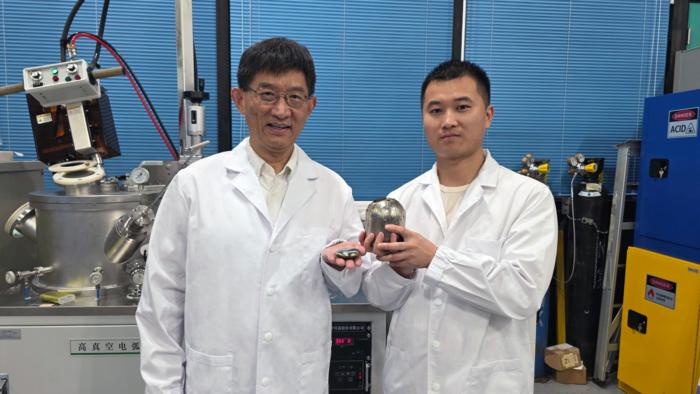
Researchers at the Hong Kong University of Science and Technology (HKUST) are breaking new ground in materials science with the innovative development of a novel elastic alloy known as Ti₇₈Nb₂₂. This groundbreaking material not only challenges the limitations of conventional metals but also promises a significant leap forward in sustainable heating and cooling technologies. The efficiency of this alloy in solid-state heat pumping is extraordinary, showcasing a reversible temperature change (ΔT) capability approximately 20 times greater than that of standard metals when subjected to mechanical stress.
The pressing need for more sustainable heating solutions stems predominantly from the fact that nearly half of global energy consumption is dedicated to heating purposes. In the building and industrial sectors, this demand is frequently met through the combustion of fossil fuels, an approach that is inherently detrimental to our environment. The resultant greenhouse gas emissions and significant energy expenditures pose considerable challenges, highlighting the urgent need for alternative methods that can mitigate these environmental issues while enhancing energy efficiency.
To address this pressing challenge, Prof. Sun Qingping’s dedicated research team devised an innovative approach that capitalizes on the thermoelastic effect (TeE). This concept, which harnesses heat generated during the elastic deformation of materials, presents an eco-friendly alternative to conventional mechanical heat pumps reliant on phase transitions. Historically, the thermoelastic effect was deemed too weak for practical applications, relegating it to the annals of 19th-century physics where pioneers like Kelvin, Joule, and Duhamel first explored its potential.
The team’s pioneering work culminated in the production of a [100]-textured Ti₇₈Nb₂₂ martensitic polycrystal. Remarkably, this advanced material demonstrates a reversible temperature alteration of 4–5 K when subjected to linear elastic deformation. This efficiency is a staggering 20 times greater in comparison with typical metallic counterparts, which can induce only a mere 0.2 K of temperature change. This breakthrough positions the Ti₇₈Nb₂₂ alloy as a formidable competitor to refrigerants traditionally utilized in vapor-compression heat pumps, offering a tantalizing glimpse into a future with enhanced energy performance.
Perhaps even more intriguing is the research team’s assertion that certain ferroelastic alloys could be engineered to yield temperature fluctuations as substantial as 22 K. The implications of such advancements are remarkable, providing a foundation upon which a new era of green heat pumping can be built. This research invites an exciting re-evaluation of existing technologies, potentially transforming the heat supply landscape into one that prioritizes environmental sustainability.
In statements revealing the impact of their findings, Prof. Sun described the research as a transformative development that alters the long-held belief that the thermoelastic effect lacks sufficient strength for practical utility. Reinforcing this, Dr. Li Qiao, the study’s first author, emphasized that as global decarbonization efforts gain urgency, this technology represents a pivotal solution for phasing out fossil fuel dependency in heating applications. As the team advances towards developing prototype heat pumps designed for industrial use, the potential societal benefits of their work are palpable.
The promising findings of this research have been formally published in the reputable journal Nature Communications, titled “Large Thermoelastic Effect in Martensitic Phase of Ferroelastic Alloys for High Efficiency Heat Pumping.” This citation mirrors the rigorous scientific standards upheld by esteemed journals, providing a platform for further exploration and validation of the results obtained. The study was graciously funded by the Hong Kong Research Grants Council, specifically through its Strategic Topics Grant and General Research Fund.
With the growling global demand for energy conservation, the emergence of Ti₇₈Nb₂₂ could herald a seismic shift in energy consumption paradigms. By tapping into the innate properties of this novel alloy and leveraging its unique thermal characteristics, researchers are setting themselves on a trajectory towards reducing reliance on fossil fuels. The innovation embodies a dual promise: it holds potential for enhanced efficiency and promotes a future where sustainable practices are at the forefront.
While further studies are needed to optimize the alloy’s practical applications, the initial findings illuminate a pathway not solely restricted to academic inquiry but literally lying the groundwork for sustainable industrial practices. The advancement is a clarion call for collaborative efforts among researchers and industries alike to galvanize the transition toward eco-friendly heating solutions that curtail carbon emissions and energize the pursuit of green technology.
This groundbreaking research is generating substantial interest and discussion within the scientific community and beyond, reflecting an era where minds are united to pivot on sustainable energy solutions. As the temperature of environmental consciousness rises, it is innovations like Ti₇₈Nb₂₂ that will set the heat of change in motion towards a green revolution in energy utilization.
In conclusion, the work produced by Prof. Sun and this dedicated team at HKUST showcases how innovative material science can transcend traditional limitations and contribute meaningfully to the global efforts for a sustainable future. Their work stands as a testament to the potential of research in devising solutions that address some of the most pressing environmental challenges of our time.
Subject of Research: Development of elastic alloys for efficient heat pumping
Article Title: Large thermoelastic effect in martensitic phase of ferroelastic alloys for high efficiency heat pumping
News Publication Date: 15-May-2025
Web References: Nature Communications
References: Research Grants Council (RGC), HKUST
Image Credits: HKUST
Keywords
Elastic Alloy, Ti₇₈Nb₂₂, Thermoelastic Effect, Heat Pumping, Sustainable Energy, Green Technologies, Metals, Energy Efficiency
Tags: energy consumption in heatingenergy-efficient heating solutionsenvironmental impact of heating systemsfossil fuel alternatives for heatinggreenhouse gas emissions reductionHKUST elastic alloy developmentinnovative materials science breakthroughsreversible temperature change in metalssolid-state heat pumps efficiencysustainable heating technologiesthermoelastic effect in materialsTi₇₈Nb₂₂ properties