• HOME
  • NEWS
  • EXPLORE
    • CAREER
      • Companies
      • Jobs
    • EVENTS
    • iGEM
      • News
      • Team
    • PHOTOS
    • VIDEO
    • WIKI
  • BLOG
  • COMMUNITY
    • FACEBOOK
    • INSTAGRAM
    • TWITTER
Sunday, May 10, 2026
BIOENGINEER.ORG
No Result
View All Result
  • Login
  • HOME
  • NEWS
  • EXPLORE
    • CAREER
      • Companies
      • Jobs
        • Lecturer
        • PhD Studentship
        • Postdoc
        • Research Assistant
    • EVENTS
    • iGEM
      • News
      • Team
    • PHOTOS
    • VIDEO
    • WIKI
  • BLOG
  • COMMUNITY
    • FACEBOOK
    • INSTAGRAM
    • TWITTER
  • HOME
  • NEWS
  • EXPLORE
    • CAREER
      • Companies
      • Jobs
        • Lecturer
        • PhD Studentship
        • Postdoc
        • Research Assistant
    • EVENTS
    • iGEM
      • News
      • Team
    • PHOTOS
    • VIDEO
    • WIKI
  • BLOG
  • COMMUNITY
    • FACEBOOK
    • INSTAGRAM
    • TWITTER
No Result
View All Result
Bioengineer.org
No Result
View All Result
Home NEWS Science News Chemistry

Histamine: an unexpected defender against heart and kidney damage

Bioengineer by Bioengineer
January 27, 2020
in Chemistry
Reading Time: 2 mins read
0
IMAGE
Share on FacebookShare on TwitterShare on LinkedinShare on RedditShare on Telegram

University of Tsukuba study shows that a histamine agonist drug prevents further damage in a mouse model of cardiorenal dysfunction
IMAGE

Credit: University of Tsukuba

Tsukuba, Japan – Chronic kidney disease and heart failure are critical medical problems worldwide, and are closely associated in a phenomenon known as “cardiorenal syndrome.” The relationship between kidney dysfunction and heart dysfunction is complex. Many studies have attempted to understand this relationship; few have provided a clear target for treatment of the combined dysfunction, until now.

In a new study published in Proceedings of the National Academy of Sciences, a University of Tsukuba research team investigated the levels of histamine, an important factor in inflammation, in mice with cardiorenal damage, and found that histamine was increased in the blood of these mice, compared with normal mice.

Heart failure is a condition in which the heart cannot pump sufficient blood to meet the body’s needs, which is often demonstrated by shortness of breath, excessive fatigue, and leg swelling. Chronic kidney disease involves gradual loss of kidney function, frequently characterized by leg swelling, fatigue, vomiting, loss of appetite, and confusion. Despite many efforts to control these two disorders, treatments for both largely involve modifications of blood vessels to mitigate their effects, rather than curative approaches to reduce the underlying disease processes.

“Histamine is an important factor in various inflammatory processes, and its inhibition generally leads to better disease control,” says Akiyoshi Fukamizu, corresponding author on the study. “We found elevated levels of histamine in a mouse model of cardiorenal syndrome, which were surprisingly protective against further damage in these mice.”

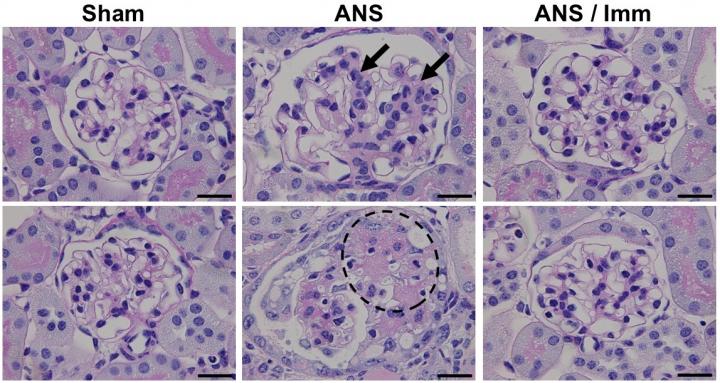
In the study, mice that could not produce histamine showed worse cardiorenal damage effects, including increased heart size, altered cardiac contractility, and poor urinary filtration. Similar effects were observed when a specific histamine receptor (H3) antagonist was administered to mice with cardiorenal damage, suggesting that this receptor may serve as a useful drug target.

“We found that targeting the H3 histamine receptor with an agonist, immethridine, could markedly alleviate some components of cardiorenal damage in our mouse model,” says Dr. Fukamizu. “Additionally, immethridine treatment led to protective changes in gene expression that affected multiple genes linked to inflammation in these mice.”

In addition to their finding that histamine can control the severity of cardiorenal syndrome in a mouse model, the researchers showed that activation of a specific histamine receptor could alleviate signs of cardiorenal damage in these mice, providing a new potential treatment for patients with heart failure and patients with chronic kidney disease.

###

Media Contact
Naoko Yamashina
[email protected]
81-298-532-066

Related Journal Article

http://dx.doi.org/10.1073/pnas.1909124117

Tags: CardiologyEndocrinologyInternal MedicineMedicine/HealthPharmaceutical SciencePhysiologyUrogenital System
Share12Tweet8Share2ShareShareShare2

Related Posts

Miniature Sensor Uses Light to Detect Touch — Chemistry

Miniature Sensor Uses Light to Detect Touch

May 8, 2026
Iron Minerals Determine Whether Dissolved Organic Matter Fuels Microbes or Becomes Long-Term Carbon Storage — Chemistry

Iron Minerals Determine Whether Dissolved Organic Matter Fuels Microbes or Becomes Long-Term Carbon Storage

May 8, 2026

Kate Evans Appointed Associate Lab Director for Biological and Environmental Systems Science at ORNL

May 8, 2026

Advancing Multiscale Modeling and Overcoming Operational Challenges in Autothermal COâ‚‚-to-Methanol Reactors

May 8, 2026
Please login to join discussion

POPULAR NEWS

  • Research Indicates Potential Connection Between Prenatal Medication Exposure and Elevated Autism Risk

    840 shares
    Share 336 Tweet 210
  • New Study Reveals Plants Can Detect the Sound of Rain

    727 shares
    Share 290 Tweet 181
  • Scientists Investigate Possible Connection Between COVID-19 and Increased Lung Cancer Risk

    68 shares
    Share 27 Tweet 17
  • Salmonella Haem Blocks Macrophages, Boosts Infection

    61 shares
    Share 24 Tweet 15

About

We bring you the latest biotechnology news from best research centers and universities around the world. Check our website.

Follow us

Recent News

Evaluating Digoxin Use in Patients with Symptomatic Rheumatic Heart Disease

Evaluating the Effectiveness and Safety of Digitalis Glycosides in Treating Heart Failure

Urdu Fall Risk Questionnaire Adapted for Elderly

Subscribe to Blog via Email

Success! An email was just sent to confirm your subscription. Please find the email now and click 'Confirm' to start subscribing.

Join 82 other subscribers
  • Contact Us

Bioengineer.org © Copyright 2023 All Rights Reserved.

Welcome Back!

Login to your account below

Forgotten Password?

Retrieve your password

Please enter your username or email address to reset your password.

Log In
No Result
View All Result
  • Homepages
    • Home Page 1
    • Home Page 2
  • News
  • National
  • Business
  • Health
  • Lifestyle
  • Science

Bioengineer.org © Copyright 2023 All Rights Reserved.