In a groundbreaking advancement poised to revolutionize our understanding and diagnosis of myotonic dystrophy type 1 (DM1), researchers have unveiled a cutting-edge targeted long-read sequencing approach that offers unprecedented high-resolution profiling of the repetitive DNA expansions underlying this complex genetic disorder. Published in Experimental & Molecular Medicine, the study by Han, Jang, and Chang signifies a monumental leap forward in addressing the challenges that have long plagued the genetic analysis of DM1, a disease caused by unstable CTG trinucleotide repeats within the DMPK gene.
Myotonic dystrophy type 1, a multisystemic disorder that manifests with muscle weakness, myotonia, cardiac conduction defects, and cognitive impairments, is rooted in the expansion of CTG repeats beyond a critical threshold. Traditional genetic testing methodologies, predominantly relying on PCR and short-read sequencing, have been severely limited in resolving the full extent and intricate structural complexity of these repetitive sequences due to their repetitive nature, large size, and somatic mosaicism. This limitation has obstructed precise genotype-phenotype correlations and complicated disease prognosis.
Addressing these diagnostic inadequacies, the study introduces a meticulously optimized targeted long-read sequencing strategy focused on direct, high-resolution interrogation of the DMPK locus. Utilizing the power of third-generation sequencing technologies, such as those leveraging nanopore or single-molecule real-time (SMRT) platforms, the platform enables researchers to bypass the fragmentary constraints of short reads and capture entire repeat expansions in a contiguous and high-fidelity manner.
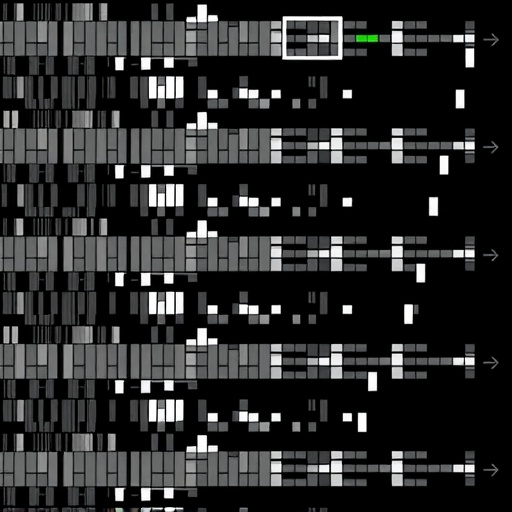
A pivotal aspect of this innovative method lies in its enrichment strategy, which selectively isolates the DMPK region harboring CTG repeats from genomic DNA samples without amplification bias. This targeted approach not only enhances sequencing depth but also mitigates errors and noise inherent in conventional amplification-based techniques. The resulting long reads encompass comprehensive repeat tract structures, revealing detailed insights into repeat length, sequence interruptions, and somatic variation patterns.
The ability to profile repeat interruptions with such precision is particularly significant, as sequence modifications within the CTG tract can modulate disease severity and progression. Interrupted alleles have been linked to milder clinical phenotypes, but prior methods struggled to detect these nuanced alterations. Through the novel sequencing technique, the authors chart a fine-scale landscape of repeat heterogeneity that informs more accurate prognostic models and individualized patient management strategies.
Moreover, this study delves into the somatic mosaicism of CTG repeats, a hallmark of DM1 pathology where repeat length varies between different tissues and over time. Conventional testing fails to capture this dynamic variability, potentially skewing diagnostic interpretations. The targeted long-read sequencing method not only qualitatively assesses mosaicism but quantitatively measures allele length distributions with exceptional resolution, providing a clearer picture of disease progression mechanisms.
From a technological standpoint, the researchers overcame several formidable obstacles intrinsic to long-read sequencing of repetitive regions, including DNA sample quality, read accuracy, and library preparation specificity. Their workflow incorporates refined protocols for high molecular weight DNA extraction optimized for fragile repeat-containing loci, coupled with novel bioinformatics pipelines designed to accurately demarcate repeat boundaries and filter sequencing artifacts.
One of the most promising clinical implications emerging from this research is the potential integration of targeted long-read sequencing into routine diagnostic workflows for DM1 and related repeat expansion disorders. The enhanced resolution, combined with cost-effective and scalable sample processing, paves the way toward early and precise diagnosis. This could markedly improve genetic counseling by providing families with comprehensive genotypic data and better expectations regarding disease trajectory.
Beyond diagnostics, the study’s methodology serves as a powerful tool for fundamental research into the molecular mechanisms driving DM1 pathogenesis. By enabling the detailed tracking of repeat expansion dynamics in patient-derived samples, it lays the groundwork for future investigations into therapeutic interventions aimed at stabilizing or contracting repeat tracts at the genomic level.
Importantly, the approach’s versatility extends to other repeat expansion diseases, such as Huntington’s disease, fragile X syndrome, and various forms of spinocerebellar ataxia, which share challenges in repeat length measurement. This cross-applicability could catalyze a paradigm shift in the genetic analysis of numerous debilitating disorders characterized by complex repetitive elements.
The study also sparks exciting possibilities regarding non-invasive diagnostics by coupling targeted long-read sequencing with liquid biopsy techniques. Detecting repeat expansions in circulating cell-free DNA could transform patient monitoring by allowing real-time assessment of disease burden and therapeutic responses without the need for invasive tissue sampling.
This pioneering research not only exemplifies a transformative application of long-read sequencing technology but also underscores the critical role of precision genomics in unravelling the complexities of repeat-mediated diseases. It lays out a robust framework that bridges the gap between technological innovation and clinical utility, heralding a new era of personalized medicine for DM1 patients worldwide.
As the field moves forward, continuing improvements in sequencing accuracy, throughput, and cost efficiency are anticipated to further democratize access to this technology. The ongoing development of comprehensive reference databases cataloging repeat variations across diverse populations will also augment the interpretive power of sequencing results, fostering more nuanced disease classification.
The implications of this work extend deeply into genetic counseling, clinical decision-making, and therapeutic design. Patients and families affected by DM1 can look forward to earlier, more accurate diagnoses alongside tailored management plans informed by their unique genetic profiles. With increased understanding of repeat structure-function relationships, it may soon be possible to design interventions that precisely target pathogenic repeats.
In sum, Han, Jang, and Chang’s targeted long-read sequencing strategy marks a pivotal milestone in the molecular diagnosis of myotonic dystrophy type 1. It provides a clarion call for the genetics and medical communities to embrace long-read technologies as essential instruments in the continual quest to decode and conquer repeat expansion diseases. This innovative platform not only enhances our diagnostic arsenal but also illuminates new frontiers in understanding the molecular basis of human genetic disorders.
Future studies building upon this foundational work are eagerly anticipated, promising to refine our knowledge of repeat dynamics and therapeutic targeting while expanding applicability to a broader range of genomic disorders. Through such relentless innovation, the promise of precision medicine for repeat expansion diseases like DM1 inches ever closer to reality.
Subject of Research: Genetic characterization and profiling of repeat expansions in myotonic dystrophy type 1 using targeted long-read sequencing.
Article Title: Targeted long-read sequencing for high-resolution repeat profiling in myotonic dystrophy type 1.
Article References:
Han, Y., Jang, JH. & Chang, H. Targeted long-read sequencing for high-resolution repeat profiling in myotonic dystrophy type 1. Exp Mol Med (2026). https://doi.org/10.1038/s12276-026-01683-6
Image Credits: AI Generated
DOI: 13 April 2026
Tags: advanced molecular diagnostics for myotonic dystrophychallenges in myotonic dystrophy genetic testingCTG trinucleotide repeat expansion analysisDMPK gene repeat profilinggenotype-phenotype correlation in DM1high-resolution sequencing of repetitive DNAlong-read sequencingmyotonic dystrophy type 1 genetic diagnosisnanopore sequencing for repeat expansion disordersovercoming somatic mosaicism in genetic analysistargeted long-read sequencing for DM1third-generation sequencing in neuromuscular disorders