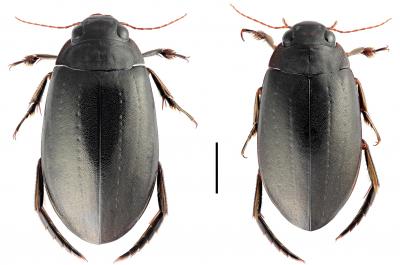
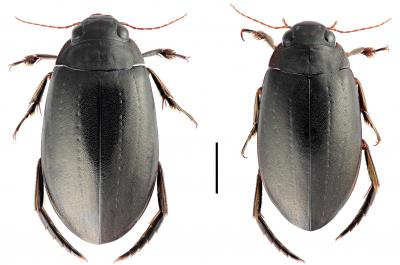
Credit: David Bilton – University of Plymouth
Scientists have used cutting-edge DNA technology and museum samples collected over the past two centuries to reveal a new species of diving beetle living in streams around the Mediterranean.
Meladema coriacea is among Europe's largest water beetles and has been considered common across the south of the continent and in North Africa since the early 19th century.
But academics from the University of Plymouth and the Institute of Evolutionary Biology in Barcelona have now shown what was long thought to be one common species is actually two.
Using DNA sequence data and detailed analysis of morphology, they have described a new species – Meladema lepidoptera – which appears virtually identical to Meladema coriacea at first glance, but is very divergent genetically.
Meladema lepidoptera is restricted to Corsica, Sardinia, adjacent small islands and some areas of the Italian mainland, where it apparently occurs to the exclusion of Meladema coriacea.
David Bilton, Professor of Aquatic Biology at the University of Plymouth, led the study having first collected samples of the beetles in the late 1990s.
He said: "We began studying the genetics of these beetles to try to understand how animals had colonised islands – we certainly weren't looking for, or expecting, a new species. Meladema are some of the largest and best-known water beetles in Europe, so we were very surprised with the genetic results suggesting that there were two species hiding under what everyone thought was only one."
The new species was in fact 'hiding in plain sight', since a study of material from a number of European museums revealed specimens of the newly identified species had been collected as long ago as the mid-19th century. But without the genetic data, these had all been thought to belong to the one, common, species.
Genetic data on more specimens, and a careful study of the appearance of the beetles themselves, has now allowed scientists to identify subtle, but consistent, ways in which the two species differ. This includes the precise sculpturing of their wing cases, with lepidoptera's appearing rather like the interlocking scales on a butterfly's wing, hence its name.
Dating based on the DNA analyses suggests that Meladema originated approximately 14.4 million years ago, and that the current species appeared more recently, separating around 1.5 million years ago, perhaps as a result of climate and sea level changes during ice ages.
Professor Bilton added: "This is only one new species, but it's been hiding amongst one of the largest, most obvious freshwater species in Europe, in an area we have supposedly explored pretty thoroughly. The fact that discoveries like ours are still possible emphasizes how little we know about the biodiversity of this planet, something which should be a major priority, particularly when so much of it is threatened by human activity. To effectively conserve biodiversity, we need to understand what's out there, because ignorance can lead to the wrong decisions being made about species and habitats."
###
Media Contact
Alan Williams
[email protected]
175-258-8004
@PlymUni
http://www.plymouth.ac.uk
Original Source
https://www.plymouth.ac.uk/news/hiding-in-plain-sight-nil-new-species-discovery-raises-questions-over-scale-of-overlooked-biodiversity http://dx.doi.org/10.3897/zookeys.702.14787