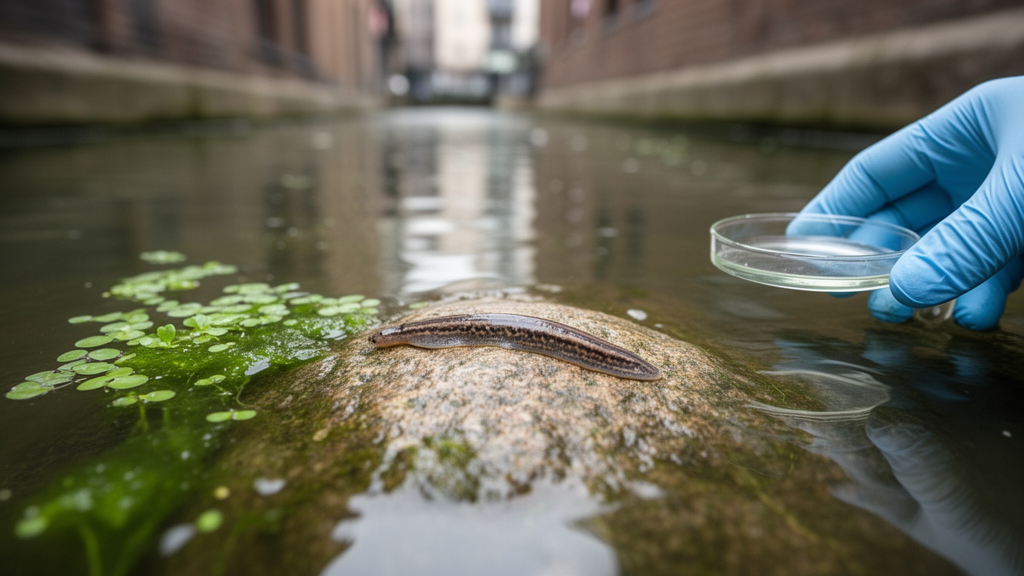
Free-living aquatic flatworms, known to scientists as turbellarians, are among the most abundant yet least understood inhabitants of freshwater ecosystems. These microscopic predators weave through submerged vegetation, litter, and even the water trapped in tree holes, playing vital roles in food webs and contributing to ecosystem health. Now, a new study published in the journal Evolutionary Systematics has revealed that Hamburg, Germany, despite being one of the best-studied countries for flatworm fauna, still harbours surprising diversity in its urban and suburban waters. The research, led by a team of taxonomists and molecular biologists, documents two species new to Germany and four species new to Hamburg, while simultaneously uncovering cryptic diversity that could reshape how scientists understand several familiar flatworm species.
Germany has long been regarded as the world’s leading region for free-living flatworm research, with more than 400 species recorded across the country. Classical taxonomists working in these regions established a foundation of knowledge that few other countries can match. The marine fauna of Sylt, an island in the North Sea, alone includes more than 246 documented species. Yet Hamburg, with its extensive network of tidal flats, rivers, streams, lakes, ponds, harbour basins, and irrigation ditches, had received remarkably little attention. Prior to this investigation, only 26 species of aquatic turbellarians had been documented in the city, most from the Elbe river, with records spanning from 1903 to 1993. The researchers suspected that this sparse documentation reflected limited sampling rather than genuinely low diversity.
To test this hypothesis, the team conducted exploratory collections at four Hamburg localities, two urban and two suburban, along with three additional sites in Germany and Switzerland. They sampled submerged vegetation from the Wandse river, litter from the Planten un Blomen park within the city centre, water-filled tree holes in the suburban forest of Wittenberg in Rissen, and a shallow irrigation ditch in the Kirchwerder-Fünfhausen farming area. Flatworms were extracted using an oxygen depletion technique, studied alive under Nomarski interference contrast microscopy, and preserved in absolute ethanol for molecular analyses. Voucher material was deposited in the Museum of Nature in Hamburg, part of the Leibniz Institute for the Analysis of Biodiversity Change.
The results exceeded expectations. The catenulid Stenostomum gotlandense, previously known only from Gotland in Sweden, and the rhabdocoel Castrella alba, recorded only from Finland and Sweden, were documented for the first time in Germany. Four additional species appeared for the first time in Hamburg: Macrostomum rostratum, Microdalyellia schmidtii, Krumbachia hiemalis, and Polycelis tenuis. Five species previously recorded from Hamburg were also recollected, including Stenostomum leucops, Prorhynchus stagnalis, Gyratrix hermaphroditus, Microdalyellia armigera, and Planaria torva. With these findings, the number of aquatic turbellarians known from Hamburg now stands at 31 species. Notably, the shallow irrigation ditch in Kirchwerder-Fünfhausen hosted the highest richness, with eight species found in a single habitat, suggesting that a broader collecting campaign could reveal far more.
Beyond the new records, the study placed selected species in a molecular phylogenetic context by amplifying partial sequences of the 18S and 28S ribosomal DNA genes, along with the COI mitochondrial gene for catenulids. The researchers compiled separate datasets for catenulids and rhabdocoels, aligned the sequences using MAFFT, and evaluated partitioning schemes and substitution models with ModelFinder on the IQ-TREE webserver. Maximum likelihood analyses with ultrafast bootstrapping and Bayesian inference with Metropolis-coupled Markov Chain Monte Carlo produced congruent topologies after collapsing weakly supported clades. The phylogenetic results revealed cryptic diversity within several species that had long been considered well-defined.
Among the catenulids, Stenostomum grande comprised two distinct clades, one from Brazil and another combining specimens from Japan and Germany. Stenostomum leucops consisted of four clades distributed across Sweden and Germany, Finland, and Brazil. One of the Finnish lineages, previously recognised as the subspecies S. leucops aquariorum, proved both morphologically and molecularly distinct. This subspecies, described by Luther in 1960 from Helsinki, is diagnosable by a reduced number of spherules in its refractile bodies, containing only six to ten compared to more than twenty in the nominal species. Given the importance of refractile body morphology in catenulid taxonomy and the molecular evidence, the researchers elevated it to full species rank as Stenostomum aquariorum. The type localities of S. leucops, S. grande, and S. simplex all lie in the United States, and the authors emphasise that studying specimens from those areas is essential to stabilise species boundaries.
Within the rhabdocoel microturbellarians, the phylogenetic analysis uncovered cryptic diversity in Castrella truncata, with at least one European and one North American lineage, and in Microdalyellia armigera, which encompasses distinct Finnish and Spanish lineages. The Hamburg population of Microdalyellia schmidtii stood out for its significantly larger stylet, the sclerotised male structure used to differentiate species, measuring around 140 micrometres compared to 66 to 100 micrometres in other populations. The analysis also clarified the long-questioned validity of M. schmidtii and its close relative M. kupelwieseri, two species that had been suggested as mere forms of M. armigera. The presence or absence of a triangular spine in the stylet’s bridge proved to be a diagnostic character, and a re-examination of Belgian specimens previously identified as M. kupelwieseri led to their reclassification as M. schmidtii, supported by the molecular clustering of Hamburg and Belgian material.
The study also provided the first molecular evidence supporting the monophyly of the genus Krumbachia, following the sequencing of Krumbachia hiemalis from Hamburg’s phytotelmata. This species, known until now only from its type locality in Schlitz, Hessen, marks only the second recorded instance since its original description in 1979. The tree holes in which it was found, 20 to 50 centimetres above ground level, represent a limnoterrestrial habitat that has received relatively little exploration in terms of meiofauna diversity. Conversely, the analysis revealed that species of Bothromesostoma are deeply nested within a clade containing species of Mesostoma, leading the authors to propose synonymising these two genera. The morphological traits historically used to distinguish them, including testis morphology and the presence of a ventral epidermal follicle, appear to have evolved or been lost multiple times within the group, suggesting they reflect interspecific variation rather than defining features of distinct genera.
The findings underscore the rich biodiversity potential of urban and suburban ecosystems for detecting freshwater turbellarian species. Hamburg’s large number of protected areas, impacted by human activities such as the development of the largest German harbour on the Elbe river, makes the region particularly relevant for freshwater conservation. The researchers highlight that molecular phylogenetic analyses have uncovered cryptic diversity in several genera, including Stenostomum, Mesostoma, and Microdalyellia, emphasising the importance of future efforts to describe potential new species. They also stress that accurate identification through detailed morphological examination of copulatory organs remains critical, as demonstrated by the case of Polycelis nigra, whose record in Hamburg requires confirmation, and Polycelis tenuis, which the team identified by the presence of two adenodactyls and the spiny armature of the male copulatory organ.
Overall, the study demonstrates that even in a country with the best-studied free-living flatworm fauna in the world, urban and suburban habitats can yield significant discoveries. The combination of traditional morphological taxonomy with modern molecular phylogenetics has revealed that several familiar species conceal multiple distinct lineages, some of which may represent undescribed species. The authors call for broader collecting campaigns in Hamburg and across Germany to clarify species distributions, and for integrative taxonomic studies that include material from type localities to resolve the boundaries of cryptic species complexes. As urbanisation continues to transform freshwater habitats worldwide, studies like this one remind scientists that the little neighbours living in city ponds and ditches may hold far more evolutionary stories than their size suggests.
Subject of Research: Little neighbours in Hamburg: free-living aquatic flatworms (Platyhelminthes)
Article Title: Little neighbours in Hamburg: free-living aquatic flatworms ( Platyhelminthes )
Article References: Diez, Y. L., & Schmidt-Rhaesa, A. (2024). Little neighbours in Hamburg: free-living aquatic flatworms (Platyhelminthes). Evolutionary Systematics, 8(2), 279-310. https://doi.org/10.3897/evolsyst.8.139468
Image Credits: AI Generated
DOI: 10.3897/evolsyst.8.139468
Keywords: Little, neighbours, Hamburg, free-living, aquatic, flatworms, Platyhelminthes, scientific research
News Source: Gavin Prescott. (October 19, 2026). Hidden Flatworm Diversity Thrives in Hamburg’s Urban Waters. Scienmag.