


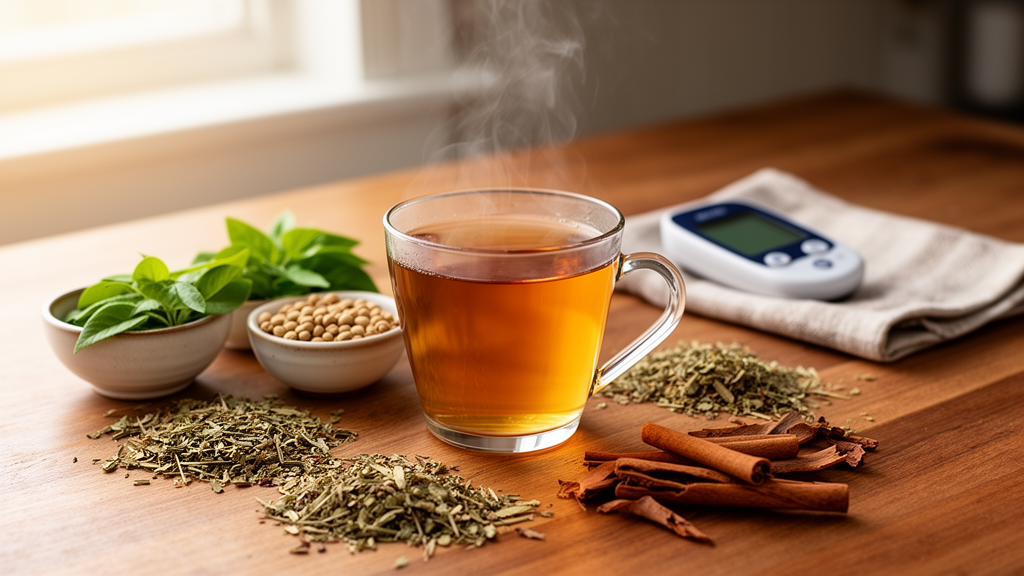
A standardized blend of eight medicinal plants and three purified plant compounds produced striking improvements in blood sugar, insulin resistance, inflammation, body fat and kidney markers in adults with type 2 diabetes, according to a 24-week controlled clinical study published in Clinical Phytoscience. Over the six-month trial, participants taking the botanical powder daily saw their average HbA1c, a measure of long-term blood sugar control, fall by 29.91 percent, from 7.02 percent to 4.92 percent. Their insulin resistance score, known as HOMA-IR, dropped by 77.25 percent, from 5.06 to 1.15, and their levels of high-sensitivity C-reactive protein, a marker of systemic inflammation, fell by 63.67 percent, from 8.73 mg/L to 3.17 mg/L. All three changes were statistically significant compared with a control group receiving standard dietary and lifestyle counseling, with p-values below 0.0001.
The study enrolled 180 adults aged 30 to 70 with type 2 diabetes, screening 268 individuals to reach that number. Participants had HbA1c values between 6.5 and 9.5 percent, HOMA-IR above 2.5, and a body mass index of at least 25 kg/m². They were allocated to either the intervention group or a standard care control group, 90 people each, using consecutive enrollment with prospective baseline matching for age, sex, baseline HbA1c, BMI and diabetes duration. Because the design was pragmatic and non-randomized, the researchers adjusted their outcome analyses for residual confounding and for modest baseline differences in HbA1c, HOMA-IR, serum creatinine and estimated glomerular filtration rate that existed between the groups before treatment began. At week 24, 80 participants in each group completed follow-up and were included in the final intention-to-treat analysis.
The formulation itself was built from traditional phytotherapeutic use and published evidence on metabolic regulation. It contained fruit of Phyllanthus emblica, leaf of Moringa oleifera, rhizome of Zingiber officinale, fruit of Momordica charantia, leaf of Gymnema sylvestre, stem of Tinospora cordifolia, seed of Linum usitatissimum and rhizome of Curcuma longa, together with purified quercetin, berberine and trans-cinnamaldehyde. Plant materials were authenticated by a qualified taxonomist, voucher specimens were deposited, and processing took place under Good Manufacturing Practice conditions. The final product was standardized to contain at least 50 percent total polyphenols expressed as gallic acid equivalents, at least 97 percent berberine and at least 95 percent quercetin by weight, with batch-to-batch phytochemical consistency confirmed through HPLC-DAD-MS fingerprinting. Batches also complied with microbiological safety standards, WHO-permissible heavy metal limits and pesticide residue specifications.
Participants in the intervention group took 30 grams of the powder each day, suspended in 200 mL of water, soaked for 8 to 10 hours and wet-ground immediately before administration. To improve absorption of lipophilic constituents, 5 mL of coconut oil and roughly 1 to 2 mg of piperine were added. The preparation was consumed once daily between 06:00 and 08:00 under fasting conditions, followed by a 30-minute fasting interval. Adherence was tracked through daily intake logs, biweekly telephone follow-ups, scheduled clinic visits and quantification of unused formulation returned at each visit. Mean adherence across the intervention group was 94.2 percent with a standard deviation of 3.8 percent, and sensitivity analyses excluding participants with adherence below 80 percent yielded consistent results. The control group received standard dietary and lifestyle counseling according to national type 2 diabetes management guidelines, and both groups were required to maintain stable dietary and lifestyle habits for at least three months before enrollment.
Beyond the headline glycemic and inflammatory changes, the intervention produced measurable shifts across several other physiological domains. Body mass index decreased by 11.45 percent, waist circumference by 19.80 percent and waist-to-hip ratio by 12.65 percent, all with p-values below 0.0001. Markers of muscle injury also fell sharply: creatine kinase-MM declined by 48.98 percent, aldolase A by 49.46 percent and WOMAC scores, a measure of joint pain and function, by 74.58 percent. Renal parameters showed the strongest between-group effects of all, with serum creatinine decreasing by 46.12 percent and estimated glomerular filtration rate increasing by 102.85 percent, both significant at p < 0.0001. The researchers calculated eGFR using the CKD-EPI 2021 equation and measured serum creatinine with an IDMS-traceable enzymatic assay.
To capture these multisystem responses in a single number, the team developed what they call the Unified Incretin Therapeutic Index, or UITI. The index integrates four domain-specific scores: an Incretin Response Composite Score combining HbA1c, HOMA-IR, satiety response measured as visual analogue scale-derived incremental area under the curve, and hs-CRP; a Metabolic Burden Score combining BMI, waist circumference and waist-to-hip ratio; a Musculoskeletal Damage Index combining CK-MM, aldolase A and WOMAC scores; and a Renal Safety Index combining serum creatinine and eGFR. Each domain was built from rank-normalized percentage changes from baseline, then standardized using pooled standard deviations and aggregated with weights proportional to each domain’s Cohen’s d effect size. The resulting composite showed marked separation between groups, with a pooled standardized effect size of d = 2.84 and a 95 percent confidence interval of 2.46 to 3.22, and consistent results were obtained using both inverse-variance and effect-size-weighted approaches.
The individual domain effect sizes were large across the board. The Incretin Response Composite Score showed a Cohen’s d of 2.84 with a 95 percent confidence interval of 2.35 to 3.23, with intervention participants scoring 0.65 ± 0.12 versus 0.35 ± 0.09 in controls. The Metabolic Burden Score reached d = 2.68 (95 percent CI 2.31 to 3.05), with scores of 0.63 ± 0.18 versus 0.25 ± 0.09. The Musculoskeletal Damage Index yielded d = 1.49 (95 percent CI 1.15 to 1.83), with 0.78 ± 0.12 versus 0.54 ± 0.20. The Renal Safety Index produced the largest effect of all, d = 3.48 (95 percent CI 3.07 to 3.89), with 0.75 ± 0.14 versus 0.25 ± 0.14. Pearson correlation network analysis further showed that HOMA-IR positively correlated with HbA1c (r = 0.68) and WOMAC scores (r = 0.47) while inversely correlating with eGFR (r = −0.54), supporting the idea that these domains move together as a system.
The mechanistic story the authors build is centered on incretin physiology, the gut-derived hormone system that GLP-1 receptor agonist drugs exploit so successfully. Notably, the study did not directly measure circulating GLP-1 or GIP. Instead, the researchers relied on validated downstream surrogate markers, including glycemic control, insulin resistance, satiety scores and inflammatory status, to evaluate incretin-associated physiological responses. They also report that insulin secretion increased by 42.3 percent in the intervention group versus 5.1 percent in controls, glucagon levels decreased by 28.4 percent versus 3.2 percent, and an additional 34.2 percent increase in GLP-1 secretion was attributable to intestinal chemosensory signaling pathways involving bitter taste receptors. Gut microbiota analysis suggested increases in butyrate-producing taxa such as Faecalibacterium prausnitzii and Roseburia species, with SCFA receptor activity positively correlating with GLP-1 area under the curve (r = 0.73), and reduced zonulin levels pointing to improved gut barrier integrity. The authors also describe AMPK-associated pathway activation, including increases in hepatic AMP:ATP ratio, CaMKKβ activation and LKB1 signaling, alongside enhanced fatty acid oxidation, increased skeletal muscle glucose uptake, reduced lipogenesis and increased mitochondrial biogenesis.
These mechanistic claims deserve careful reading. Because direct incretin hormone measurements, comprehensive microbiome sequencing, SCFA quantification and oxidative stress biomarker assessment were all unavailable in this study, the pathway-level findings are inferential rather than directly demonstrated. The authors themselves acknowledge this, noting that while direct oxidative stress biomarkers such as malondialdehyde and 8-hydroxy-2′-deoxyguanosine were not measured, the observed improvements in inflammatory and metabolic parameters are consistent with a reduction in oxidative burden, given the well-documented antioxidant properties of constituents like the polyphenols in Phyllanthus emblica, the curcuminoids in Curcuma longa and the gingerols in Zingiber officinale. They similarly caution that the inclusion of piperine and lipid-based delivery components may have enhanced intestinal absorption and systemic bioavailability of active phytoconstituents through modulation of CYP3A4 and P-glycoprotein activity, a plausible but untested contribution to the observed effects.
The limitations of the study are substantial and the authors state them plainly. The non-randomized pragmatic design may introduce residual selection bias despite baseline matching and covariate adjustment. Formal dietary intake assessment using validated tools such as food frequency questionnaires or 24-hour dietary recalls was not incorporated, limiting the ability to isolate intervention-specific effects from background nutritional patterns. The single-center design, a relatively homogeneous participant population with a mean BMI around 28.5 kg/m² representing overweight and mild-to-moderate obesity, and the 24-week follow-up duration all constrain generalizability. Whether the effects would hold in people with severe obesity, advanced renal impairment or different ethnic backgrounds remains uncertain. The study was not registered in a public clinical trial registry. The authors call for randomized, double-blind, placebo-controlled multicenter trials incorporating direct incretin hormone profiling, targeted metabolomics, microbiome characterization and long-term extension studies to evaluate durability, chronic safety and effects on diabetic complications, and they note that direct comparative studies against established incretin-based pharmacotherapies remain necessary before any definitive therapeutic positioning can be established. Until such trials are done, the UITI stands as a promising analytical framework, and the botanical formulation as a standardized candidate worth testing rigorously, rather than a proven replacement for conventional diabetes therapy.
Subject of Research: Clinical evaluation of a standardized multi-component botanical formulation in adults with type 2 diabetes using a composite incretin therapeutic index
Article Title: Clinical evaluation of a standardized botanical formulation in type 2 diabetes using a unified incretin therapeutic index
Article References: Ganguly, A. K., Banerjee, S. K., Sagar, G. V. V., Singal, D. K., & Ganguly, A. (2026). Clinical evaluation of a standardized botanical formulation in type 2 diabetes using a unified incretin therapeutic index. Clinical Phytoscience, 12(1), Article 12. https://doi.org/10.1186/s40816-026-00428-2
Image Credits: AI Generated
DOI: 10.1186/s40816-026-00428-2
Keywords: type 2 diabetes, botanical formulation, HbA1c, HOMA-IR, incretin, GLP-1, hs-CRP, eGFR, polyphenols, berberine, quercetin, clinical study
News Source: Ophelia Keating. (October 30, 2026). Herbal Blend Cuts Blood Sugar and Inflammation in Type 2 Diabetes Trial. Scienmag.



