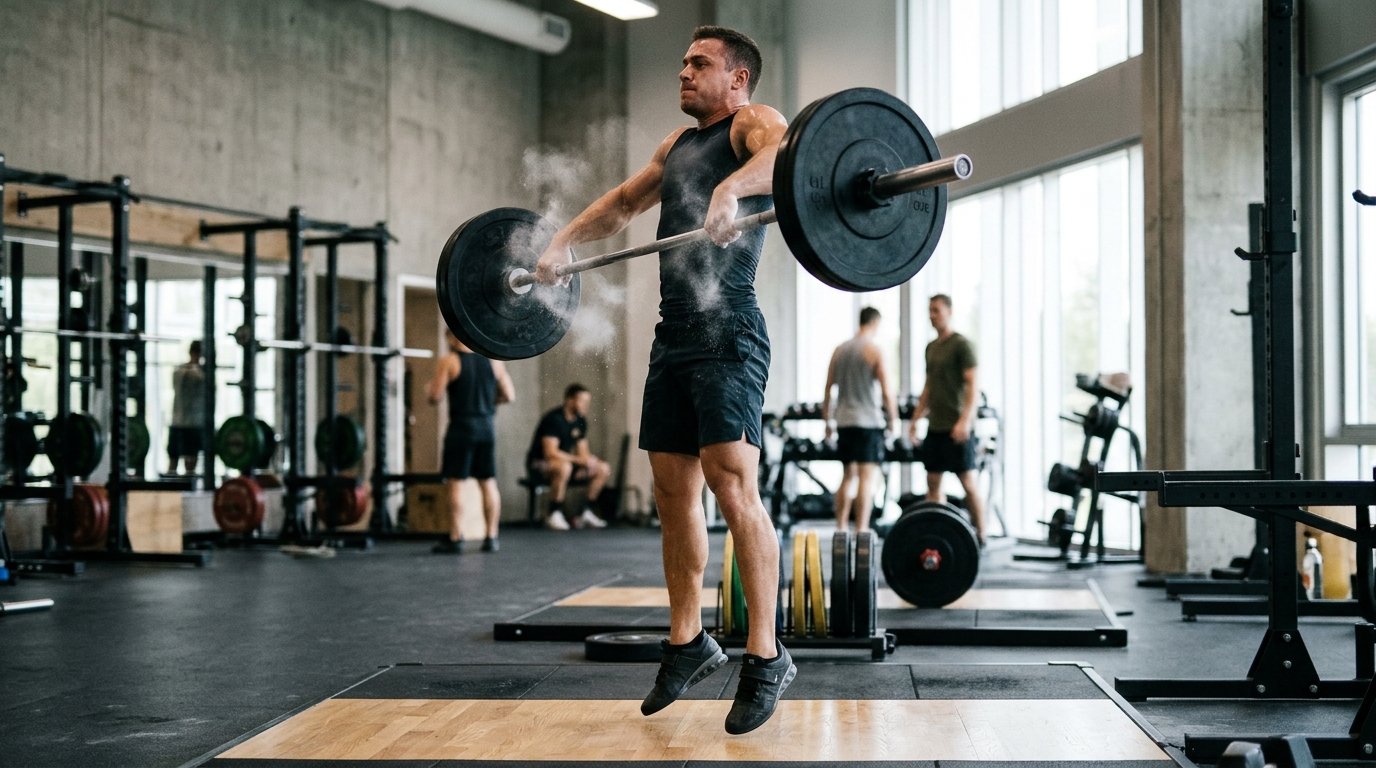
For decades, strength coaches have chased a single number: the load that lets an athlete express the greatest possible power in a single lift. A new systematic review and meta-analysis published in Physiological Reports suggests that, for two of the most popular weight-lifting derivatives, that number may not exist as a single point at all. Pooling data from 14 studies and 197 participants, the researchers found that peak power in the power clean and hang power clean climbs steeply once loads exceed 40 percent of one-repetition maximum, then plateaus, with no statistically meaningful differences among the moderate, heavy, and very heavy zones above that threshold.
The analysis, conducted according to PRISMA guidelines, searched PubMed, Web of Science, EBSCO, and EMBASE from database inception to December 14, 2025. After screening 808 records and removing 474 duplicates, the team reviewed 34 full texts and ultimately included 14 studies published between 2005 and 2025. All participants were healthy, aged 16 to 29, and experienced with weight-lifting derivatives; 189 of the 197 participants with reported sex were male, and 121 performed the hang power clean while 76 performed the power clean.
To compare studies that tested different loads, the researchers divided the loading spectrum into four mutually exclusive zones: 40 percent of one-repetition maximum or less, greater than 40 to 70 percent, greater than 70 to 85 percent, and greater than 85 percent. When a study did not report the representative target load of 40, 60, 80, or 90 percent for a given zone, the authors retained the load associated with the highest observed peak power within that zone. This rule, they acknowledge, means the extracted values represent maximal observed responses within each zone rather than typical responses across the entire interval, and it may have introduced a degree of selection bias because zones with more tested loads had more opportunities to capture a higher response.
Peak power was measured with force platforms, and eligibility required that body mass be incorporated into the power calculation, focusing the analysis on whole-system power rather than barbell-only power. Effect sizes were expressed as Hedges’ g with 95 percent confidence intervals, with fixed-effects models used when heterogeneity was 50 percent or less and random-effects models when it exceeded 50 percent. Publication bias was assessed with Egger’s test, and trim-and-fill adjustment was applied where bias was detected.
The results were strikingly consistent across both lifts. For the hang power clean, loads in the greater-than-40-to-70-percent zone produced significantly greater peak power than loads at or below 40 percent, with a standardized mean difference of 0.58 and low heterogeneity. The same comparison in the power clean yielded an identical effect size of 0.58 with zero heterogeneity. Moving up the ladder, the greater-than-70-to-85-percent zone beat the low-load zone with a standardized mean difference of 0.80 in both lifts, and the greater-than-85-percent zone did so with effect sizes of 0.94 for the hang power clean and 0.68 for the power clean.
Above 40 percent, however, the picture flattened. Comparisons between the greater-than-40-to-70-percent zone and the greater-than-70-to-85-percent zone showed no significant differences in either lift, with standardized mean differences of 0.18 for the hang power clean and 0.23 for the power clean. The greater-than-40-to-70-percent zone also matched the greater-than-85-percent zone, with effect sizes of 0.01 and 0.19 respectively. Even the two heaviest zones, greater than 70 to 85 percent and greater than 85 percent, were statistically indistinguishable, with a standardized mean difference of negative 0.21 for the hang power clean and 0.06 for the power clean. In every one of these upper-zone comparisons, heterogeneity was zero, indicating remarkable consistency across studies.
The authors interpret this pattern as a threshold followed by a plateau rather than a straight line. Power is the product of force and velocity, and very light loads may not provide enough external resistance to drive high force production even when bar velocity is elevated. As loads increase into moderate-to-high ranges, force rises substantially while velocity remains relatively high, creating favorable conditions for maximal power. At very heavy loads above 85 percent, muscular force continues to increase, but movement speed declines, and peak power may fail to rise further or may even decrease in certain individuals.
One practical caveat deserves emphasis: the findings apply most directly to force-plate-derived system power, not barbell-only power, and these two measures are not interchangeable because they represent different mechanical quantities. Peak-power estimates can be affected by how velocity is derived from ground reaction force data, the treatment of body weight and initial conditions, signal processing, and the time window used to identify the peak. Although Hedges’ g reduces the influence of differences in absolute power scales, it cannot fully account for variation in computational procedures, so the pooled results should be read as relative differences between loading zones rather than universal absolute power references.
Publication bias emerged in one comparison only: the hang power clean between the lowest and greater-than-40-to-70-percent zones, where Egger’s test returned a p value of 0.009. After trim-and-fill adjustment, the pooled effect size remained significant at 0.44, suggesting the conclusion was robust. A subgroup analysis found no statistically significant effect of training status on the Zone 1 versus Zone 3 comparison, though the authors note that the limited number of studies may have reduced the ability to detect subgroup differences. Among recreationally trained participants specifically, the hang power clean comparison between the lowest and greater-than-70-to-85-percent zones showed no significant difference and high heterogeneity, possibly attributable to one study that included both athletes and recreationally trained individuals.
For practitioners, the message is that loads above 40 percent of one-repetition maximum generally elicit greater acute peak power than lighter loads, but no single zone above that threshold can be declared statistically superior. The authors caution that the moderate, heavy, and very heavy zones impose different force-velocity demands and should be selected according to training emphasis rather than treated as interchangeable. The greater-than-70-to-85-percent range may be considered one practical option when a greater force emphasis is desired, but heavier loads cannot be justified on the basis of greater acute peak power from these findings. Because the analysis evaluated acute peak power rather than long-term adaptations, and because most participants were male and experienced with the lifts, the authors stress that optimal loading for chronic strength, power, or sport-specific gains remains uncertain and requires confirmation in longitudinal training studies, ideally including female athletes and participants with diverse training backgrounds.
Subject of Research: Optimal power load ranges for peak power output in the power clean and hang power clean weight-lifting derivatives
Article Title: Optimal power load ranges for the power clean and hang power clean weight‐lifting derivatives: A systematic review and meta‐analysis
Article References: Sun, J., Wu, Y., Zhang, Y., Shi, L., & Li, L. (2026). Optimal power load ranges for the power clean and hang power clean weight‐lifting derivatives: A systematic review and meta‐analysis. Physiological Reports, 14(21), Article e71154. https://doi.org/10.14814/phy2.71154
Image Credits: AI Generated
DOI: 10.14814/phy2.71154
Keywords: power clean, hang power clean, peak power, optimal load, meta-analysis, resistance training, one-repetition maximum, force plates, strength and conditioning, weight-lifting derivatives, load prescription, systematic review
News Source: Drew Townsend. (November 6, 2026). Heavier Is Not Always Better: Meta-Analysis Maps Peak Power in the Power Clean and Hang Power Clean. Scienmag.