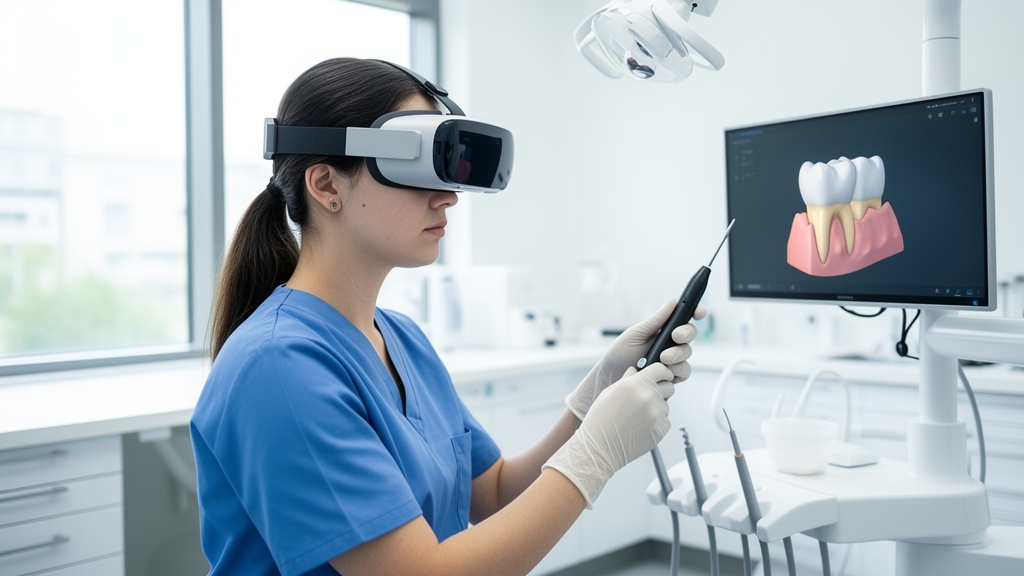
First-year dental students who trained on a haptic virtual reality simulator achieved significantly better depth accuracy and floor smoothness in cavity-like preparations than peers trained only with conventional Perspex blocks, according to a new study in BMC Medical Education.
The research team split the students into two groups. Group A received haptic virtual reality simulation (HVRS) training before performing preparations on polymethylmethacrylate (Perspex) blocks, while Group B trained with Perspex blocks alone. Both groups then prepared Oval and Bow shaped cavities, which were assessed for outline conformity, floor smoothness and depth accuracy using standardized and calibrated William’s probes — the same instruments faculty and students use in the clinical setting. Group differences were analyzed with the Mann-Whitney U Test.
The results showed a clear advantage for the haptics group on two of the three measures. Group A recorded a median depth score of 79 (interquartile range 39) versus 65 (IQR 32) for Group B, and a median floor smoothness score of 78 (IQR 20) versus 55 (IQR 21), with p < 0.001 for both comparisons. Outline conformity, however, showed no significant difference between the groups (p = 0.585), suggesting the simulator’s benefit was concentrated on depth control and surface finishing rather than the external shape of the preparation.
The authors attribute the advantage to the nature of haptic simulation itself. Traditional benchtop methods offer limited tactile and kinesthetic feedback and demand substantial material resources, whereas HVRS creates an interactive environment with instantaneous feedback — a feature that may particularly suit digitally native learners entering dental school today. In their conclusion, the researchers describe haptic virtual reality simulation as a meaningful adjunct to traditional preclinical dental training, while noting that the lack of improvement in outline conformity means it complements rather than replaces conventional practice.
Subject of Research: Haptic virtual reality simulation training for psychomotor skill development in preclinical dental education
Article Title: The impact of haptic virtual reality simulation on the development of psychomotor skills in preclinical dentistry among dental undergraduate students
Article References: Rehman, K., Seow, L. L., Sultan, O. S., binti Zakaria, A., Gunjal, S., & Mahdi, S. S. (2026). The impact of haptic virtual reality simulation on the development of psychomotor skills in preclinical dentistry among dental undergraduate students. BMC Medical Education. https://doi.org/10.1186/s12909-026-10689-7
Image Credits: AI Generated
DOI: 10.1186/s12909-026-10689-7
Keywords: haptic virtual reality, dental education, psychomotor skills, preclinical dentistry, simulation training, Perspex blocks, depth accuracy, floor smoothness, undergraduate students, BMC Medical Education, impact, haptic
News Source: Courtney Benton. (October 29, 2026). Haptic Virtual Reality Training Boosts Depth Accuracy in Dental Students. Scienmag.