


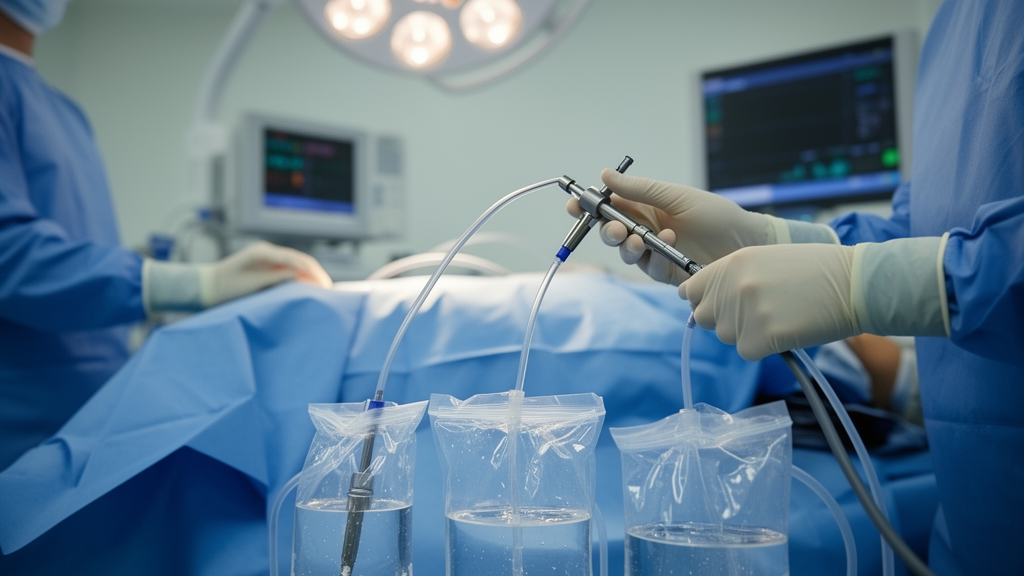
A prospective observational study of 609 men undergoing bipolar transurethral resection of the prostate (TURP) has found that hyperchloremia, an elevation of plasma chloride, is the dominant acid-base disturbance after this common operation. The research, published in BMC Surgery, tracked arterial blood gas and biochemistry measurements taken before and immediately after surgery and analyzed the results with a simplified Stewart approach, a physicochemical framework for dissecting the individual contributors to plasma pH.
The surgical technique itself matters here.
To quantify the effect, the researchers categorized patients by the direction of their perioperative pH change. Those whose pH fell, the Acidifying Group, numbered 378 of 609, or 62.1% of the cohort. Their postoperative pH averaged 7.31 plus or minus 0.08, and their standard base excess, an index of metabolic acid-base status, dropped sharply from 1.10 plus or minus 1.32 mmol/L before surgery to minus 3.87 plus or minus 2.06 mmol/L afterward, a difference the authors reported as statistically significant at P < 0.001.
Stewart analysis pinpointed the mechanism. In these acidifying patients, the sodium-chloride difference in plasma narrowed from 34.4 plus or minus 5.9 mmol/L to 28.6 plus or minus 6.2 mmol/L, and the base excess contribution attributed to that difference fell from minus 0.61 plus or minus 1.05 mmol/L to minus 6.44 plus or minus 3.43 mmol/L, again with P < 0.001. In plain terms, chloride rose relative to sodium, and this shift in strong-ion balance accounted for the acidifying process. Patients whose pH did not fall showed none of these changes.
The link to irrigation fluid absorption was strikingly direct. Linear regression showed that the postoperative change in plasma chloride concentration increased with the estimated volume of irrigant absorbed, with a coefficient of determination of 0.8243 and P < 0.001. Postoperative pH, in turn, declined as the chloride change grew, with an R-squared of 0.6703 and P < 0.001.
Multivariable logistic regression identified two operative factors independently associated with postoperative acidification: surgical duration, with an odds ratio of 3.067 per 10 minutes (95% confidence interval 1.306 to 9.956; P = 0.013), and resected tissue weight, with an odds ratio of 3.203 per 10 grams (95% confidence interval 1.041 to 9.855; P = 0.042).
The acidifying patients also fared measurably worse in the immediate recovery period. Their rate of postoperative hypotension was 14.3% versus 6.9% in the non-acidifying group, and their post-anesthesia care unit stays lasted 1.44 plus or minus 0.56 hours versus 0.96 plus or minus 0.45 hours, both differences statistically significant at P < 0.05. The authors caution that these are associations in a single prospective observational cohort, not proof that chloride-driven acidification causes the longer recoveries, and the study was registered with the Chinese Clinical Trial Registry (ChiCTR2300079095).
The clinical implication the authors draw is that hyperchloremia-associated acidification warrants greater attention during perioperative care of bipolar TURP patients, and that real-time monitoring of irrigation fluid absorption may be necessary in this surgical population. Because the published version is an early-access article subject to further edits, the figures should be read as peer-reviewed but provisional pending the final Version of Record.
Subject of Research: Hyperchloremia and metabolic acidification associated with irrigation fluid absorption during bipolar transurethral resection of the prostate
Article Title: Association between hyperchloremia and metabolic acidification in patients undergoing bipolar transurethral resection of the prostate: a prospective observational study
Article References: Jia, H., Zheng, Q., Bai, J., Wang, G., Zhang, L., Jin, Q., Guo, T., Lu, Y., Wang, Y., Wang, Z., & Dong, Z. (2026). Association between hyperchloremia and metabolic acidification in patients undergoing bipolar transurethral resection of the prostate: a prospective observational study. BMC Surgery. https://doi.org/10.1186/s12893-026-04311-2
Image Credits: AI Generated
DOI: 10.1186/s12893-026-04311-2
Keywords: hyperchloremia, metabolic acidification, bipolar TURP, irrigation fluid absorption, Stewart approach, base excess, prostate surgery, perioperative care, arterial blood gas, hypotension, prospective observational study, Association
News Source: Ophelia Keating. (October 29, 2026). Saline Irrigation Absorption Associated With Acidification After Bipolar Prostate Surgery. Scienmag.



