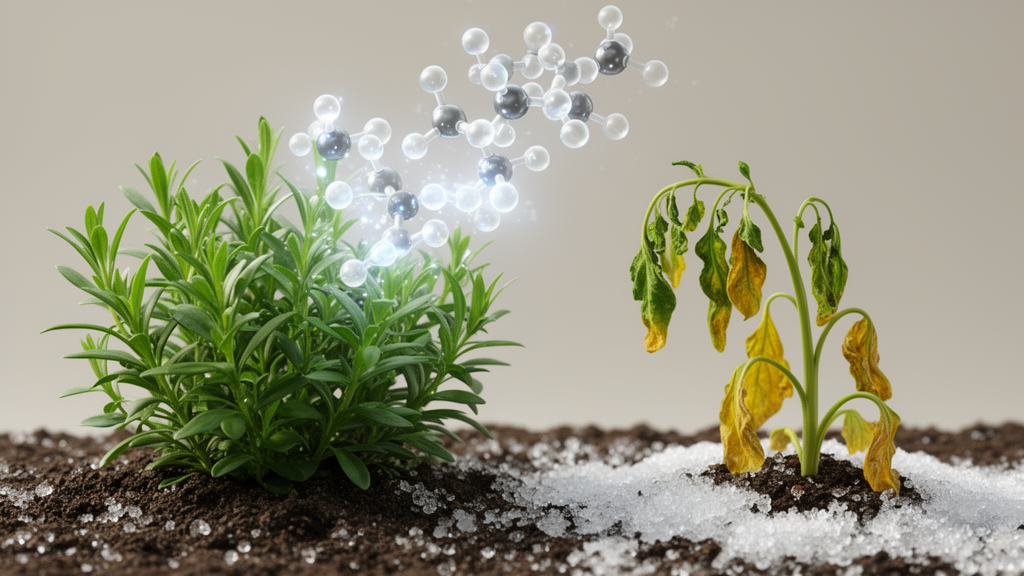
A new study comparing the glycophyte Arabidopsis thaliana with its close relative, the extreme halophyte Schrenkiella parvula, shows that the two species differ fundamentally in how they handle this carbonyl burden, and that the halophyte’s advantage lies in the composition and regulation of its carbonyl pool rather than in simply making fewer carbonyls overall.
The research, published in BMC Plant Biology, examined patterns of reactive carbonyl species accumulation and the activity of detoxifying enzymes in both species under salt stress. Arabidopsis accumulated significant levels of these reactive species and showed clear signs of oxidative stress. Schrenkiella parvula, by contrast, maintained a distinct and more tightly regulated carbonyl profile, with lower accumulation of key cytotoxic carbonyls such as acrolein. The authors emphasise that this reflects a difference in the composition of the constitutive carbonyl pool rather than a uniformly lower carbonyl content across the board.
Physiological measurements supported this picture. Increasing sodium chloride concentrations caused a dramatic decline in the Fv/Fm ratio of Arabidopsis, an indicator of impaired photosystem II efficiency, whereas the halophyte sustained stable Fv/Fm values even under high salinity.
Under salinity, the two species differed in how their RCS-detoxifying enzymes were regulated rather than in a uniform upswing of activity. Glutathione-S-transferase, or GST, was the enzyme most consistently up-regulated in Schrenkiella parvula, reaching up to a twofold increase. Aldehyde dehydrogenase (ALDH) and aldo-keto reductase (AKR) showed treatment-dependent changes in both species, meaning their responses varied with the specific salt conditions rather than following a single predictable pattern.
To probe detoxification capacity more directly, the researchers applied reactive carbonyl species exogenously. This revealed species-specific efficiencies: Schrenkiella parvula displayed a strong increase in ALDH and AKR activity, particularly under high acrolein concentrations, while Arabidopsis did not sustain comparable induction at elevated RCS levels. The strong induction of GST in the halophyte, the authors note, indicates a pronounced capacity to activate these detoxification activities upon direct RCS exposure.
The study also examined hormonal responses to RCS exposure, and here the species diverged again. In Arabidopsis, abscisic acid and salicylic acid levels rose in response to the reactive carbonyls HNE and HHE, while acrolein reduced ABA levels. Schrenkiella parvula, in contrast, exhibited a more stable hormonal profile across the treatments. Notably, the halophyte showed a pronounced increase in jasmonic acid after RCS exposure, which the authors suggest may contribute to its stress response, although they are careful to state that a causal role remains to be established.
The authors add an important caveat about the hormonal data: hormones were measured only after exogenous RCS application and not under the sodium chloride series, so these responses relate only indirectly to salt tolerance. The hormonal findings should therefore be read as responses to carbonyl exposure itself, not as direct measurements of the salt-stress response.
Overall, the work characterises carbonyl metabolism in a halophyte in detail and identifies glutathione conjugation as a candidate pathway for functional investigation. The authors frame any application to crop improvement as a perspective requiring genetic and physiological validation rather than as a conclusion of this study. The value of the findings lies in pinpointing which enzymatic routes differ between a salt-sensitive species and its salt-tolerant relative, providing a defined starting point for future experiments.
Because the article was shared early as a peer-reviewed accepted manuscript, it carries a permanent DOI and is citable, with the final version of record to follow. For researchers interested in salinity tolerance, the study’s central message is that tolerance may hinge on which carbonyls accumulate and which detoxification enzymes can be rapidly mobilised, with GST-mediated glutathione conjugation standing out as the most consistent difference observed in the halophyte.
Subject of Research: Reactive carbonyl species metabolism in a glycophyte and an extreme halophyte under salt stress
Article Title: Reactive carbonyl species metabolism in glycophyte Arabidopsis thaliana and its close relative extreme halophyte Schrenkiella parvula under salt stress
Article References: Uzilday, B., Yalcinkaya, T., Turkan, I., & Ozgur, R. (2026). Reactive carbonyl species metabolism in glycophyte Arabidopsis thaliana and its close relative extreme halophyte Schrenkiella parvula under salt stress. BMC Plant Biology. https://doi.org/10.1186/s12870-026-10029-3
Image Credits: AI Generated
DOI: 10.1186/s12870-026-10029-3
Keywords: reactive carbonyl species, salt stress, halophyte, Arabidopsis thaliana, Schrenkiella parvula, acrolein, glutathione-S-transferase, aldehyde dehydrogenase, aldo-keto reductase, jasmonic acid, photosynthesis, oxidative stress
News Source: Drew Townsend. (October 29, 2026). Halophyte keeps toxic carbonyls in check under salt stress where Arabidopsis fails. Scienmag.