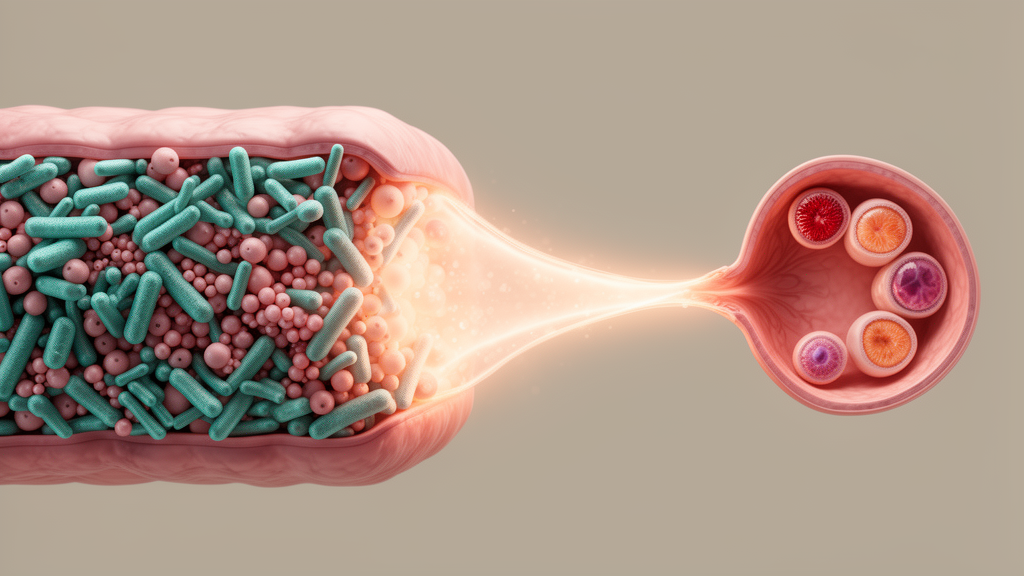
The ovary is often described as an internal clock, ticking down a finite supply of follicles from birth to menopause. A new critical narrative review published in Food Science & Nutrition argues that this clock may not run entirely on its own: the trillions of microbes in the gut could, in principle, influence how fast it ticks. The review maps a plausible gut–ovarian axis built on microbial metabolites, immune signaling, and endocrine relays, but its authors deliver an unusually blunt verdict on the probiotic industry’s ambitions. Despite a growing stack of encouraging animal experiments, no completed randomized human trial has yet tested whether probiotics actually slow the physiological loss of ovarian reserve in women.
The biological rationale rests on three interconnected processes that drive ovarian aging. The first is oxidative stress and mitochondrial dysfunction: oocytes and their surrounding granulosa cells depend heavily on mitochondrial metabolism, and when redox homeostasis falters, both follicular development and oocyte quality suffer. Human ovarian tissue from older women shows oxidative damage and altered nicotinamide, purine, and glutathione metabolism, while mice lacking the antioxidant-regulating gene Gclm lose their primordial follicle pool at an accelerated rate. The second process is chronic immune-inflammatory remodeling of the ovarian microenvironment, with aged ovaries accumulating macrophages, CD4-positive T cells, and inflammatory mediators such as interleukin-1, tumor necrosis factor-alpha, and the NLRP3 inflammasome. The third is dysregulated granulosa-cell death, which starves growing follicles of metabolic and endocrine support and pushes them toward atresia.
What makes the gut relevant to all three processes is its capacity to generate systemic signals. Short-chain fatty acids produced by fiber-fermenting bacteria can be sensed through G-protein-coupled receptors on granulosa cells, where butyrate alters histone acetylation, steroidogenesis, and mitochondrial dynamics. In animal work, microbiota-derived short-chain fatty acids also act indirectly, activating GPR43 receptors in the fat tissue surrounding the ovary, triggering leptin secretion, and reducing granulosa-cell apoptosis. Bile acids, another microbiota-modified signaling class, connect the gut to the ovary through the GATA3–interleukin-22 pathway, while lipopolysaccharide leaking across a compromised intestinal barrier can drive ovarian inflammation via the TLR4–NF-κB route. Tryptophan metabolism and microbial modification of reproductive steroids add further layers to this communication network.
The most compelling preclinical evidence comes from studies that go beyond correlation. In a mouse model of premature ovarian insufficiency induced by Tripterygium glycosides, the probiotic strain Lactobacillus salivarius Li01 improved hormone profiles, preserved follicles, and reduced ovarian inflammatory injury. Crucially, these protective effects largely vanished in germ-free mice, demonstrating that the strain’s benefit depended on an intact gut microbial ecosystem. In a separate model of cisplatin-induced ovarian injury, Limosilactobacillus reuteri DSM 17938 preserved follicular reserve, and mechanistic experiments traced the effect to its associated metabolite beta-resorcylic acid, which suppressed nuclear SOX7 accumulation and downstream BAX-mediated granulosa-cell apoptosis.
Fecal microbiota transplantation experiments push the story closer to genuine reproductive aging. Transplanting gut microbes from young donors into reproductively aged mice improved ovulation, oocyte quality, spindle integrity, and litter outcomes, with multi-omics analyses implicating a Bacteroides caecimuris–glutamate pathway that supported mitochondrial function in aged oocytes. Oral administration of Parabacteroides johnsonii in middle-aged mice improved ovarian reserve and reduced follicular atresia. Yet the review’s authors are careful to note that these interventions are not defined probiotic products, and that the benefits of young-donor FMT faded substantially within about thirty days.
The human evidence tells a more sobering story. Most clinical trials have been conducted in polycystic ovary syndrome, a related but distinct ovarian dysfunction. Two recent meta-analyses reported statistically significant pooled improvements in fasting insulin, testosterone, and lipids with microbiota-targeted supplementation, but the review shows they share most of their primary studies and should not be treated as independent replications. Their outcomes measure metabolic and endocrine features of PCOS, not the rate at which the follicular reserve declines. In menopause-related populations, randomized trials of Lactobacillus acidophilus YT1 and of a three-strain KABP formulation improved symptom and quality-of-life scores, but neither demonstrated changes in ovarian-reserve markers such as anti-Müllerian hormone or antral follicle count. Notably, the two KABP trials involved the same formulation, overlapping industry-affiliated investigators, and industry sponsorship, so they extend rather than independently confirm the dataset.
The review’s structured search of PubMed, Web of Science, and clinical trial registries, spanning more than 4,700 retrieved records and 75 unique registry entries, found no completed randomized human trial designed to test whether probiotics slow longitudinal physiological ovarian-reserve decline. Registered studies in premature ovarian insufficiency and diminished ovarian reserve do include AMH and follicle-count outcomes, but these are disease-specific or short-term endpoints, not demonstrations of a reduced rate of age-related follicular depletion. A trial of Limosilactobacillus reuteri NCU-37 in infertile women with leuprorelin-induced perimenopausal symptoms reported higher AMH and estradiol after four weeks, but the authors of the review caution that reversible pharmacological suppression of the hypothalamic–pituitary–ovarian axis is a very different physiological state from natural reproductive aging.
Translation also faces practical hurdles that are often glossed over in popular coverage. Probiotic effects are highly strain-, dose-, and host-dependent, and cannot be generalized across preparations. Animal doses cannot be linearly converted into human-equivalent colony-forming units, because CFU counts quantify viable organisms rather than a systemically absorbed chemical exposure, and activity depends on strain identity, formulation, viability during storage and gastrointestinal transit, and host context. Safety, too, must be assessed strain by strain: opportunistic infections have been reported in severely immunocompromised patients, and regulatory frameworks such as the European Qualified Presumption of Safety impose strain-specific qualifications. The review also highlights a surprising twist on the assumption that an aged microbiome is uniformly harmful: transplanting microbiota from estropausal donors into young adult mice unexpectedly improved several ovarian health measures, suggesting some late-life microbial changes may be compensatory rather than damaging.
The authors’ conclusion is measured but firm. The gut–ovarian axis is biologically plausible, experimentally testable, and increasingly supported by mechanistically rigorous animal studies that use germ-free conditions, metabolite rescue, and receptor manipulation to establish causality. But improving an ovarian phenotype in an induced disease model is not the same as delaying physiological ovarian aging in women, and no human evidence currently supports the latter claim. The priority, they argue, is not simply more probiotic trials but adequately powered, prospectively registered, double-blind, placebo-controlled studies of well-characterized strains in clearly defined reproductive-aging populations, with prespecified ovarian endpoints, longitudinal follow-up, and mechanistic biomarkers built in from the start. Until such trials are completed, probiotic functional foods should be regarded as promising research candidates for female reproductive health, not established interventions for extending reproductive lifespan.
Subject of Research: Probiotic modulation of the gut–ovarian axis in female reproductive aging
Article Title: Modulating the Gut–Ovarian Axis: Mechanistic Rationale and the Limits of Current Evidence for Probiotics in Female Reproductive Aging
Article References: Chen, M., Su, Q., Sun, M., Zhang, H., Xu, J., Zhang, C., & Wang, Y. (2026). Modulating the Gut–Ovarian Axis: Mechanistic Rationale and the Limits of Current Evidence for Probiotics in Female Reproductive Aging. Food Science & Nutrition, 14(10), Article e72454. https://doi.org/10.1002/fsn3.72454
Image Credits: AI Generated
DOI: 10.1002/fsn3.72454
Keywords: gut-ovarian axis, ovarian aging, probiotics, ovarian reserve, microbiota, granulosa cells, short-chain fatty acids, bile acids, premature ovarian insufficiency, PCOS, menopause, fecal microbiota transplantation
News Source: Beatrice Stafford. (October 9, 2026). Gut Microbes and the Aging Ovary: Why Probiotic Hype Outpaces the Evidence. Scienmag.