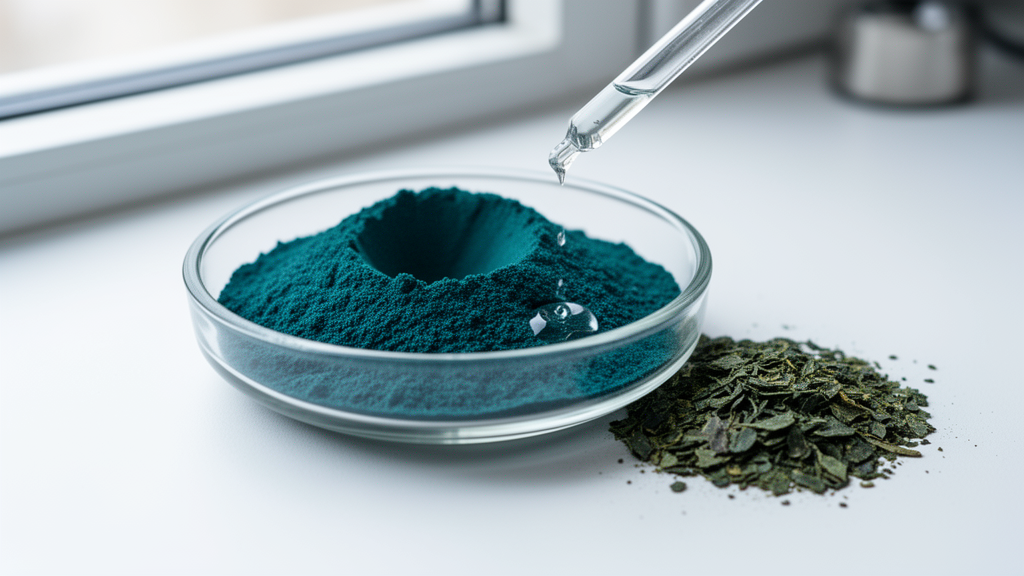
Spirulina has spent years riding a wave of superfood enthusiasm, appearing in smoothies, supplements, and health-food aisles around the world. The blue-green microalga Arthrospira platensis, sold commercially as Spirulina, is prized for its dense protein content and its vivid pigments, chief among them C-phycocyanin, the light-harvesting protein that gives the biomass its striking turquoise hue. Yet while regulators have long considered Spirulina generally safe, clinicians have begun documenting allergic reactions in sensitized individuals, prompting a fundamental question: what exactly in this alga does the immune system recognize, and what happens to it once it reaches the human gut? A new study published in npj Science of Food by researchers at the University of Parma takes that question apart at the molecular level, following C-phycocyanin from the extraction flask to the simulated stomach and intestine.
The research team, led by Delfino Danila and Kelly Bugatti, who contributed equally to the work, set out to build a complete profile of Spirulina’s most abundant pigment-protein. Their approach combined protein chemistry, structural characterization, immunology, and mass spectrometry into a single pipeline. First, C-phycocyanin was extracted and purified from A. platensis biomass. The researchers then verified that the purified protein retained its native structural integrity and characteristic oligomeric state, a critical step because the way a protein is folded and assembled into complexes strongly influences how antibodies see it. Only after confirming that they were working with properly folded, biologically representative C-phycocyanin did the team move on to the immunological experiments.
Structural characterization of the purified protein confirmed that C-phycocyanin behaves as the well-organized phycobiliprotein complex known from decades of photosynthesis research. The protein carries open-chain tetrapyrrole chromophores, the phycocyanobilins responsible for both its intense blue color and its role in capturing light energy for the algal cell. This architecture, with chromophore-bearing subunits assembled into larger oligomers, creates a large and structurally complex surface that the immune system can potentially recognize. The Parma team’s careful verification of the oligomeric state matters for allergen assessment in a practical sense as well: a denatured or fragmented preparation would present a very different antibody-binding landscape than the intact protein that consumers actually ingest in whole Spirulina products.
With the protein characterized, the researchers turned to the central immunological question. They assessed immunoreactivity using sera from patients sensitized to Spirulina, as well as sera from patients allergic to crustaceans, mites, and fish. The rationale for this panel was to explore potential cross-reactivity, the phenomenon in which IgE antibodies raised against one allergen also bind structurally related or epitope-similar proteins from unrelated sources. Cross-reactivity is a major concern in food allergy because it can mean that a person sensitized to, say, dust mites might react to an apparently unrelated food. By testing C-phycocyanin against this range of sera, the team could map how broadly the pigment-protein is recognized by allergic immune systems.
The result was unambiguous. Intact C-phycocyanin displayed clear IgE-binding activity, confirming for the first time in this systematic framework that Spirulina’s major pigment-protein is a relevant potential allergen. In other words, the immune systems of sensitized individuals produce IgE antibodies that specifically recognize this protein, and those antibodies can bind it in vitro. This finding reframes the safety conversation around Spirulina. The alga may be generally recognized as safe on a population level, but for the subset of people who have become sensitized, the very protein that makes Spirulina so colorful and nutritionally distinctive is also the molecule their immune system has learned to attack.
What happens next in the digestive tract, however, tells a more nuanced story. The researchers subjected purified C-phycocyanin to simulated gastrointestinal digestion, a laboratory protocol that mimics the sequential action of gastric and intestinal enzymes at physiological pH and temperature. Such in vitro digestion models are the standard tool for predicting how food proteins survive the journey from mouth to bloodstream, because an allergen must generally resist enzymatic breakdown long enough to cross the gut lining and encounter the immune system in its intact or near-intact form. Highly digestible proteins are usually considered less risky, while digestion-resistant proteins, such as some seed storage allergens, tend to be more potent.
The digestion experiment produced a striking transformation. Simulated gastrointestinal digestion caused extensive fragmentation of C-phycocyanin, breaking the intact pigment-protein complex into a swarm of smaller peptides. Crucially, this fragmentation was accompanied by a reduction in IgE-binding activity. The antibodies that had readily recognized the intact protein bound the digested fragments far less effectively, suggesting that the digestive process destroys or substantially alters the conformational epitopes, the three-dimensional structural features on the folded protein that IgE antibodies target. High-resolution liquid chromatography coupled with mass spectrometry allowed the team to map this digestive profile in detail, identifying the peptide fragments that survived the enzymatic assault and assessing which of them retained any residual immunoreactivity.
This combination of findings, intact IgE recognition followed by digestion-driven loss of binding, has practical implications for how Spirulina products are evaluated and used. For most consumers, the digestive system appears to dismantle the allergenic architecture of C-phycocyanin before it can do harm, which is consistent with the protein’s overall safety record. But the picture is not entirely reassuring for everyone. Residual binding after digestion, even if reduced, means that some immunoreactive material may persist, and individuals with strong pre-existing sensitization could theoretically still react, particularly if the protein is exposed to immune tissue in a form that retains partial epitopes. The study’s authors position their work as a foundation for a more accurate allergenicity assessment of Spirulina proteins, one that accounts for both the intact protein’s recognition by IgE and its transformation during digestion.
The timing of this research is significant for another reason. Microalgae are increasingly promoted as sustainable protein sources for future food systems, valued for their high yields, low land requirements, and rich complement of bioactive compounds. As Spirulina and other algae move from niche supplements into mainstream foods, protein ingredients, and nutraceutical formulations, understanding their allergenic potential becomes a matter of food safety policy, not just clinical curiosity. The Parma study provides exactly the kind of molecular evidence that regulators and food developers need: a purified, structurally verified allergen candidate, a demonstration of its IgE-binding capacity in sensitized patients, an assessment of cross-reactivity across common allergen sources, and a high-resolution map of how digestion reshapes its immunological profile.
The work also highlights a broader lesson for the booming alternative-protein sector. Novel ingredients cannot be assumed safe simply because they are natural or traditionally consumed; their proteins must be profiled with the same rigor applied to established allergens. By tracing C-phycocyanin from extraction through structure, immune recognition, and digestive transformation, the University of Parma team has offered a template for that rigor. Their findings support the responsible use of Spirulina in food and nutraceutical applications while giving allergists and sensitized patients a clearer picture of the risks. For the millions of people who blend blue-green algae into their morning routine, the message is measured: the pigment that makes Spirulina glow can be recognized by allergic immune systems, but the stomach’s enzymes substantially blunt that recognition, a molecular balancing act that future food safety assessments will need to keep in view.
Subject of Research: Allergenicity and digestive stability of the Spirulina pigment-protein C-phycocyanin
Article Title: Profiling C‑Phycocyanin: From Extraction to Structure, IgE Recognition and Digestive Transformation of Spirulina’s Major Pigment‑Protein
Article References: Danila, D., Bugatti, K., Cutroneo, S., Calcinai, L., Ridolo, E., Cavazzini, D., Tedeschi, T., & Folli, C. (2026). Profiling C‑Phycocyanin: From Extraction to Structure, IgE Recognition and Digestive Transformation of Spirulina’s Major Pigment‑Protein. npj Science of Food. https://doi.org/10.1038/s41538-026-01184-w
Image Credits: AI Generated
DOI: 10.1038/s41538-026-01184-w
Keywords: Spirulina, C-phycocyanin, Arthrospira platensis, food allergy, IgE, allergen, gastrointestinal digestion, microalgae, mass spectrometry, cross-reactivity, food safety, nutraceuticals
News Source: Alan Morgan. (October 9, 2026). Spirulina’s Blue Pigment Protein Can Trigger Allergy, but Digestion Weakens Its Grip. Scienmag.