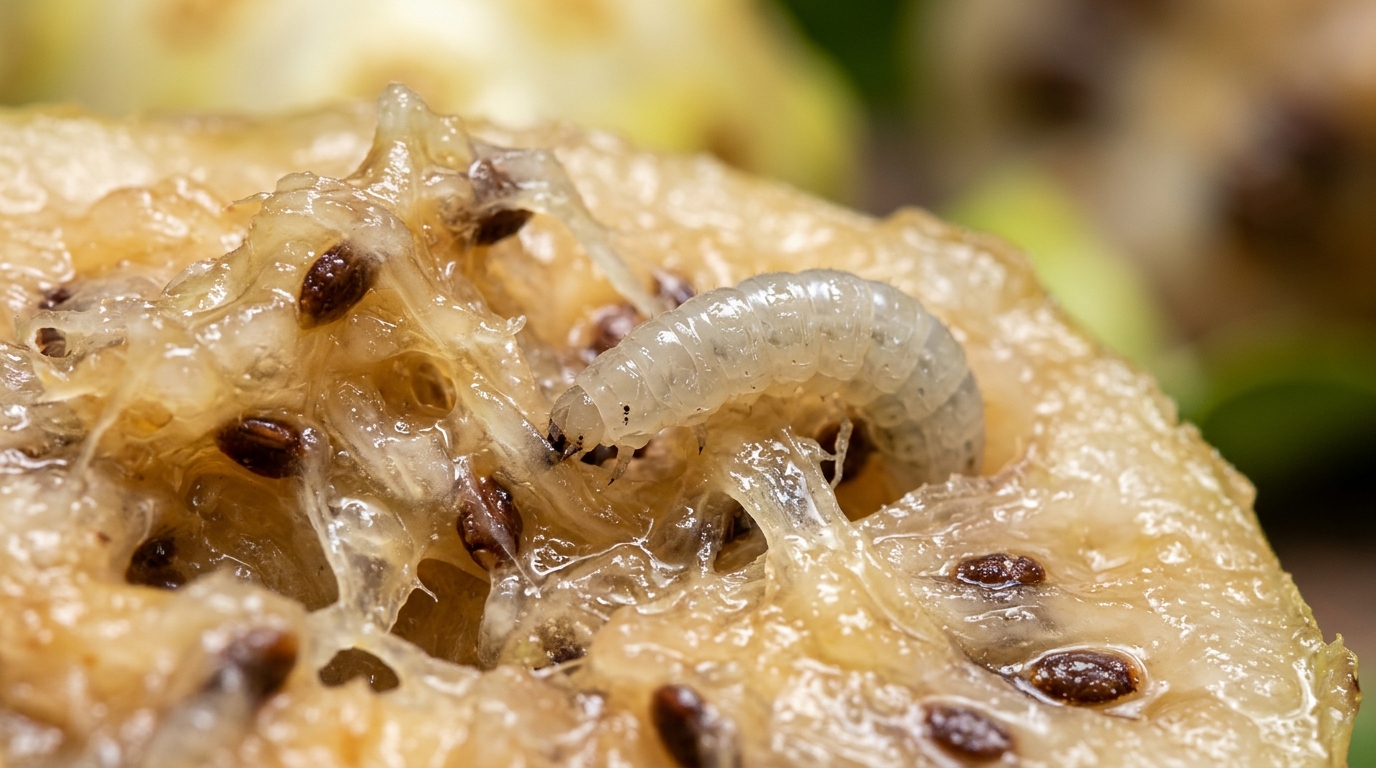
Larvae of the fruit fly Anastrepha acris feed on one of the most toxic fruits on Earth, the Apple of Death (Hippomane mancinella), a pulp loaded with ellagitannins such as Hippomanin A, phorbol-type diterpene esters, sapogenins and furanocoumarins. A new open-access study in Animal Microbiome, published on 11 September 2026, reports how this monophagous tephritid manages the assault. Researchers led by Daniel Cerqueda-García, Erick Enciso-Ortíz, Lorena López-Sánchez and Martín Aluja combined a high-dose dietary challenge with a reconstituted lyophilized H. mancinella pulp (RLHMP), antibiotic treatments, whole-larva RNA sequencing, transmission electron microscopy and 16S rRNA amplicon profiling of gut bacteria to dissect the mechanisms behind the fly’s tolerance.
The team measured larval performance with a multitrait index (ω, scaled 0–1) covering a variety of survival parameters. On the standard diet, antibiotics improved fitness, but under the toxic pulp they conferred no benefit. Across all groups, the RLHMP diet at 50% concentration lowered ω by about 0.28 on average, and the reduction was amplified when larvae were reared with antibiotics: the decline reached roughly 0.38 with antibiotics compared with about 0.17 without them. In other words, removing gut bacteria made the toxic diet substantially worse, a pattern the authors interpret as evidence that the microbiota contributes to tolerance precisely when xenobiotic pressure peaks.
Transcriptomic profiling across an RLHMP gradient revealed a coordinated transcriptional response. The larvae induced carbohydrate and lipid catabolism, apparently reallocating energy toward detoxification, along with xenobiotic-processing enzymes including cytochrome P450s and oxidoreductases. Large cohorts of serine-type endopeptidases were also upregulated, and antibacterial humoral signaling pathways were enriched. At the same time, microtubule-associated transcripts were selectively down-modulated, suggesting a targeted remodeling of cytoskeletal gene expression rather than a wholesale stress shutdown.
Electron microscopy showed that these molecular adjustments coincide with structural resilience. Even at high RLHMP concentrations, A. acris larvae kept an intact midgut peritrophic matrix, densely packed microvilli, preserved mitochondrial membranes, and characteristic cytoplasmic vacuoles and lipid droplets. The contrast with the closely related species A. ludens was stark: that species exhibited early mitochondrial and microvillar collapse in midgut tissue at much lower RLHMP diet concentrations. The authors frame this as preservation of midgut barrier architecture, one of three components in what they describe as an integrated tolerance strategy.
The third component emerged from the bacterial community data. 16S rRNA profiling showed gut communities dominated by Proteobacteria and structured by a small set of core genera that persisted despite both the xenobiotic pulp and the antibiotic treatments. RLHMP consistently reduced the relative abundance of Achromobacter and enriched Phyllobacterium and Ralstonia regardless of antibiotic history, indicating a reproducible community shift under toxin exposure rather than random dysbiosis.
Neutral community models added nuance to that picture. Achromobacter and Phyllobacterium occurred more often than expected in laboratory treatments, consistent with deterministic processes favoring these taxa under experimental conditions. By contrast, taxa occurring less often than expected accounted for a larger proportion of reads in wild larvae and in the combined RLHMP–antibiotic treatment, hinting that dispersal-limited or filtered taxa dominate in natural settings and under the harshest laboratory combination.
Taken together, the authors conclude that A. acris larvae withstand extreme xenobiotic loads through an integrated three-component strategy: preservation of midgut barrier architecture, metabolic reallocation that sustains energy-demanding detoxification and proteostasis, and immune-mediated pruning that fosters a phenolic-tolerant core microbiota. The antibiotic experiments carry the sharpest message: removing microbial allies exacerbated performance costs under RLHMP exposure, so the resident bacteria appear to function as part of the tolerance machinery rather than as passive passengers.
The study addresses a long-standing gap. Plant phenolics and other xenobiotics impose strong selection pressure on phytophagous insects, yet the mechanistic basis of tolerance in extreme specialists has remained poorly understood for true fruit flies (Tephritidae). By pairing a monophagous specialist with its notoriously toxic host and manipulating both diet and microbiota, the work offers one of the most complete mechanistic portraits to date of how a tephritid copes with a single, chemically hostile food source.
The findings also point toward applied possibilities. The authors note that targeted manipulation of the identified core taxa and metabolic pathways offers testable levers to improve larval survival on phenolic-rich hosts. Because the article is being shared early as a peer-reviewed, accepted manuscript that is citable and carries a permanent DOI, with a final Version of Record to follow, readers should treat the reported numbers as current but subject to the usual copyediting updates. Even so, the picture is coherent: a stable gut barrier, a reprogrammed metabolism and a curated bacterial community acting together to let a specialist fly thrive where most insects would perish.
Subject of Research: Mechanisms of toxin tolerance in larvae of the tephritid fruit fly Anastrepha acris feeding on the toxic host fruit Hippomane mancinella
Article Title: Gut barrier stability, metabolic reprogramming, and microbiota shifts support toxin tolerance in Anastrepha acris (Diptera: Tephritidae) larvae
Article References: Cerqueda-García, D., Enciso-Ortíz, E., López-Sánchez, L., & Aluja, M. (2026). Gut barrier stability, metabolic reprogramming, and microbiota shifts support toxin tolerance in Anastrepha acris (Diptera: Tephritidae) larvae. Animal Microbiome. https://doi.org/10.1186/s42523-026-00633-x
Image Credits: AI Generated
DOI: 10.1186/s42523-026-00633-x
Keywords: Anastrepha acris, Hippomane mancinella, tephritid fruit flies, xenobiotic tolerance, gut microbiota, peritrophic matrix, cytochrome P450, detoxification, RNA sequencing, transmission electron microscopy, antibiotic treatment, ellagitannins
News Source: Morgan Morrow. (November 6, 2026). Gut Barrier, Metabolic Shifts and Microbiota Help Toxic-Fruit Fly Larvae Survive. Scienmag.