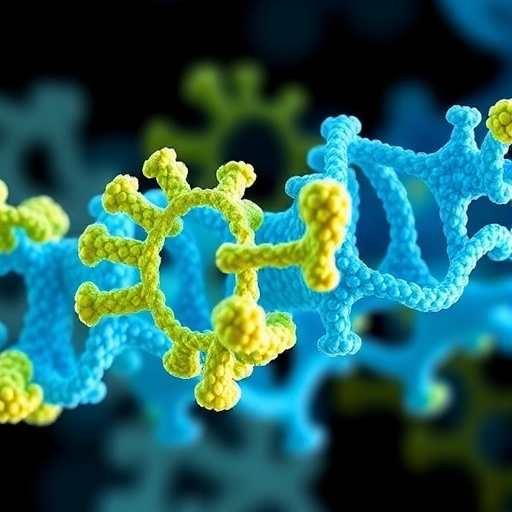
In a groundbreaking advancement at the intersection of molecular biology and artificial intelligence, researchers have achieved an unprecedented leap in visualizing the intricate process of ribosome formation. Ribosomes, the quintessential molecular machines driving protein synthesis in all living cells, have long been a subject shrouded in complexity, with their assembly mechanisms remaining elusive despite decades of research. Now, utilizing a pioneering combination of AI-driven structural prediction, cryo-electron microscopy, and innovative genetic engineering, scientists have captured the near-continuous, stepwise transformation of the small ribosomal subunit (SSU) from an immature precursor to a fully functional molecular factory.
The ribosome is fundamental to life, decoding messenger RNA templates to synthesize proteins essential for cellular function, growth, and repair. Yet, the biogenesis of ribosomes—the choreography that orchestrates the assembly of numerous ribosomal proteins and RNAs into a cohesive functional unit—has defied continuous observation due to its rapid, transient, and highly regulated nature. Previous studies have relied primarily on static snapshots revealing isolated stages or intermediates, which, though valuable, inadequately portrayed the fluid, dynamic progression that defines ribosome maturation.
Sebastian Klinge and his team have shattered this limitation by producing what can best be described as a molecular movie, illuminating each phase of SSU processome maturation in remarkable detail. This feat was made possible by an integrated strategy starting with the AI program AlphaFold, which predicted over 3,500 possible protein-protein and protein-RNA interaction scenarios involved in ribosome assembly. These predictive models laid out a structural roadmap that guided subsequent experimental design, enabling targeted genetic tagging of assembly factors in yeast cells and precise capture of molecular states by advanced cryo-electron microscopy.
The team amassed an extensive dataset exceeding 200,000 individual cryo-EM images. These were computationally sorted and combined to reconstruct sixteen distinct intermediate states spanning the entire formation process of the SSU. The resulting structural series elucidates how molecular machines work in concert to ensure directionality, accuracy, and quality control during ribosome biogenesis, revealing mechanisms that had only been speculated upon previously.
Central to this newly uncovered mechanism is the helicase enzyme Mtr4. Acting analogously to a molecular motor, Mtr4 progressively degrades specific RNA segments, driving an irreversible remodeling cascade critical for the maturation process to proceed forward and circumvent potential backtracking or error accumulation. This RNA remodeling triggers conformational rearrangements and the sequential displacement of assembly factors, orchestrating a unidirectional progression toward ribosome completion.
Another pivotal player identified through the molecular movie is the protein Utp14, which functions as a regulatory linchpin by controlling the activity and positioning of another helicase, Dhr1. Dhr1’s activation by Utp14 marks a decisive finishing step, where it unwinds and displaces an RNA chaperone, culminating the assembly of a properly formed SSU ready to engage in protein synthesis. This intricate interplay of helicases and assembly factors underscores the sophistication of molecular handoffs essential for cellular fidelity.
Beyond mapping the choreography of assembly, the study sheds light on the surveillance network that maintains the integrity of nascent ribosomal subunits. The RNA exosome, a complex dedicated to RNA degradation and quality control, remains intimately tethered throughout the maturation process, vigilantly monitoring the structural state and progress of the SSU. Only upon successful completion do these interactions relax, allowing the exosome to enact stringent quality control checks, thereby enabling only fully functional ribosomes to proceed to subsequent roles within the cell.
Reflecting on the journey from rudimentary molecular insights to this detailed temporal visualization, Klinge notes the remarkable evolution of the field: from enumerating assembly factors to gaining a continuous, dynamic perspective that captures not only static compositions but also the fundamental kinetic and regulatory principles that define ribosome genesis. This paradigm shift transforms our understanding of a process essential to all life forms, from simple bacteria to complex multicellular organisms.
Significantly, this research exemplifies the transformative potential of artificial intelligence in structural biology. The iterative feedback between high-confidence AI-generated protein interaction models and experimental validation accelerates discovery, enabling rational hypothesis testing and mechanistic exploration that were previously impractical or impossible. This integrative approach promises to become a standard for decoding multifaceted biological systems situated at the heart of cellular function.
Looking forward, Klinge’s lab is poised to leverage these powerful tools to unravel even earlier stages of ribosome assembly as well as the molecular safeguards preventing erroneous formation. Such insights may illuminate how cells maintain ribosomal quality under stress or pathological conditions, thereby opening avenues for therapeutic interventions targeting ribosome assembly pathways implicated in disease.
Fundamentally, the formation of ribosomes represents one of biology’s most profound moments: the assembly of non-living molecular components into a dynamic apparatus capable of synthesizing proteins — the engines of life. By revealing this process with such granularity, the study not only deepens our fundamental knowledge but also positions scientists to visualize the inner workings of life as they unfold, frame by molecular frame.
Klinge muses on this threshold of biological understanding: “The formation of ribosomes from non-living matter is perhaps the closest we get to witnessing the origins of life itself. Ribosomes are not alive, yet studying their assembly offers a glimpse into the moment when molecular complexity begins to embody the essence of life.”
This breakthrough heralds a new era in molecular cell biology, where the mysteries of life’s machinery become accessible, manipulable, and observable with an unprecedented resolution and continuity. The convergence of AI prediction, cutting-edge microscopy, and genetic precision engineering opens a vista onto the fundamental processes that sustain all living things—one molecular film at a time.
Subject of Research: Ribosome biogenesis; specifically, the maturation and disassembly mechanisms of the small ribosomal subunit (SSU) processome.
Article Title: Helicase-mediated mechanism of SSU processome maturation and disassembly
News Publication Date: 29-Oct-2025
Web References: http://dx.doi.org/10.1038/s41586-025-09688-3
Image Credits: Phospho biomedical animation
Keywords: Ribosomes, Cryo electron microscopy, Ribosome assembly, Helicase, Artificial intelligence, AlphaFold, Structural biology, Molecular machinery, RNA exosome, Protein synthesis, Molecular motor, Processome maturation
Tags: AI in molecular biologycellular function and ribosomescryo-electron microscopy advancementsdynamic ribosome maturation processesgenetic engineering in ribosome studiesinnovative techniques in biochemistrymolecular movies in biologyprotein synthesis mechanismsribosome assembly visualizationribosome biogenesis researchsmall ribosomal subunit transformationstructural prediction in ribosome assembly