• HOME
  • NEWS
  • EXPLORE
    • CAREER
      • Companies
      • Jobs
    • EVENTS
    • iGEM
      • News
      • Team
    • PHOTOS
    • VIDEO
    • WIKI
  • BLOG
  • COMMUNITY
    • FACEBOOK
    • INSTAGRAM
    • TWITTER
Wednesday, July 8, 2026
BIOENGINEER.ORG
No Result
View All Result
  • Login
  • HOME
  • NEWS
  • EXPLORE
    • CAREER
      • Companies
      • Jobs
        • Lecturer
        • PhD Studentship
        • Postdoc
        • Research Assistant
    • EVENTS
    • iGEM
      • News
      • Team
    • PHOTOS
    • VIDEO
    • WIKI
  • BLOG
  • COMMUNITY
    • FACEBOOK
    • INSTAGRAM
    • TWITTER
  • HOME
  • NEWS
  • EXPLORE
    • CAREER
      • Companies
      • Jobs
        • Lecturer
        • PhD Studentship
        • Postdoc
        • Research Assistant
    • EVENTS
    • iGEM
      • News
      • Team
    • PHOTOS
    • VIDEO
    • WIKI
  • BLOG
  • COMMUNITY
    • FACEBOOK
    • INSTAGRAM
    • TWITTER
No Result
View All Result
Bioengineer.org
No Result
View All Result
Home NEWS Science News Biology

Green means GO! Ultra-violet means STOP!

Bioengineer by Bioengineer
November 28, 2022
in Biology
Reading Time: 3 mins read
0
C. elegans Stoplight
Share on FacebookShare on TwitterShare on LinkedinShare on RedditShare on Telegram

Is it possible to control an animal’s or a cell’s behavior using light? In recent years, remarkable progress in optogenetics has been made as research methods come close to realizing this goal.
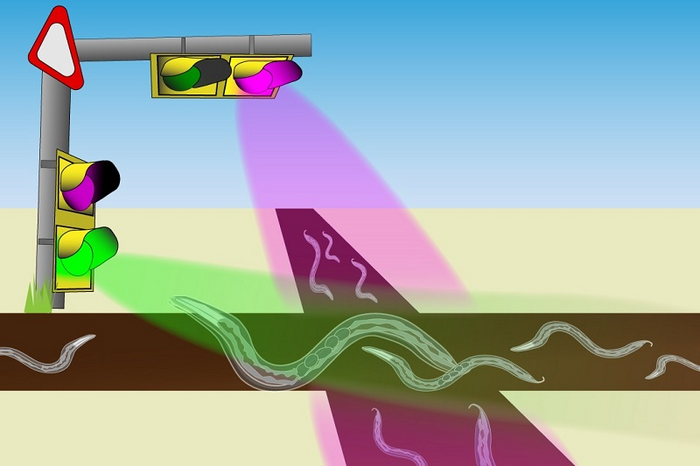
C. elegans Stoplight

Credit: Osaka Metropolitan University

Is it possible to control an animal’s or a cell’s behavior using light? In recent years, remarkable progress in optogenetics has been made as research methods come close to realizing this goal.

A research group led by Professors Mitsumasa Koyanagi and Akihisa Terakita of the Graduate School of Science, and Professor Eriko Kage-Nakadai of the Graduate School of Human Life and Ecology at Osaka Metropolitan University has revealed a new system that allows them to control the behavior of the nematode worm Caenorhabditis elegans, using two different light-sensitive proteins called opsins.

A light-sensitive opsin isolated from mosquitos was introduced into C. elegans‘ sensory cells responsible for avoidance behavior that makes the worm move away after sensing a chemical or physical stimulus. The group found that exposing the worms to white light triggered this avoidance behavior, with a sensitivity approximately 7,000 times higher than that observed with channelrhodopsin-2, a common optogenetic protein.

Likewise, a UV-sensitive opsin first found in the pineal organ of lampreys was introduced into motor neurons of C. elegans. After that the worms stopped moving when exposed to UV light and began moving again when exposed to green light. This stop-start behavior was repeated many times, switching between the UV and green lights, indicating that the opsin could be switched on and off without destroying the protein.

“Both the mosquito and lamprey opsins we used are members of the G protein-coupled receptor (GPCR) family of receptors—which are used to sense various stimuli including smell, taste, hormones, and neurotransmitters—demonstrating that this system using light can be used to manipulate various GPCRs and their subsequent intracellular signaling and physiological responses,” said Professor Koyanagi.

Importantly, both opsins tested are bistable, meaning they can switch between stable forms when active and inactive without photobleaching or breaking down, allowing them to be used again after absorbing a different wavelength of light. The difference between the wavelengths of UV and green lights is large enough that inactive UV-sensitive opsin can recover, allowing for color-dependent on-and-off optogenetic control of GPCR signaling.

“The high-performance optogenetic tool based on bistable animal GPCR opsins reported here is a breakthrough, not only in a wide range of biological research, but might contribute to the field of drug discovery where it has already received considerable attention,” concluded Professor Terakita.


###

About OMU

Osaka Metropolitan University is a new public university established in April 2022, formed by a merger between Osaka City University and Osaka Prefecture University. For more research news, visit https://www.upc-osaka.ac.jp/new-univ/en-research/research/ or follow us on Twitter: @OsakaMetUniv_en, or on Facebook.


Journal

Proceedings of the National Academy of Sciences

DOI

10.1073/pnas.2204341119

Method of Research

Experimental study

Subject of Research

Animals

Article Title

High-performance optical control of GPCR signaling by bistable animal opsins MosOpn3 and LamPP in a molecular property-dependent manner

Article Publication Date

23-Nov-2022

Share12Tweet8Share2ShareShareShare2

Related Posts

Here are a few rewritten headlines for a science magazine post, each with a slightly different tone: Intriguing & poetic: How do organs sculpt themselves? Sea stars hold the secret Direct & research-focused: Sea stars reveal the hidden rules of organ formation Metaphorical & inviting: Tiny architects beneath the waves: What sea stars teach us about building organs Short & punchy: Star-shaped clues to how our organs take shape Question-led: Could a sea star show us how organs form? Elegant & feature-style: The body’s blueprint, glimpsed in a sea star’s arm

July 6, 2026
Bacteria evolve faster with unconventional gene copies — Biology

Bacteria evolve faster with unconventional gene copies

July 6, 2026

Neighbours rewire soil feedback via root microbiome shifts

July 6, 2026

Evolution-Inspired Biosensors Revolutionize Lipid Tracking in Real Time

July 2, 2026

POPULAR NEWS

  • Detection of EDCs in Breast Milk and Infant Urine Up to Six Months Highlights Early Exposure Risks

    77 shares
    Share 31 Tweet 19
  • New Drug Candidate Developed at McMaster Shows Potential for Treating Brain Cancer

    58 shares
    Share 23 Tweet 15
  • Saying Goodbye to PGY-6: Pediatric Fellowship Realities

    103 shares
    Share 41 Tweet 26
  • KTU Researchers Explore Ultrasound’s Role in Enhancing Blood Flow Beyond Diagnostics

    53 shares
    Share 21 Tweet 13

About

We bring you the latest biotechnology news from best research centers and universities around the world. Check our website.

Follow us

Recent News

Flame retardant BDE-209 targets molecularly linked to ulcerative colitis

Ultra-high frequency particle impacts mimic rockbursts to shatter hard rock

Kidney transplant outcomes in older adults studied by German researchers

Subscribe to Blog via Email

Success! An email was just sent to confirm your subscription. Please find the email now and click 'Confirm' to start subscribing.

Join 83 other subscribers
  • Contact Us

Bioengineer.org © Copyright 2023 All Rights Reserved.

Welcome Back!

Login to your account below

Forgotten Password?

Retrieve your password

Please enter your username or email address to reset your password.

Log In
No Result
View All Result
  • Homepages
    • Home Page 1
    • Home Page 2
  • News
  • National
  • Business
  • Health
  • Lifestyle
  • Science

Bioengineer.org © Copyright 2023 All Rights Reserved.