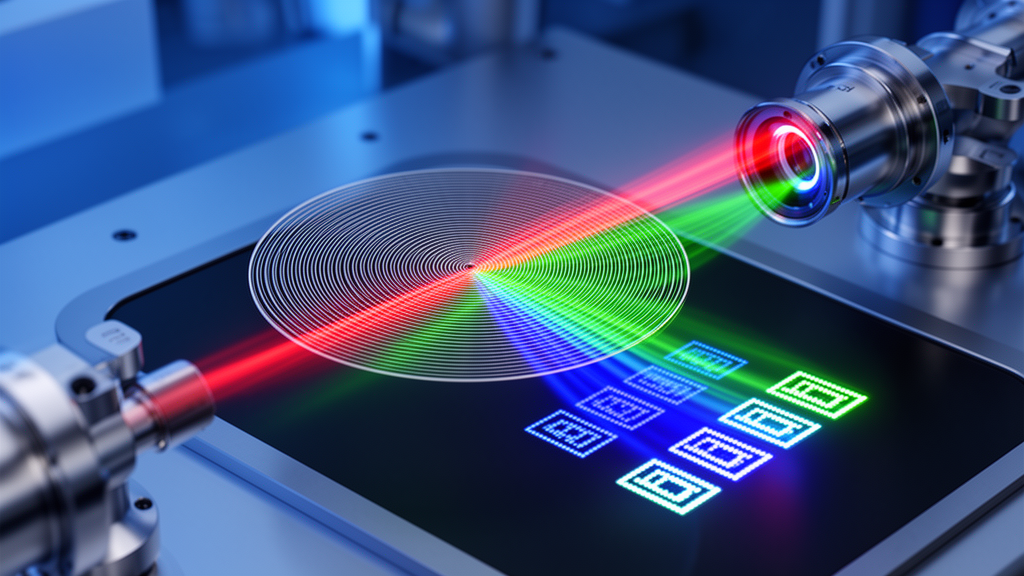
A graphene diffractive optical device can generate different authentication responses when illuminated with different combinations of red, green and blue light, according to an experimental proof-of-concept study published in Opto-Electronic Advances . The system combines spectrally encoded diffraction patterns with a transformer-based readout model to convert complex optical images into compact binary responses. In the proposed arrangement, the wavelength composition of the incident light serves as the challenge, while the device’s physical structure produces the response.
The work was made available online on July 22, 2026, and the researchers described the result as a demonstration of spectrally programmable optical authentication rather than a finished manufacturing platform. The proposal addresses a weakness in conventional electronic authentication, which often depends on stored digital keys or software-based credentials. Such information can become vulnerable if it is copied, leaked or reproduced by an attacker.
Physical unclonable functions, commonly abbreviated PUFs, take a different approach: instead of storing a secret separately, they derive responses from small and unavoidable manufacturing variations in a physical object. Optical PUFs use light to interrogate a complex material or optical structure, producing a pattern that can be difficult to reproduce exactly. Many such systems generate analog images or speckle patterns, but these rich responses are not straightforward to convert into short, stable and verifiable digital outputs.
The graphene system was designed to retain the physical basis of a PUF while providing a more compact form for authentication-oriented comparison. At the center of the device is a graphene diffractive zone plate, an ultrathin optical element that focuses light through interference and diffraction rather than the curved surfaces used in conventional lenses. Because diffraction depends strongly on wavelength, the same zone plate responds differently to different combinations of red, green and blue illumination.
In the reported configuration, the color composition of the incident light acts as an optical challenge. The graphene zone plate then produces wavelength-dependent focal and interference patterns, which form the physical response to that challenge. The spectral challenge can be changed without mechanically moving the device or scanning the beam to another position, allowing a fixed optical geometry to support multiple challenge-response states.
This is a key difference from a system that derives one response from a single fixed image and one interrogation condition. The diffraction patterns contain information from two sources. The first is the designed Fresnel-zone geometry, which establishes how the optical structure diffracts and focuses the incoming light.
The second is small local heterogeneity in the multilayer graphene structure introduced during fabrication. Those local differences provide fabrication-dependent physical information that is incorporated into the response, while the designed zones give the device its characteristic focusing and interference behavior. The spectral challenge determines how these features are exposed in the captured image: changing the illumination alters the wavelength-dependent pattern that the reader observes.
The experiment used graphene transfer and focused-ion-beam patterning to define the diffractive structures accurately and validate the operating principle. To turn the analog optical response into a form suitable for authentication, the researchers used a vision transformer model to analyze captured RGB diffraction images. The model reduces each high-dimensional pattern to a compact numerical representation, or embedding.
Rather than using the model only to classify an optical image, the team used it to extract global diffraction features and stabilize information associated with the device’s response. Stable components of that representation were selected and converted into binary response units. These units can then be compared using standard authentication metrics.
The analytical stage thus serves as a bridge between a rich, physically generated diffraction image and the shorter digital outputs that practical authentication procedures must compare, store and verify. It also preserves the dependence on the spectral challenge rather than reducing the graphene element to a single unchanging image. The system’s principal achievement is the combination of two properties within one optical PUF: a physically complex response shaped by fabrication-induced local heterogeneity, and the ability to reconfigure the interrogation through the RGB spectral challenge.
When the illumination changes, the resulting focal and interference patterns change with wavelength, revealing different aspects of the designed structure and the local material variations. A fixed graphene zone plate can therefore be interrogated in several ways. The binary readout is intended to retain this challenge dependence while making the response repeatable and suitable for comparison.
Authentication would consequently involve recovering the appropriate spectrally encoded response from the correct physical device, not simply recognizing that an optical image has an unusual appearance. The study places the experiment within a broader effort to build security functions directly into physical hardware. As artificial intelligence, edge computing and connected devices become more widespread, researchers are exploring identifiers that do not depend entirely on software credentials or stored digital secrets.
Hardware-level optical elements could add another layer of trust because reproducing both the designed optical geometry and the tiny fabrication variations would be difficult. The approach may eventually be relevant to optical security tags, anti-counterfeiting technologies, chip or package authentication, and hardware roots of trust. In these envisioned uses, the graphene structure would act as a physical layer that is difficult to clone, while a sequence of RGB challenges would provide a programmable way to interrogate it.
These remain proposed future applications; the reported work does not demonstrate commercial products or completed authentication modules. Several limitations define the present stage of the research. The publication presents a proof-of-concept rather than a finalized fabrication or deployment platform.
Graphene transfer and focused-ion-beam patterning were used to define the zone plates precisely, but the study does not establish a scalable manufacturing route or a complete chip- or package-level system. Future implementations would need to explore scalable fabrication, integrated optical readers, and modules suitable for authentication hardware. The supplied research report also does not provide the quantitative performance characterization needed to establish field readiness, including large-scale reproducibility among independently made devices, long-term environmental stability, or performance under realistic operating variations.
The evidence therefore supports the physical principle and the programmable challenge-response concept, but not the readiness of the platform for large-scale security use. Even with those constraints, the experiment shows a concrete route from nanophotonic hardware to machine-assisted physical security. Its distinctive step is to use the wavelength dependence of graphene diffraction to create multiple programmable states in a single optical PUF, then employ a vision transformer to extract stable features from those states for binarization.
The learning-based analysis is not merely a final classifier in this arrangement; it is part of the readout that converts a physically meaningful diffraction image into a compact digital response. This combination of graphene nanomaterials, diffractive optics and transformer-based interpretation could support further development of programmable optical authentication, secure photonic hardware and adaptive physical security systems. The immediate result is an experimental demonstration in which the color of light controls the challenge, a graphene diffractive structure creates the physical answer, and a vision transformer converts that answer into compact binary units for further authentication analysis.
Subject of Research: Experimental development of spectrally programmable optical authentication using graphene diffractive zone plates and transformer-based readout.
Article Title: New graphene diffraction technology enables spectrally programmable optical authentication
Article References: New graphene diffraction technology enables spectrally programmable optical authentication. Original publication (Bibliographic details unavailable.)
Image Credits: AI Generated
DOI: Not provided
Keywords: graphene, diffractive optics, optical authentication, physical unclonable functions, vision transformers, nanophotonics, binary security codes, hardware security, RGB diffraction, focal patterns, diffraction, technology
News Source: Neil Sanderson. (October 26, 2026). Graphene zone plates turn colored light into programmable security codes. Scienmag.