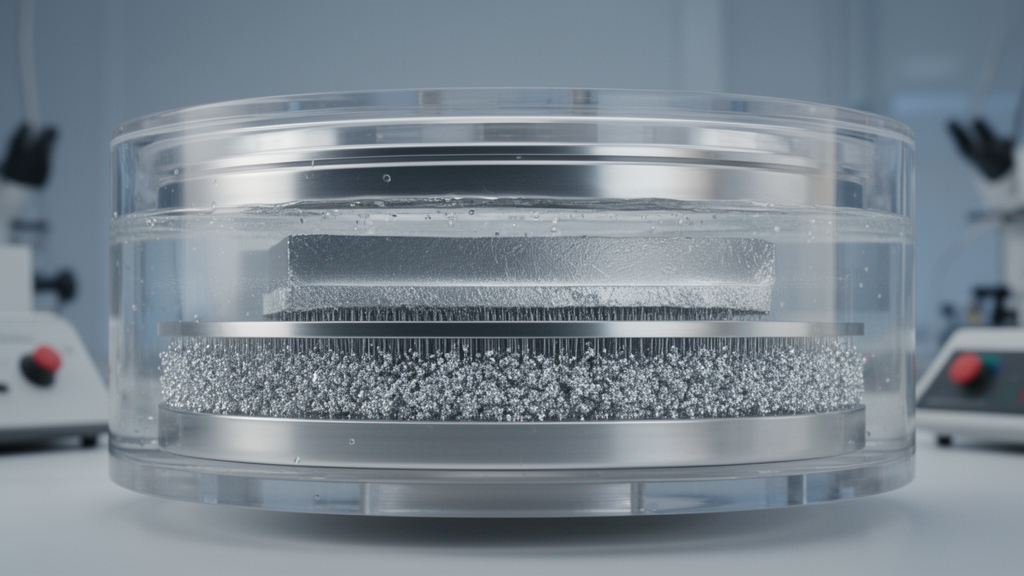
A sulfosuccinic acid strategy designed to regulate the zinc–electrolyte interface enabled deep, fast charging in laboratory aqueous zinc metal batteries, according to a peer-reviewed study in Nano-Micro Letters. The approach uses an ultratrace electrolyte additive to create a water-poor, chemically controlled inner Helmholtz plane at the zinc anode, where zinc ions are stripped of their surrounding water molecules before depositing as metal. In zinc–copper half cells, the optimized electrolyte delivered an average Coulombic efficiency of 99.48% for more than 1,600 cycles at 2 mA cm−2 and 1 mAh cm−2. Symmetric zinc cells also operated for more than 1,600 hours under high-current, high-capacity conditions.
The problem addressed by the researchers is the uneven and kinetically sluggish interface between aqueous electrolyte and zinc metal. In conventional zinc sulfate electrolyte, strongly hydrated Zn²⁺ ions undergo slow desolvation and charge transfer, while local electric-field variations encourage nonuniform zinc nucleation. These conditions can favor dendrite growth, hydrogen evolution, corrosion and other parasitic reactions. Aqueous zinc batteries are attractive because of their potential safety and low cost, but those interfacial limitations have made rapid charging and extensive use of the zinc anode difficult. The new study reports an electrolyte strategy intended to improve transport, reaction kinetics and deposition uniformity without substantially changing the bulk electrolyte.
Sulfosuccinic acid, abbreviated SUSA, preferentially adsorbs on zinc through zincophilic carboxyl groups. This displaces water and sulfate ions from the inner Helmholtz plane and produces a water-poor interfacial environment that more evenly distributes ions and electric fields. Density functional theory calculations indicated that SUSA binds more strongly to zinc than water on both the Zn(101) and Zn(002) surfaces. The calculations further suggested that preferential adsorption on Zn(101) promotes exposure of the Zn(002) orientation, which the researchers associated with more uniform zinc deposition. Electrochemical measurements showed that the additive increased the Zn²⁺ transference number from 0.26 to 0.41, lowered the apparent activation energy from 21.36 to 9.57 kJ mol−1, and reduced the zinc nucleation overpotential by 23 mV. These results support faster desolvation and charge transfer as well as more controlled metal formation at the interface.
Long-duration symmetric-cell tests showed stable cycling at demanding areal current densities and capacities. Zinc–zinc cells ran for more than 1,600 hours at 5 mA cm−2 and 2 mAh cm−2, and for more than 675 hours at 10 mA cm−2 and 10 mAh cm−2. The experiments also examined cumulative zinc deposition: with a 30 μm zinc electrode, the system reached 3,500 mAh cm−2 of cumulative plated capacity and achieved 56.93% zinc utilization. These are laboratory cell results rather than evidence of performance in commercial batteries, and the reported tests used specific electrodes, electrolytes and current conditions. Nevertheless, the measurements indicate that regulating the interfacial field can improve zinc reversibility while simultaneously increasing the depth of zinc use and the charging rate.
The findings were carried forward into iodine-based full cells designed to test the strategy beyond symmetric cells. A full cell using a 10 μm zinc electrode and an N/P ratio of 2.31 completed more than 1,490 cycles at 1 A g−1 while retaining 77.13% of its capacity. A pouch cell with an N/P ratio of 2.04 completed more than 680 cycles and retained 70.17% of capacity. Zinc cycling was also demonstrated from −20 to 60 °C, including operation for more than 300 hours at 60 °C. The study therefore presents a single interfacial strategy that the authors evaluated against several performance targets: high current density, deep discharge, extended cycle life, high zinc utilization and broad operating temperature. Its central result is that an ultratrace organic electrolyte additive can reorganize the closest molecular environment around zinc, offering a way to address several linked obstacles in aqueous zinc metal batteries at once.
Subject of Research: Sulfosuccinic acid regulation of zinc interfaces in fast-charging aqueous zinc metal batteries
Article Title: Bolstered interfacial field chemistry for deep fast‑charging aqueous zinc metal batteries
Article References: Bolstered interfacial field chemistry for deep fast‑charging aqueous zinc metal batteries. Original publication (Bibliographic details unavailable.)
Image Credits: AI Generated
DOI: Not provided
Keywords: aqueous zinc batteries, zinc metal anodes, sulfosuccinic acid, fast charging, interfacial chemistry, inner Helmholtz plane, zinc deposition, dendrite suppression, zinc–iodine cells, energy storage, Bolstered, interfacial
News Source: Faith Mcneil. (October 26, 2026). Ultratrace SUSA strategy boosts fast-charging aqueous zinc battery cells. Scienmag.