The HEATS study protocol sets out a longitudinal field investigation of how indoor environmental conditions relate to sleep, physical activity and cardiovascular measures among working-age adults in Singapore. Researchers plan to recruit up to 150 healthy adults and monitor each participant for approximately 60 days under free-living conditions in their usual home environments. The protocol, published in BMC Public Health on 30 September 2026, combines bedroom sensors, wearable devices, near-body temperature measurement and repeated self-reports to study residential heat exposure in a tropical urban setting.
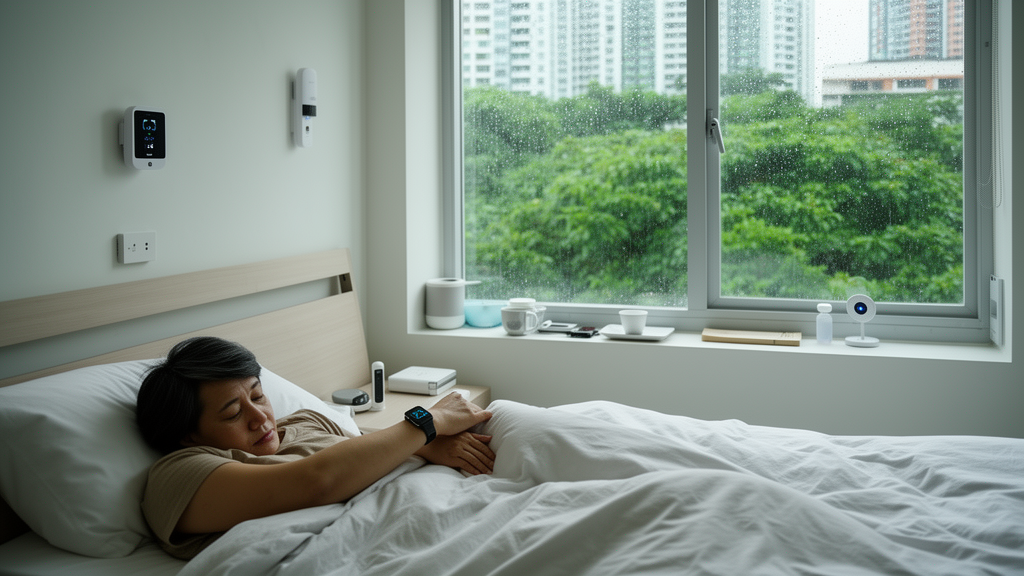
Heat exposure in tropical cities can persist during both daytime and nighttime, while evidence about sleep and physical activity often relies on outdoor measurements that may not represent conditions inside a home. The protocol specifically focuses on the bedroom, where conditions can differ from outdoor temperatures and may change through behavioral adaptations such as air-conditioning or fan use. Near-body measurements are also planned, allowing researchers to compare conditions immediately around the participant’s body with ambient conditions recorded in the bedroom.
This design is intended to examine the relationships among real-world heat, indoor environments, sleep and activity rather than treating a single outdoor or room-level temperature measurement as a complete description of exposure. Data collection is planned across four complementary components. Smartwatch-based ecological momentary assessments will capture repeated reports at participants’ homes, while wearable devices will record physiological signals and activity.
Environmental sensors will continuously monitor the bedroom, and near-body temperature devices will track conditions close to participants during sleep. Together, these streams will allow the investigators to align indoor conditions with sleep and activity over repeated days while retaining information about each participant’s normal residential routine. The bedroom sensors will record air temperature, relative humidity, sound pressure, carbon dioxide, formaldehyde and particulate matter in three fractions: PM₁, PM₂.₅ and PM₁₀.
The monitoring system will also provide a total volatile organic compound index, atmospheric pressure and illuminance. Alongside these environmental measurements, the primary sleep outcomes are total sleep time and wake after sleep onset. Secondary outcomes include daily physical activity and cardiovascular measures.
Participants will also complete repeated assessments of thermal perception, sleep disruption and adaptive behaviors, including changes to cooling-system settings, providing information on how participants experience and respond to their indoor environment. The main statistical analysis will use linear mixed-effects models to estimate within-person associations between environmental exposures and sleep. Additional analyses are planned for physical activity, comparisons between near-body and ambient exposure, and non-linear relationships.
The protocol states that these analyses are intended to identify which environmental metrics are most relevant to sleep and activity and to examine how adaptive behaviors shape those relationships. As a protocol, the article reports planned recruitment, monitoring and analysis rather than measured associations, health effects or intervention outcomes. The planned sample of up to 150 healthy adults and the approximately 60-day individual monitoring period define the study’s intended scope, but no conclusions about heat-related sleep disruption or cardiovascular effects can be drawn before the research is conducted and the results are available.
Subject of Research: A longitudinal field protocol for studying indoor heat exposure, sleep and physical activity among working-age adults in Singapore.
Article Title: HEATS exposure: protocol for wearable and in-home monitoring of indoor environment, sleep, and activity in Singapore
Article References: Renard, M., Frei, M., Chua, Y. X., Zhang, W., Parkinson, T., Lo, J. C.-Y., Lee, J. K. W., Schiavon, S., & Miller, C. (2026). HEATS exposure: protocol for wearable and in-home monitoring of indoor environment, sleep, and activity in Singapore. BMC Public Health. https://doi.org/10.1186/s12889-026-29597-y
Image Credits: AI Generated
DOI: 10.1186/s12889-026-29597-y
Keywords: indoor heat, sleep, physical activity, Singapore, wearable sensors, home monitoring, near-body temperature, tropical cities, longitudinal study, HEATS, exposure, protocol
News Source: Ophelia Keating. (October 26, 2026). HEATS protocol plans home heat, sleep and activity monitoring in Singapore adults. Scienmag.