• HOME
  • NEWS
  • EXPLORE
    • CAREER
      • Companies
      • Jobs
    • EVENTS
    • iGEM
      • News
      • Team
    • PHOTOS
    • VIDEO
    • WIKI
  • BLOG
  • COMMUNITY
    • FACEBOOK
    • INSTAGRAM
    • TWITTER
Wednesday, July 8, 2026
BIOENGINEER.ORG
No Result
View All Result
  • Login
  • HOME
  • NEWS
  • EXPLORE
    • CAREER
      • Companies
      • Jobs
        • Lecturer
        • PhD Studentship
        • Postdoc
        • Research Assistant
    • EVENTS
    • iGEM
      • News
      • Team
    • PHOTOS
    • VIDEO
    • WIKI
  • BLOG
  • COMMUNITY
    • FACEBOOK
    • INSTAGRAM
    • TWITTER
  • HOME
  • NEWS
  • EXPLORE
    • CAREER
      • Companies
      • Jobs
        • Lecturer
        • PhD Studentship
        • Postdoc
        • Research Assistant
    • EVENTS
    • iGEM
      • News
      • Team
    • PHOTOS
    • VIDEO
    • WIKI
  • BLOG
  • COMMUNITY
    • FACEBOOK
    • INSTAGRAM
    • TWITTER
No Result
View All Result
Bioengineer.org
No Result
View All Result
Home NEWS Science News Biology

Grant to support research into grape downy mildew

Bioengineer by Bioengineer
June 11, 2020
in Biology
Reading Time: 3 mins read
0
IMAGE
Share on FacebookShare on TwitterShare on LinkedinShare on RedditShare on Telegram

IMAGE

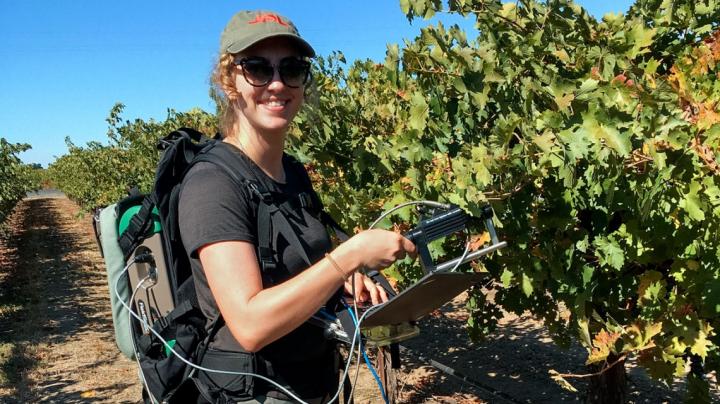
Credit: Kaitlin Gold, Cornell University

ITHACA, N.Y. – The climate in New York state is ideal for cultivating many grape varieties but also makes the region a breeding ground for pathogens such as grape downy mildew disease.

While pesticides are commonly used to help control it, the pathogen is beginning to develop resistance to a group of fungicides commonly used in East Coast vineyards.

A new project led by Kaitlin (Katie) Gold, assistant professor of plant pathology and plant microbe-biology at Cornell AgriTech, may help mitigate this issue of emerging resistance.

The project, “Advancing Downy Mildew Resistance Management for New York Grape Growers,” was recently awarded a $100,000 USDA Specialty Crop Block Grant. Gold will collaborate with Hans Walter Peterson, viticulture extension specialist for Cornell Cooperative Extension, and Tim Miles, assistant professor and extension specialist at Michigan State University. Their goal is to develop management strategies for grape downy mildew fungicide resistance.

Caused by the fungus Plasmopara viticola, grape downy mildew (GDM) is one of the most devastating grape diseases in New York state. Grape clusters are highly susceptible after the vines finish blooming, and late-season infections can defoliate vines right when the berries are trying to ripen. This damages maturation, winter hardiness and eventually crop return.

In 2018, the first known occurrence in North America of the disease’s resistance to carboxylic acid amide (CAA) fungicides was documented in Virginia and North Carolina.

“Right now, CAA fungicides are one of the most widely used tools in the fight against GDM in New York, and the grape industry simply can’t rely on this stand-alone strategy,” Gold said. “If we can develop additional management strategies as CAA resistance continues to emerge, we’ll be better able to safeguard our state’s grape industry.”

This summer, Gold will start surveying vineyards in the Finger Lakes region to determine the prevalence of grape downy mildew. As the project continues, the team will test a variety of non-CAA fungicides and then create extension materials for grape growers about managing CAA resistance.

Current methods for detecting fungicide resistance require growers to take grapes off the vine and test them in a laboratory setting, which is time-consuming and destructive. The long-term objective for Gold’s project is to test whether hyperspectral sensors can detect fungicide resistance right from the vineyard while keeping grapes on the vine.

At the early stages of infection, before the leaf gets too diseased, these sensors can detect subtle differences in light reflectance linked to pathogen properties. In theory, Gold could use the sensors to look at a fungal isolate inside the leaf and see differences in the leaf spectral profile that could indicate how sensitive that particular strain of downy mildew is to fungicides.

If this theory holds, then she will evaluate whether this process could be scaled up to passive monitoring, rather than through active sampling.

“Ultimately, if both these things are true, this means that sensors could make finding resistant downy mildew a whole lot easier for growers,” she said. “The findings from this project will immediately improve downy mildew resistance detection, mitigation and management for New York growers, while driving forward the basic science needed to make long-term advances in plant disease sensing that could help them make better management decisions.”

###

Media Contact
Lindsey Hadlock
[email protected]

Original Source

https://news.cornell.edu/stories/2020/06/grant-support-research-grape-downy-mildew

Tags: AgricultureBiologyPlant Sciences
Share12Tweet8Share2ShareShareShare2

Related Posts

Here are a few rewritten headlines for a science magazine post, each with a slightly different tone: Intriguing & poetic: How do organs sculpt themselves? Sea stars hold the secret Direct & research-focused: Sea stars reveal the hidden rules of organ formation Metaphorical & inviting: Tiny architects beneath the waves: What sea stars teach us about building organs Short & punchy: Star-shaped clues to how our organs take shape Question-led: Could a sea star show us how organs form? Elegant & feature-style: The body’s blueprint, glimpsed in a sea star’s arm

July 6, 2026
Bacteria evolve faster with unconventional gene copies — Biology

Bacteria evolve faster with unconventional gene copies

July 6, 2026

Neighbours rewire soil feedback via root microbiome shifts

July 6, 2026

Evolution-Inspired Biosensors Revolutionize Lipid Tracking in Real Time

July 2, 2026
Please login to join discussion

POPULAR NEWS

  • Detection of EDCs in Breast Milk and Infant Urine Up to Six Months Highlights Early Exposure Risks

    77 shares
    Share 31 Tweet 19
  • New Drug Candidate Developed at McMaster Shows Potential for Treating Brain Cancer

    58 shares
    Share 23 Tweet 15
  • Saying Goodbye to PGY-6: Pediatric Fellowship Realities

    103 shares
    Share 41 Tweet 26
  • KTU Researchers Explore Ultrasound’s Role in Enhancing Blood Flow Beyond Diagnostics

    53 shares
    Share 21 Tweet 13

About

We bring you the latest biotechnology news from best research centers and universities around the world. Check our website.

Follow us

Recent News

Flame retardant BDE-209 targets molecularly linked to ulcerative colitis

Ultra-high frequency particle impacts mimic rockbursts to shatter hard rock

Kidney transplant outcomes in older adults studied by German researchers

Subscribe to Blog via Email

Success! An email was just sent to confirm your subscription. Please find the email now and click 'Confirm' to start subscribing.

Join 83 other subscribers
  • Contact Us

Bioengineer.org © Copyright 2023 All Rights Reserved.

Welcome Back!

Login to your account below

Forgotten Password?

Retrieve your password

Please enter your username or email address to reset your password.

Log In
No Result
View All Result
  • Homepages
    • Home Page 1
    • Home Page 2
  • News
  • National
  • Business
  • Health
  • Lifestyle
  • Science

Bioengineer.org © Copyright 2023 All Rights Reserved.