


Triple-negative breast cancer remains one of the most difficult tumors to treat because it lacks the estrogen receptor, progesterone receptor, and HER2 that anchor most targeted breast cancer therapies. A new research article published in Cellular & Molecular Biology Letters reports that a receptor better known for controlling reproductive signaling may help drive this aggressive subtype. The study, led by Cho-Long Kim, Ho-Young Ryu, Li-Jung Kang, Youngsoo Lee, Ji Shin Lee, Hee-Sae Park and Jung-Soon Mo, identifies GPR54 — also called KISS1R, the kisspeptin receptor — as a regulator of the Hippo pathway effector YAP in triple-negative breast cancer cells, and maps the signaling route through which it acts.
The authors start from a clinical observation: GPR54 expression was elevated in breast tumors compared with normal breast tissue, and higher expression was associated with poor recurrence-free and distant metastasis-free survival in patients with triple-negative breast cancer. YAP, the transcriptional coactivator normally restrained by the Hippo tumor-suppressor pathway, is frequently hyperactivated in this subtype and contributes to tumor progression and therapeutic resistance. The question the team posed was whether GPR54 promotes triple-negative breast cancer progression by modulating YAP activity, and if so, by what molecular mechanism.
To answer it, the researchers combined a broad functional toolkit. They used quantitative reverse transcription polymerase chain reaction, western blotting with densitometric quantification, luciferase reporter assays, immunostaining, co-immunoprecipitation, and chromatin immunoprecipitation. Dependence on the G proteins Gαq/11 and on the small GTPase RhoA was tested with knockout cells and dominant-negative mutants, while the involvement of YAP and its paralog TAZ was probed with small interfering RNA knockdown and CRISPR/Cas9-mediated knockout. Tumorigenicity was assessed in vivo using subcutaneous and orthotopic xenograft models, and pharmacological studies employed the GPR54 antagonist p234, the YAP inhibitor verteporfin, and a combination of the two.
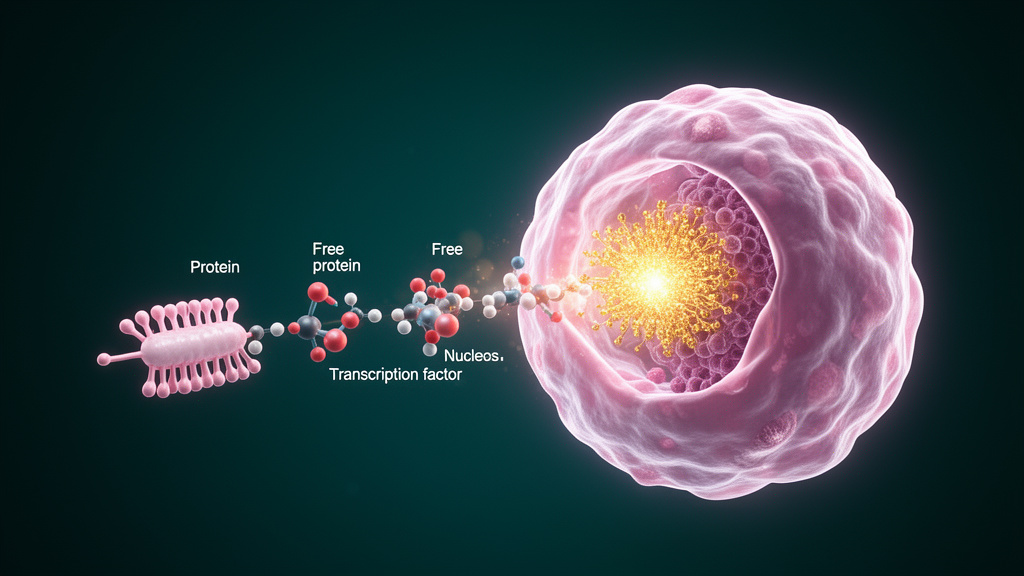
The central mechanistic finding concerns what happens when triple-negative breast cancer cells are stimulated with kisspeptin-10, the ligand for GPR54. KP-10 stimulation reduced YAP phosphorylation, promoted YAP nuclear localization, and enhanced TEAD-dependent transcription of the classic YAP target genes connective tissue growth factor (CTGF) and cysteine-rich angiogenic inducer 61 (CYR61). In other words, the receptor signal switched YAP from its phosphorylated, cytoplasmic, inactive state into a nuclear transcriptional activator.
Tracing the pathway upstream, the team showed that GPR54 activates YAP through a Gαq/11–RhoA–actin signaling cascade that suppresses the activity of the large tumor suppressor kinases LATS1/2. Because LATS1/2 are the kinases that normally phosphorylate and inhibit YAP, their suppression removes the brake on YAP-driven gene expression. This places a G protein-coupled receptor squarely upstream of the Hippo pathway in these cancer cells, providing a concrete route by which an extracellular peptide signal can be converted into transcriptional oncogenic output.
Functional assays then established that this signaling matters for cancer-relevant behavior. GPR54-driven proliferation, migration, invasion, and anchorage-independent growth all required YAP/TAZ, as demonstrated by the knockdown and knockout experiments. The relationship also runs in reverse at the transcriptional level: YAP activation upregulated both GPR54 and its ligand gene KISS1, forming a positive regulatory feedback loop that could sustain oncogenic signaling once initiated. The authors note that β-arrestin2, a signaling adaptor often recruited by GPCRs, contributed to MAPK signaling in this system but was dispensable for Hippo–YAP regulation, sharpening the conclusion that the Gαq/11–RhoA arm is the relevant route to YAP.
In vivo evidence supported the cell-culture findings. GPR54 overexpression accelerated tumor growth in both subcutaneous and orthotopic triple-negative breast cancer models, whereas YAP depletion abolished these effects, indicating that YAP is necessary for the tumor-promoting activity of the receptor. On the therapeutic side, combined treatment with the GPR54 antagonist p234 and the YAP inhibitor verteporfin synergistically suppressed YAP activation and tumorigenic phenotypes, suggesting that hitting the axis at two points may be more effective than targeting either node alone.
The authors conclude that GPR54 promotes triple-negative breast cancer progression primarily through activation of YAP via the Gαq/11–RhoA axis and suppression of LATS1/2 activity, establishing a positive feedback loop that sustains oncogenic signaling. They position the GPR54–YAP signaling axis as a potential therapeutic target in YAP-driven triple-negative breast cancer. It is worth noting that this is an early-release, peer-reviewed accepted version of the article, citable under a permanent DOI and subject to further edits before the final Version of Record appears. As with any preclinical study, the xenograft and cell-line findings will need to be weighed against clinical evidence before any therapeutic implications can be evaluated in patients, but the study offers a mechanistically detailed map of how a reproductive-axis receptor can be co-opted to drive one of the hardest-to-treat breast cancer subtypes.
Subject of Research: How GPR54 receptor signaling activates the YAP oncoprotein to promote triple-negative breast cancer tumorigenesis
Article Title: GPR54 signaling activates YAP through the Gαq/11–RhoA axis to promote tumorigenesis in triple-negative breast cancer
Article References: Kim, C.-L., Ryu, H.-Y., Kang, L.-J., Lee, Y., Lee, J. S., Park, H.-S., & Mo, J.-S. (2026). GPR54 signaling activates YAP through the Gαq/11–RhoA axis to promote tumorigenesis in triple-negative breast cancer. Cellular & Molecular Biology Letters. https://doi.org/10.1186/s11658-026-01001-y
Image Credits: AI Generated
DOI: 10.1186/s11658-026-01001-y
Keywords: GPR54, KISS1R, YAP, Hippo pathway, triple-negative breast cancer, Gαq/11, RhoA, LATS1/2, verteporfin, xenograft models, TEAD transcription, oncogenic feedback loop
News Source: Nathaniel Bowman. (October 28, 2026). GPR54 activates YAP via Gαq/11–RhoA axis in triple-negative breast cancer. Scienmag.



