• HOME
  • NEWS
  • EXPLORE
    • CAREER
      • Companies
      • Jobs
    • EVENTS
    • iGEM
      • News
      • Team
    • PHOTOS
    • VIDEO
    • WIKI
  • BLOG
  • COMMUNITY
    • FACEBOOK
    • INSTAGRAM
    • TWITTER
Thursday, June 25, 2026
BIOENGINEER.ORG
No Result
View All Result
  • Login
  • HOME
  • NEWS
  • EXPLORE
    • CAREER
      • Companies
      • Jobs
        • Lecturer
        • PhD Studentship
        • Postdoc
        • Research Assistant
    • EVENTS
    • iGEM
      • News
      • Team
    • PHOTOS
    • VIDEO
    • WIKI
  • BLOG
  • COMMUNITY
    • FACEBOOK
    • INSTAGRAM
    • TWITTER
  • HOME
  • NEWS
  • EXPLORE
    • CAREER
      • Companies
      • Jobs
        • Lecturer
        • PhD Studentship
        • Postdoc
        • Research Assistant
    • EVENTS
    • iGEM
      • News
      • Team
    • PHOTOS
    • VIDEO
    • WIKI
  • BLOG
  • COMMUNITY
    • FACEBOOK
    • INSTAGRAM
    • TWITTER
No Result
View All Result
Bioengineer.org
No Result
View All Result
Home NEWS Science News Chemistry

Good vibrations for new energy

Bioengineer by Bioengineer
October 21, 2020
in Chemistry
Reading Time: 2 mins read
0
IMAGE
Share on FacebookShare on TwitterShare on LinkedinShare on RedditShare on Telegram

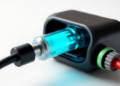
Nanogenerator ‘scavenges’ power from their surroundings

IMAGE

Credit: Flinders University

Imagine a mobile phone charger that doesn’t need a wireless or mains power source. Or a pacemaker with inbuilt organic energy sources within the human body.

Australian researchers led by Flinders University are picking up the challenge of ‘scavenging’ invisible power from low-frequency vibrations in the surrounding environment, including wind, air or even contact-separation energy (static electricity).

“These so-called triboelectric nanogenerators (or ‘TENGs’) can be made at low cost in different configurations, making them suitable for driving small electronics such as personal electronics (mobile phones), biomechanics devices (pacemakers), sensors (temperature/pressure/chemical sensors), and more,” says Professor Youhong Tang, from Flinders University’s College of Science and Engineering.

Further research aims to further develop this renewable form of energy harvesting by designing simple fabrication from cheap and sustainable materials, with high efficiency.

“They can use non-invasive materials, so could one day be used for implantable and wearable energy harvesting aims,” says PhD candidate Mohammad Khorsand, co-lead author on recent papers in international journal Nano Energy.

The latest paper uses AI-enhanced mathematical modelling to compare the function of the number of segments, rotational speed and tribo-surface spacing of an advanced TENG prototype to optimise the storage and performance.

The researchers, with colleagues at the University of Technology Sydney and elsewhere, are working to improve power generation of TENGs and store the generated power on supercapacitor or battery.

“We have been able to effectively harvest power from sliding movement and rotary motion which are abundantly available in our living environment,” says Professor Tang.

###

The latest paper, Artificial intelligence enhanced mathematical modeling on rotary triboelectric nanogenerators under various kinematic and geometric conditions (2020) by Mohammad Khorsand, Javad Tavakoli (University of Technology Sydney), Haowen Guan and Youhong Tang has been published in Nano Energy (Elsevier) DOI: 10.1016/j.nanoen.2020.104993

Also see 2019 paper Simulation of high-output and lightweight sliding-mode triboelectric nanogenerators DOI: 10.1016/j.nanoen.2019.104115

Key points:

  • The first generation of triboelectric nanogenerators (TENGs) was fabricated at Georgia Institute of Technology in the US about 10 years ago.
  • Research at Flinders University is aiming design cost effective and high-efficient sliding and rotary TENGs for further development and possible commercialisation.
  • This research on the next generation of TENG is using AI and simulation modelling to reduce the cost of repeating the experiment for various conditions.
  • The research team is focusing on numerically predicting the outputs of TENGs by measuring their voltage, current, power and energy under various electric specifications and geometries of dielectric films.

Media Contact
Professor Youhong Tang
[email protected]

Related Journal Article

http://dx.doi.org/10.1016/j.nanoen.2020.104993

Tags: Biomedical/Environmental/Chemical EngineeringElectrical Engineering/ElectronicsNanotechnology/MicromachinesResearch/DevelopmentRobotry/Artificial IntelligenceTechnology/Engineering/Computer Science
Share12Tweet8Share2ShareShareShare2

Related Posts

AI and Physics Collaborate to Design Advanced Hydrogen Storage Materials

June 25, 2026

International Team Including Dresden Scientists Develops Novel Designer Proteins for Advanced Study of Living Tissue

June 25, 2026

New Study Uncovers Key Factors Driving Water Chemistry in Nanoscale Environments

June 25, 2026

Plasma Technology Extends Catalyst Lifespan in Hydrogen Production

June 24, 2026
Please login to join discussion

POPULAR NEWS

  • Saying Goodbye to PGY-6: Pediatric Fellowship Realities

    103 shares
    Share 41 Tweet 26
  • Multi-Hospital Study Reveals Long Covid Burden Is Twice as High as Current Estimates

    92 shares
    Share 36 Tweet 23
  • Detection of EDCs in Breast Milk and Infant Urine Up to Six Months Highlights Early Exposure Risks

    77 shares
    Share 31 Tweet 19
  • New Drug Candidate Developed at McMaster Shows Potential for Treating Brain Cancer

    58 shares
    Share 23 Tweet 15

About

We bring you the latest biotechnology news from best research centers and universities around the world. Check our website.

Follow us

Recent News

Tracking Lanthanide-Labeled Microplastics in Plants

POSTECH Researchers Slash Cost of Reconstituted Cell-Free Systems by 95%

AI and Physics Collaborate to Design Advanced Hydrogen Storage Materials

Subscribe to Blog via Email

Success! An email was just sent to confirm your subscription. Please find the email now and click 'Confirm' to start subscribing.

Join 82 other subscribers
  • Contact Us

Bioengineer.org © Copyright 2023 All Rights Reserved.

Welcome Back!

Login to your account below

Forgotten Password?

Retrieve your password

Please enter your username or email address to reset your password.

Log In
No Result
View All Result
  • Homepages
    • Home Page 1
    • Home Page 2
  • News
  • National
  • Business
  • Health
  • Lifestyle
  • Science

Bioengineer.org © Copyright 2023 All Rights Reserved.