• HOME
  • NEWS
  • EXPLORE
    • CAREER
      • Companies
      • Jobs
    • EVENTS
    • iGEM
      • News
      • Team
    • PHOTOS
    • VIDEO
    • WIKI
  • BLOG
  • COMMUNITY
    • FACEBOOK
    • INSTAGRAM
    • TWITTER
Friday, May 15, 2026
BIOENGINEER.ORG
No Result
View All Result
  • Login
  • HOME
  • NEWS
  • EXPLORE
    • CAREER
      • Companies
      • Jobs
        • Lecturer
        • PhD Studentship
        • Postdoc
        • Research Assistant
    • EVENTS
    • iGEM
      • News
      • Team
    • PHOTOS
    • VIDEO
    • WIKI
  • BLOG
  • COMMUNITY
    • FACEBOOK
    • INSTAGRAM
    • TWITTER
  • HOME
  • NEWS
  • EXPLORE
    • CAREER
      • Companies
      • Jobs
        • Lecturer
        • PhD Studentship
        • Postdoc
        • Research Assistant
    • EVENTS
    • iGEM
      • News
      • Team
    • PHOTOS
    • VIDEO
    • WIKI
  • BLOG
  • COMMUNITY
    • FACEBOOK
    • INSTAGRAM
    • TWITTER
No Result
View All Result
Bioengineer.org
No Result
View All Result
Home NEWS Science News

Gold nanoparticles to save neurons from cell death

Bioengineer by Bioengineer
June 25, 2020
in Science News
Reading Time: 2 mins read
0
IMAGE
Share on FacebookShare on TwitterShare on LinkedinShare on RedditShare on Telegram

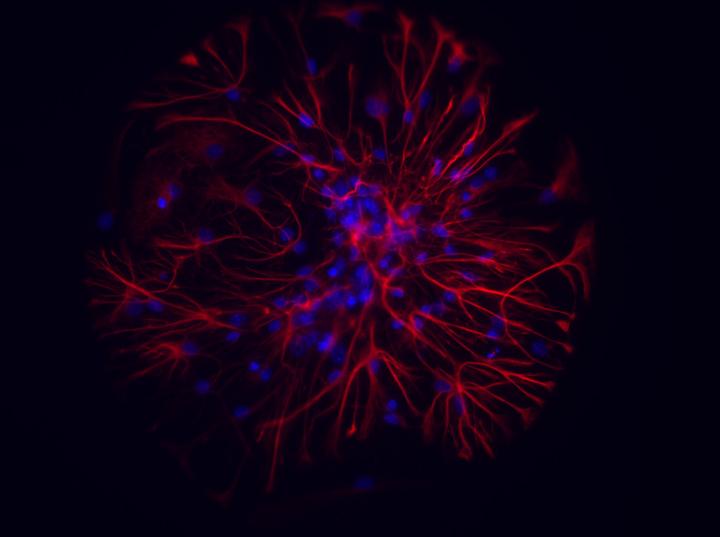
Published on ACS Nano, journal of the American Chemical Society, the study opens important perspectives for treatment of diseases such as Alzheimer’s and Huntington’s disease, but also epilepsy, brain trauma and stroke.
IMAGE

Credit: IIT-Istituto Italiano di Tecnologia

Lecce, 25th June 2020 – Gold nanoparticles have been developed in the laboratory in order to reduce the cell death of neurons exposed to overexcitement. The study, is the result of an international collaboration coordinated by Roberto Fiammengo, researcher at the Center of Biomolecular Nanotechnologies of the IIT-Istituto Italiano di Tecnologia (Italian Institute of Technology) in Lecce (Italy). The international team also involves colleagues at the University of Genoa, Imperial College London, King’s College London, the Center for Synaptic Neuroscience and Technology of the Istituto Italiano di Tecnologia in Genoa and the Max Planck Institute for Medical Research in Heidelberg.

Excessive stimulation of neurons by the neurotransmitter glutamate, which is usually involved in the excitatory communication among neurons, can damage nerve cells and cause their degeneration. This phenomenon, known with the term excitotoxicity, is common in many neuroinflammatory and neurodegenerative diseases, such as Alzheimer’s and Huntington’s disease, but also in case of epilepsy, brain trauma and stroke.

In particular, these nanoparticles were designed and prepared by the IIT team in Lecce (Italy), and are functionalized with peptides that allow selective inhibition of extrasynaptic glutamate receptors involved in the excitotoxicity. In fact, the size of the nanoparticles is 20 – 50 times larger than that of classic drugs resulting in the blockade of only the receptors located outside the synapses. In this way, correct neurotransmission is preserved while the excessive activation that leads to cell death is avoided.

The molecular mechanism underlying the neuroprotective effect of the nanoparticles has been clarified by the experimental work carried out by Pierluigi Valente at the University of Genoa, in collaboration with Fabio Benfenati’s group of the Center for Synaptic Neuroscience and Technology of the IIT in Genoa (Italy).

The results of this research sets the basis for treatment of neurological diseases in which the excessive release of glutamate is at the basis of the pathology. The possibility of specifically blocking extrasynaptic receptors, mainly responsible for cell death, without interfering with synaptic transmission, opens up promising perspectives for targeted therapy without major side effects.

“We have developed nanoparticles with unique and necessary properties to answer to the indications of neurobiologists and physiologists – declares Roberto Fiammengo – Coordinating such a multidisciplinary group of researchers was an extremely stimulating task and the results obtained show that this is the winning approach.”

“Even if, at the moment, the nanoparticles developed cannot be used in therapy, – concludes Pierluigi Valente of the University of Genoa, first author of the paper – this study shows how nanotechnology can provide important indications for treatment of many neuroinflammatory and neurodegenerative diseases.”

###

Media Contact
Valeria delle Cave
[email protected]

Related Journal Article

http://dx.doi.org/10.1021/acsnano.0c00201

Tags: AlzheimerBiologyCell BiologyMedicine/HealthMolecular Biologyneurobiology
Share12Tweet8Share2ShareShareShare2

Related Posts

Digital Health Fear Patterns in Older Cancer Patients

May 15, 2026

A*STAR Scientists Unveil Novel Technique to Decipher RNA Structure’s Impact on Health and Disease

May 15, 2026

Smart Hydrogels Revolutionize Information Security with Photo-Patterning and Multi-Stimuli Responsive Structural Colors

May 15, 2026

Unveiling the Unseen: POSTECH Team Creates AI Framework to Detect Hidden Defects in Metal 3D Printing

May 15, 2026
Please login to join discussion

POPULAR NEWS

  • Research Indicates Potential Connection Between Prenatal Medication Exposure and Elevated Autism Risk

    843 shares
    Share 337 Tweet 211
  • New Study Reveals Plants Can Detect the Sound of Rain

    729 shares
    Share 291 Tweet 182
  • Salmonella Haem Blocks Macrophages, Boosts Infection

    62 shares
    Share 25 Tweet 16
  • Breastmilk Balances E. coli and Beneficial Bacteria in Infant Gut Microbiomes

    58 shares
    Share 23 Tweet 15

About

We bring you the latest biotechnology news from best research centers and universities around the world. Check our website.

Follow us

Recent News

Digital Health Fear Patterns in Older Cancer Patients

A*STAR Scientists Unveil Novel Technique to Decipher RNA Structure’s Impact on Health and Disease

Smart Hydrogels Revolutionize Information Security with Photo-Patterning and Multi-Stimuli Responsive Structural Colors

Subscribe to Blog via Email

Enter your email address to subscribe to this blog and receive notifications of new posts by email.

Join 82 other subscribers
  • Contact Us

Bioengineer.org © Copyright 2023 All Rights Reserved.

Welcome Back!

Login to your account below

Forgotten Password?

Retrieve your password

Please enter your username or email address to reset your password.

Log In
No Result
View All Result
  • Homepages
    • Home Page 1
    • Home Page 2
  • News
  • National
  • Business
  • Health
  • Lifestyle
  • Science

Bioengineer.org © Copyright 2023 All Rights Reserved.