• HOME
  • NEWS
  • EXPLORE
    • CAREER
      • Companies
      • Jobs
    • EVENTS
    • iGEM
      • News
      • Team
    • PHOTOS
    • VIDEO
    • WIKI
  • BLOG
  • COMMUNITY
    • FACEBOOK
    • INSTAGRAM
    • TWITTER
Monday, July 6, 2026
BIOENGINEER.ORG
No Result
View All Result
  • Login
  • HOME
  • NEWS
  • EXPLORE
    • CAREER
      • Companies
      • Jobs
        • Lecturer
        • PhD Studentship
        • Postdoc
        • Research Assistant
    • EVENTS
    • iGEM
      • News
      • Team
    • PHOTOS
    • VIDEO
    • WIKI
  • BLOG
  • COMMUNITY
    • FACEBOOK
    • INSTAGRAM
    • TWITTER
  • HOME
  • NEWS
  • EXPLORE
    • CAREER
      • Companies
      • Jobs
        • Lecturer
        • PhD Studentship
        • Postdoc
        • Research Assistant
    • EVENTS
    • iGEM
      • News
      • Team
    • PHOTOS
    • VIDEO
    • WIKI
  • BLOG
  • COMMUNITY
    • FACEBOOK
    • INSTAGRAM
    • TWITTER
No Result
View All Result
Bioengineer.org
No Result
View All Result
Home NEWS Science News Biology

Geometry goes viral: Researchers use maths to solve virus puzzle

Bioengineer by Bioengineer
September 27, 2019
in Biology
Reading Time: 3 mins read
0
IMAGE
Share on FacebookShare on TwitterShare on LinkedinShare on RedditShare on Telegram

Researchers have developed a new mathematical framework that changes the way we understand the structure of viruses such as Zika and Herpes
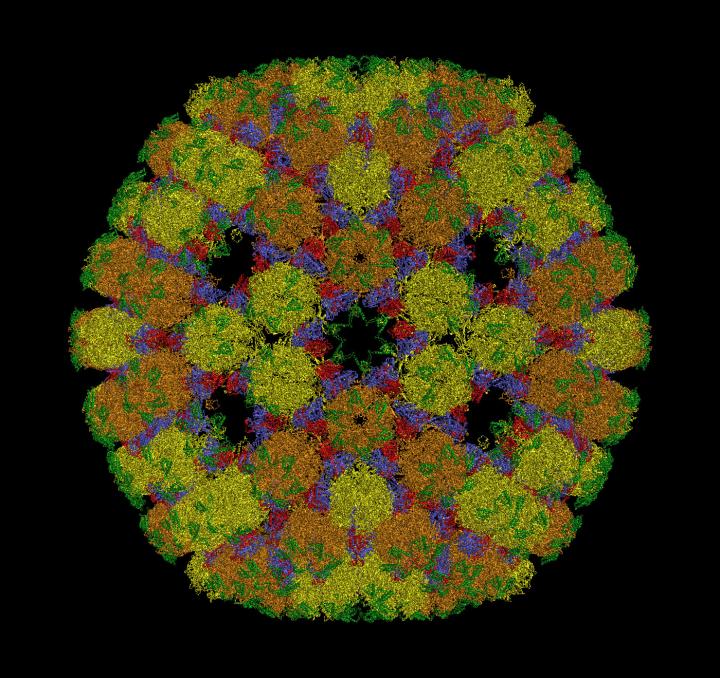
IMAGE

Credit: Prof Reidun Twarock, University of York.

Researchers have developed a new mathematical framework that changes the way we understand the structure of viruses such as Zika and Herpes.

The discovery, by researchers at the University of York (UK) and San Diego State University (US), paves the way for new insights into how viruses form, evolve and infect their hosts and may eventually open up new avenues in anti-viral therapy.

Viruses look like tiny footballs because they package their genetic material into protein containers that adopt polyhedral shapes.

The new theory revolutionises our understanding of how these containers are shaped, solving a scientific mystery that has endured for half a century.

For more than fifty years, scientists have followed the Caspar-Klug theory (CKT) about how the protein containers of viruses are structured. However, improvements in our ability to image viral particles at high resolution have made it apparent that many virus structures do not conform to these blueprints.

Published in the journal Nature Communications, the new theory accurately predicts the positions of proteins in the containers of all icosahedral (or twenty-sided) for the first time. It simultaneously works for viruses that conform to CKT and for those that posed an unresolved problem to that theory.

Professor Reidun Twarock, mathematical biologist at the University of York’s departments of Mathematics and Biology and a member of the York Cross-disciplinary Centre for Systems Analysis, said: “Our study represents a quantum leap forward in the field of structural virology, and closes gaps in our understanding of the structures of many viruses that are ill described by the existing framework.

“This theory will help scientists to analyse the physical properties of viruses, such as their stability, which is important for a better understanding of the mechanism of infection. Such insights can then be exploited for the development of novel anti-viral strategies.

“In particular the structures of larger and more complex viruses that are formed from multiple different components were previously not well understood.

“Our over-arching scheme reveals container architectures with protein numbers that are excluded by the current framework, and thus closes the size gaps in CKT.

“The new blueprints also provide a new perspective on viral evolution, suggesting novel routes in which larger and more complex viruses may have evolved from simple ones at evolutionary timescales.”

Dr Antoni Luque, theoretical biophysicist at San Diego State University and their Viral Information Institute, said: “We can use this discovery to target both the assembly and stability of the capsid, to either prevent the formation of the virus when it infects the host cell, or break it apart after it’s formed. This could facilitate the characterization and identification of antiviral targets for viruses sharing the same icosahedral layout.”

###

Structural puzzles in virology solved with an overarching icosahedral design principle is published in Nature Communications. The study was supported by the EPSRC, the Royal Society, the Wellcome Trust and San Diego State University.

Media Contact
Shelley Hughes
[email protected]

Related Journal Article

http://dx.doi.org/10.1038/s41467-019-12367-3

Tags: BiologyMathematics/StatisticsVirology
Share12Tweet8Share2ShareShareShare2

Related Posts

Here are a few rewritten headlines for a science magazine post, each with a slightly different tone: Intriguing & poetic: How do organs sculpt themselves? Sea stars hold the secret Direct & research-focused: Sea stars reveal the hidden rules of organ formation Metaphorical & inviting: Tiny architects beneath the waves: What sea stars teach us about building organs Short & punchy: Star-shaped clues to how our organs take shape Question-led: Could a sea star show us how organs form? Elegant & feature-style: The body’s blueprint, glimpsed in a sea star’s arm

July 6, 2026
Bacteria evolve faster with unconventional gene copies — Biology

Bacteria evolve faster with unconventional gene copies

July 6, 2026

Neighbours rewire soil feedback via root microbiome shifts

July 6, 2026

Evolution-Inspired Biosensors Revolutionize Lipid Tracking in Real Time

July 2, 2026
Please login to join discussion

POPULAR NEWS

  • Detection of EDCs in Breast Milk and Infant Urine Up to Six Months Highlights Early Exposure Risks

    77 shares
    Share 31 Tweet 19
  • New Drug Candidate Developed at McMaster Shows Potential for Treating Brain Cancer

    58 shares
    Share 23 Tweet 15
  • Saying Goodbye to PGY-6: Pediatric Fellowship Realities

    103 shares
    Share 41 Tweet 26
  • KTU Researchers Explore Ultrasound’s Role in Enhancing Blood Flow Beyond Diagnostics

    53 shares
    Share 21 Tweet 13

About

We bring you the latest biotechnology news from best research centers and universities around the world. Check our website.

Follow us

Recent News

Flame retardant BDE-209 targets molecularly linked to ulcerative colitis

Ultra-high frequency particle impacts mimic rockbursts to shatter hard rock

Kidney transplant outcomes in older adults studied by German researchers

Subscribe to Blog via Email

Enter your email address to subscribe to this blog and receive notifications of new posts by email.

Join 83 other subscribers
  • Contact Us

Bioengineer.org © Copyright 2023 All Rights Reserved.

Welcome Back!

Login to your account below

Forgotten Password?

Retrieve your password

Please enter your username or email address to reset your password.

Log In
No Result
View All Result
  • Homepages
    • Home Page 1
    • Home Page 2
  • News
  • National
  • Business
  • Health
  • Lifestyle
  • Science

Bioengineer.org © Copyright 2023 All Rights Reserved.