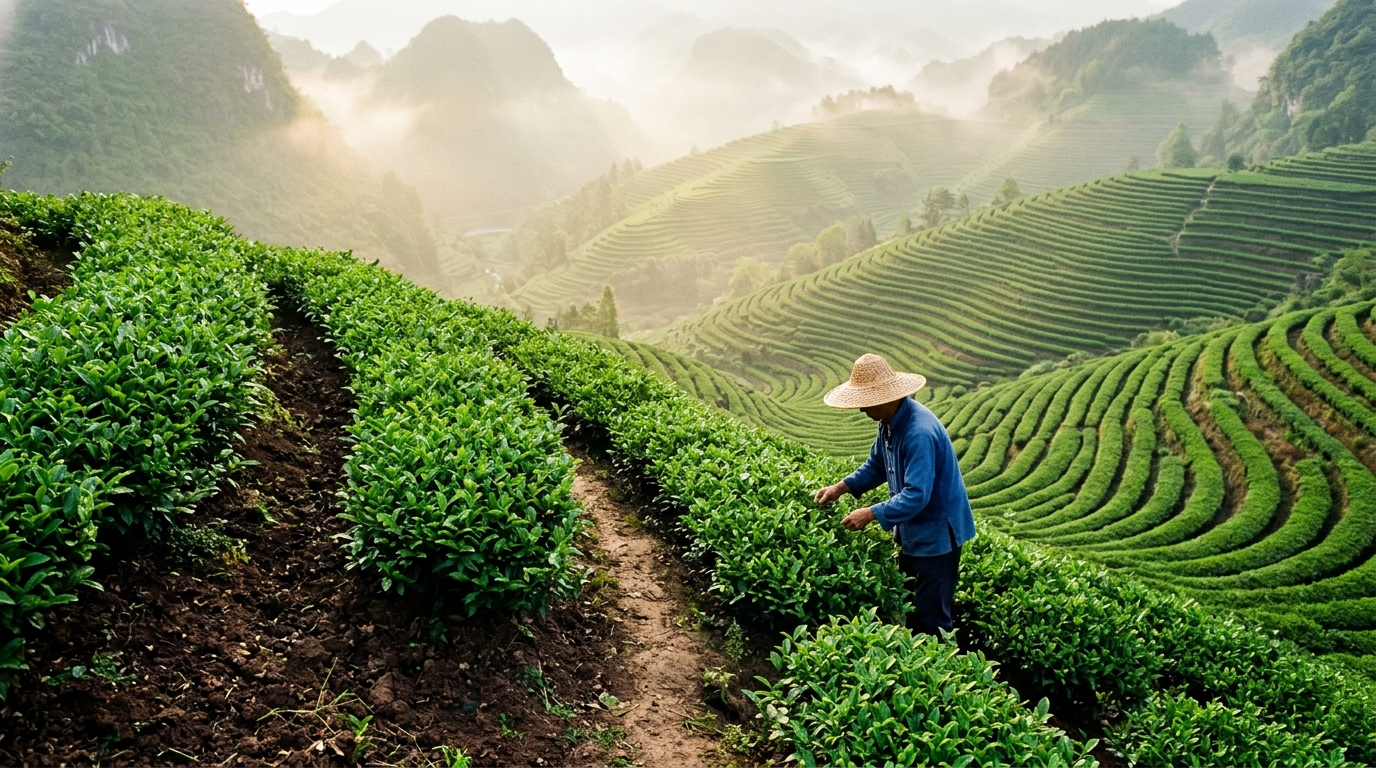
Farmers in China whose villages fall inside officially designated geographical indication areas apply significantly less chemical fertilizer than comparable farmers outside them, according to a new study published in Agricultural and Food Economics. Using household-level panel data from 1,517 farmers tracked between 2009 and 2021, researchers Jihong Ge, Jing Liu and Wuyang Hu found that geographical indication implementation reduced fertilizer use intensity by an average of 8.3 kilograms per mu, equivalent to roughly 124.6 kilograms per hectare. Set against a sample mean of about 72 kilograms per mu, that represents a decline of approximately 11.5 percent, achieved without any direct fertilizer-restriction policy.
Geographical indications, or GIs, are signs that identify products whose quality, reputation or other characteristics are essentially attributable to a specific geographical origin. According to the World Intellectual Property Organization, 114 countries had adopted GI systems by 2023, and more than 90 percent of registered GIs were associated with agricultural products. In many countries, the production standards attached to GI status contain explicit fertilizer requirements. The standard for Wuchang Rice in China, for example, requires annual nitrogen application to be maintained between 105 and 120 kilograms per hectare, while the French specification for Menton Lemon restricts nitrogen application at different growth stages and the Portuguese standard for Pêra Rocha do Oeste mandates soil analysis before planting.
Despite these explicit requirements, empirical evidence on whether GI implementation actually changes fertilizer behavior at the farm level had remained limited. Earlier research on GIs concentrated largely on economic and social effects such as farmers’ income growth, economic development, technological innovation, consumer preferences and employment. Environmental studies relied mainly on case studies, regional-level indicators or life cycle assessment approaches, leaving a gap in micro-level evidence on farmers’ production decisions. The new study addresses that gap by treating GI registration as a quasi-natural experiment and applying a staggered difference-in-differences approach to household panel data from China’s Rural Fixed Observation Points survey.
The researchers matched villages where sampled farmers live with the officially designated protection areas of GI products related to rice and fruit production, using registration data from the China National Intellectual Property Administration and the Ministry of Agriculture and Rural Affairs. When a village was covered by multiple GI products, the registration year of the first registered product marked the start of GI implementation. The final dataset contained 19,721 valid observations from farmers who exclusively cultivate rice or fruit, including 826 rice farmers, accounting for 54 percent of the sample, and 691 fruit farmers, accounting for 46 percent. Economic variables were deflated to 2009 values using the agricultural product price index.
The baseline regression showed a coefficient of -8.309 on the GI variable, statistically significant at the 1 percent level. Because fertilizer inputs in agricultural practice often exhibit strong inertia and path dependence, the authors argue that a reduction of more than 10 percent achieved solely through GI-related institutional arrangements carries both economic and environmental significance. Given that GI coverage involves many agricultural producers, even a modest per-household reduction could generate substantial resource savings at broader scales. An event-study analysis supported the parallel trends assumption: before implementation, the estimated coefficients were not statistically different from zero, while after implementation, fertilizer use intensity among treated households declined consistently relative to untreated households, with post-treatment coefficients significantly negative at the 1 percent level.
A battery of robustness checks reinforced the finding. Propensity score matching with nearest-neighbor matching yielded a coefficient of -10.268, significant at the 5 percent level, and radius matching with a caliper of 0.05 produced a coefficient of -8.339, significant at the 1 percent level, both close to the baseline estimate. Because contemporaneous policies such as the 2015 Zero Growth Action Plan for Fertilizer Use by 2020 and the 2017 Action Plan for Replacing Chemical Fertilizer with Organic Fertilizer in Fruit, Vegetable, and Tea Production could confound the results, the researchers excluded observations from 2015 onward and the GI coefficient remained significantly negative. A Goodman-Bacon decomposition showed that comparisons between treated and untreated observations carried a combined weight of 76 percent, suggesting treatment-timing heterogeneity was unlikely to substantially bias the estimates. A placebo test that randomly assigned pseudo-treatments 500 times produced coefficients centered around zero and substantially smaller than the baseline estimate.
An additional check replaced chemical fertilizer use intensity with organic fertilizer use intensity, measured as farmyard manure applied per unit of cultivated area. The coefficients on the GI variable turned positive and significant at the 1 percent level, indicating that GI implementation not only reduced chemical fertilizer use but also increased organic fertilizer input. Taken together with the baseline result, this pattern is consistent with farmers partially substituting organic fertilizer for chemical fertilizer to meet the quality requirements and production standards associated with GI products, suggesting a shift in the composition of fertilizer inputs rather than a simple across-the-board cut.
Why would a collective brand label change how much fertilizer a farmer spreads? The study points to two potential channels. The first is price incentives. GI products can convey quality signals that raise consumers’ willingness to pay premiums, and excessive fertilizer use can undermine the very quality those premiums depend on. Prior research has shown that excessive nitrogen application reduces rice quality by increasing chalkiness and lowering cooking quality, while unbalanced single-nutrient fertilization failed to improve the quality of a pear variety and even lowered soluble solids content, sugar-acid ratio and fruit weight. Balanced nutrient management and partial substitution of chemical fertilizers with organic ones, by contrast, have been shown to improve the quality of rice and fruit products. Consistent with this logic, the mechanism analysis found that GI implementation significantly increased the selling price of agricultural products, calculated from sales value and sales quantity reported in the survey.
The second channel is collective action. The value of a GI rests on a collective reputation shared by all producers in a region, which creates public-good attributes and exposes the brand to free-riding and moral hazard if some producers cut costs through excessive fertilizer use while still enjoying the brand premium. Stakeholders therefore have strong incentives to cooperate, and the study found that GI implementation was significantly and positively associated with village-level productive service expenditures for farmers, which cover spending on agricultural productive fixed assets, basic water conservancy construction and support for agricultural technology extension. Higher expenditures of this kind indicate stronger collective service provision and a greater capacity for collective action, with the coefficient significant at the 1 percent level.
The effects were not uniform across the sample. The fertilizer-reducing effect was statistically detectable among high-education households, defined as those whose members average six or more years of schooling, but not among low-education households. It appeared among smallholders operating less than 15 mu but not among large-scale households, and among households with low off-farm employment shares but not those with high off-farm employment, possibly because more diversified livelihoods make farmers less responsive to GI market incentives. At the village level, the effect was significant in economically high-development villages and in villages with enterprises present, but not in medium- or low-development villages or villages without enterprises, suggesting that local organizational and market conditions shape how effectively GI arrangements translate into changed farming behavior.
The authors are careful about the limits of their evidence. GI registration does not mean that all farmers within a protected area immediately use GI labels, strictly comply with production standards or become subject to formal monitoring, and the data do not reveal whether individual farmers are authorized to use the labels. The study also cannot determine whether the observed reduction reflects improved fertilizer-use efficiency, substitution toward organic fertilizers or reduced overuse, and it covers only rice and fruit producers, so the findings should be interpreted within that scope. The researchers note that they could not apply recently developed methods such as Doubly Robust Multiple-Period DID because of restricted access to the original panel data during revision, and they flag this as an avenue for future work.
Even with those caveats, the results carry policy weight. The authors argue that evaluations of geographical indications should consider not only their economic functions of product identification and brand protection but also their potential contribution to environmentally sustainable agriculture. Their four policy implications emphasize strengthening post-registration governance, including promotion of production standards, quality monitoring and brand maintenance; reinforcing the link between product quality and market value so that sustainable practices are rewarded; fostering coordination among local governments, producer associations, cooperatives and other stakeholders; and tailoring policy design to local market conditions, organizational capacity and farmer characteristics rather than applying a uniform approach. As of March 2025, China had recognized more than 9,800 GI agricultural products, the largest number in the world, making the finding that certification itself can nudge fertilizer use downward a potentially consequential one for sustainable farming at scale.
Subject of Research: The effect of geographical indication implementation on fertilizer use intensity among Chinese rice and fruit farmers
Article Title: Geographical indications and fertilizer reduction
Article References: Ge, J., Liu, J., & Hu, W. (2026). Geographical indications and fertilizer reduction. Agricultural and Food Economics, 14(1), Article 86. https://doi.org/10.1186/s40100-026-00530-6
Image Credits: AI Generated
DOI: 10.1186/s40100-026-00530-6
Keywords: geographical indications, fertilizer use intensity, China, staggered difference-in-differences, rice farming, fruit farming, price incentives, collective action, organic fertilizer, sustainable agriculture, rural household panel data, agricultural policy
News Source: Alan Morgan. (November 5, 2026). Geographical Indications Cut Fertilizer Use on Chinese Farms by 11.5 Percent. Scienmag.