• HOME
  • NEWS
  • EXPLORE
    • CAREER
      • Companies
      • Jobs
    • EVENTS
    • iGEM
      • News
      • Team
    • PHOTOS
    • VIDEO
    • WIKI
  • BLOG
  • COMMUNITY
    • FACEBOOK
    • INSTAGRAM
    • TWITTER
Thursday, June 25, 2026
BIOENGINEER.ORG
No Result
View All Result
  • Login
  • HOME
  • NEWS
  • EXPLORE
    • CAREER
      • Companies
      • Jobs
        • Lecturer
        • PhD Studentship
        • Postdoc
        • Research Assistant
    • EVENTS
    • iGEM
      • News
      • Team
    • PHOTOS
    • VIDEO
    • WIKI
  • BLOG
  • COMMUNITY
    • FACEBOOK
    • INSTAGRAM
    • TWITTER
  • HOME
  • NEWS
  • EXPLORE
    • CAREER
      • Companies
      • Jobs
        • Lecturer
        • PhD Studentship
        • Postdoc
        • Research Assistant
    • EVENTS
    • iGEM
      • News
      • Team
    • PHOTOS
    • VIDEO
    • WIKI
  • BLOG
  • COMMUNITY
    • FACEBOOK
    • INSTAGRAM
    • TWITTER
No Result
View All Result
Bioengineer.org
No Result
View All Result
Home NEWS Science News Chemistry

Genome-editing tool TALEN outperforms CRISPR-Cas9 in tightly packed DNA

Bioengineer by Bioengineer
January 27, 2021
in Chemistry
Reading Time: 2 mins read
0
IMAGE
Share on FacebookShare on TwitterShare on LinkedinShare on RedditShare on Telegram

IMAGE

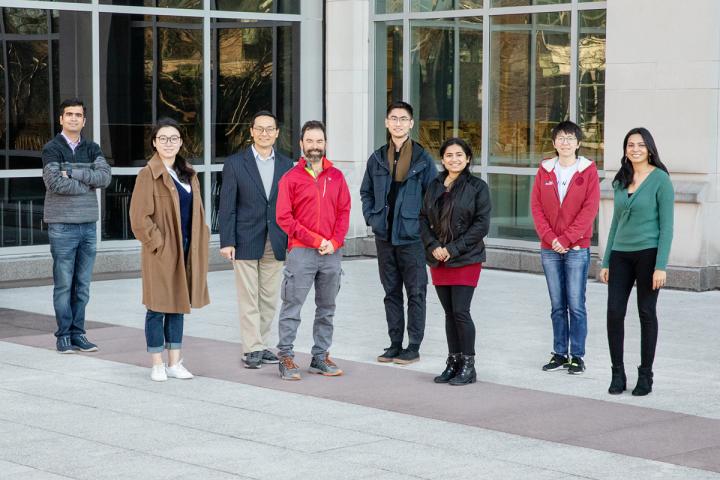
Credit: Composite photo by L. Brian Stauffer

CHAMPAIGN, Ill. — Researchers used single-molecule imaging to compare the genome-editing tools CRISPR-Cas9 and TALEN. Their experiments revealed that TALEN is up to five times more efficient than CRISPR-Cas9 in parts of the genome, called heterochromatin, that are densely packed. Fragile X syndrome, sickle cell anemia, beta-thalassemia and other diseases are the result of genetic defects in the heterochromatin.

The researchers report their findings in the journal Nature Communications.

The study adds to the evidence that a broader selection of genome-editing tools is needed to target all parts of the genome, said Huimin Zhao, a professor of chemical and biomolecular engineering at the University of Illinois Urbana-Champaign who led the new research.

“CRISPR is a very powerful tool that led to a revolution in genetic engineering,” Zhao said. “But it still has some limitations.”

CRISPR is a bacterial molecule that detects invading viruses. It can carry one of several enzymes, such as Cas-9, that allow it to cut viral genomes at specific sites. TALEN also scans DNA to find and target specific genes. Both CRISPR and TALEN can be engineered to target specific genes to fight disease, improve crop plant characteristics or for other applications.

Zhao and his colleagues used single-molecule fluorescence microscopy to directly observe how the two genome-editing tools performed in living mammalian cells. Fluorescent-labeled tags enabled the researchers to measure how long it took CRISPR and TALEN to move along the DNA and to detect and cut target sites.

“We found that CRISPR works better in the less-tightly wound regions of the genome, but TALEN can access those genes in the heterochromatin region better than CRISPR,” Zhao said. “We also saw that TALEN can have higher editing efficiency than CRISPR. It can cut the DNA and then make changes more efficiently than CRISPR.”

TALEN was as much as five times more efficient than CRISPR in multiple experiments.

The findings will lead to improved approaches for targeting various parts of the genome, Zhao said.

“Either we can use TALEN for certain applications, or we could try to make CRISPR work better in the heterochromatin,” he said.

###

The National Institutes of Health and National Science Foundation support this work.

Zhao is a member of the Carl R. Woese Institute for Genomic Biology at the U. of I.

Editor’s notes:

To reach Huimin Zhao, email [email protected].

The paper “TALEN outperforms Cas9 in editing heterochromatin target sites” is available from the U. of I. News Bureau.

Media Contact
Diana Yates, Life Sciences Editor, U. of I. News Bureau
[email protected]

Related Journal Article

http://dx.doi.org/10.1038/s41467-020-20672-5

Tags: BiotechnologyCell BiologyGene TherapyGeneticsMedicine/HealthPharmaceutical ChemistryPharmaceutical Science
Share13Tweet8Share2ShareShareShare2

Related Posts

AI and Physics Collaborate to Design Advanced Hydrogen Storage Materials

June 25, 2026

International Team Including Dresden Scientists Develops Novel Designer Proteins for Advanced Study of Living Tissue

June 25, 2026

New Study Uncovers Key Factors Driving Water Chemistry in Nanoscale Environments

June 25, 2026

Plasma Technology Extends Catalyst Lifespan in Hydrogen Production

June 24, 2026
Please login to join discussion

POPULAR NEWS

  • Saying Goodbye to PGY-6: Pediatric Fellowship Realities

    103 shares
    Share 41 Tweet 26
  • Multi-Hospital Study Reveals Long Covid Burden Is Twice as High as Current Estimates

    92 shares
    Share 36 Tweet 23
  • Detection of EDCs in Breast Milk and Infant Urine Up to Six Months Highlights Early Exposure Risks

    77 shares
    Share 31 Tweet 19
  • New Drug Candidate Developed at McMaster Shows Potential for Treating Brain Cancer

    58 shares
    Share 23 Tweet 15

About

We bring you the latest biotechnology news from best research centers and universities around the world. Check our website.

Follow us

Recent News

Tracking Lanthanide-Labeled Microplastics in Plants

POSTECH Researchers Slash Cost of Reconstituted Cell-Free Systems by 95%

AI and Physics Collaborate to Design Advanced Hydrogen Storage Materials

Subscribe to Blog via Email

Enter your email address to subscribe to this blog and receive notifications of new posts by email.

Join 82 other subscribers
  • Contact Us

Bioengineer.org © Copyright 2023 All Rights Reserved.

Welcome Back!

Login to your account below

Forgotten Password?

Retrieve your password

Please enter your username or email address to reset your password.

Log In
No Result
View All Result
  • Homepages
    • Home Page 1
    • Home Page 2
  • News
  • National
  • Business
  • Health
  • Lifestyle
  • Science

Bioengineer.org © Copyright 2023 All Rights Reserved.