• HOME
  • NEWS
  • EXPLORE
    • CAREER
      • Companies
      • Jobs
    • EVENTS
    • iGEM
      • News
      • Team
    • PHOTOS
    • VIDEO
    • WIKI
  • BLOG
  • COMMUNITY
    • FACEBOOK
    • INSTAGRAM
    • TWITTER
Sunday, October 4, 2026
BIOENGINEER.ORG
No Result
View All Result
  • Login
  • HOME
  • NEWS
  • EXPLORE
    • CAREER
      • Companies
      • Jobs
        • Lecturer
        • PhD Studentship
        • Postdoc
        • Research Assistant
    • EVENTS
    • iGEM
      • News
      • Team
    • PHOTOS
    • VIDEO
    • WIKI
  • BLOG
  • COMMUNITY
    • FACEBOOK
    • INSTAGRAM
    • TWITTER
  • HOME
  • NEWS
  • EXPLORE
    • CAREER
      • Companies
      • Jobs
        • Lecturer
        • PhD Studentship
        • Postdoc
        • Research Assistant
    • EVENTS
    • iGEM
      • News
      • Team
    • PHOTOS
    • VIDEO
    • WIKI
  • BLOG
  • COMMUNITY
    • FACEBOOK
    • INSTAGRAM
    • TWITTER
No Result
View All Result
Bioengineer.org
No Result
View All Result
Home NEWS Science News Biology

Genetics of the tree of life

Bioengineer by Bioengineer
August 27, 2020
in Biology
Reading Time: 2 mins read
0
IMAGE
Share on FacebookShare on TwitterShare on LinkedinShare on RedditShare on Telegram

USFS scientists advance genetic understanding of African baobab tree
IMAGE

Credit: Islam-Faradi, Sakhanokho & Nelson

The African baobab tree (Adansonia digitata) is called the tree of life. Baobab trees can live for more than a thousand years and provide food, livestock fodder, medicinal compounds, and raw materials. Baobab trees are incredibly significant. However, there are growing conservation concerns and until now, a lack of genetic information.

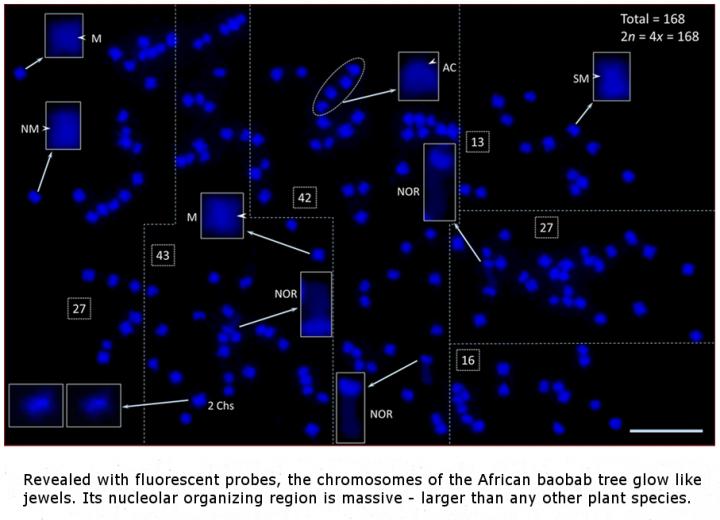
The African baobab tree has 168 chromosomes – critical knowledge for further genetic studies, conservation, and improvement for agricultural purposes. The findings were published in the journal Scientific Reports. Previous studies estimated that the tree has between 96 and 166 chromosomes.

“We were able to unequivocally count the chromosomes,” says Nurul Faridi, a USDA Forest Service research geneticist who co-led the study with Hamidou Sakhanokho, a USDA Agricultural Research Service research geneticist.

The researchers used fluorescent probes to see the genetic components of individual chromosomes within the cells – which glow like jewels.

The analysis also revealed that the tree has a massive nucleolus organizer region (NOR). Relative to the main chromosome body, this region appears larger than that of any other plant species. During certain stages of the cell cycle, nucleoli form at the NORs. The nucleoli are essential for ribosome assembly and protein synthesis in eukaryotes and are an important feature that differentiates eukaryotes from prokaryotes.

“These genetic findings are foundational and will make genetic conservation of the African baobab tree more efficient and effective,” says Dana Nelson, a coauthor and project leader of the Southern Research Station’s genetic unit. “This research is also a precursor for tree breeding programs seeking to improve baobab for silvicultural applications.”

###

All content is freely available through the Forest Service online catalog at https://www.fs.usda.gov/treesearch/pubs/60778

Media Contact
Sarah Farmer
[email protected]

Related Journal Article

http://dx.doi.org/10.1038/s41598-020-68697-6

Tags: AgricultureBiologyForestryGenesGeneticsPlant Sciences
Share13Tweet8Share2ShareShareShare2

Related Posts

Ocean Bacteria That Eat Oil May Also Help Recycle the World's Plastics

Ocean Bacteria That Eat Oil May Also Help Recycle the World’s Plastics

October 4, 2026
Genomic Inbreeding Leaves Measurable Fingerprints on Pig Production Traits

Genomic Inbreeding Leaves Measurable Fingerprints on Pig Production Traits

October 4, 2026

Warming World, Hungrier Cannibals: Climate Change Reshapes Disease Spread in a Devastating Crop Pest

October 4, 2026

Popular Gene Pathway Scoring Tools Can Silently Erase Disease Signals, Benchmark Warns

October 4, 2026
Please login to join discussion

POPULAR NEWS

  • Alloys That Shrink Their Own Grains: New PIX Mechanism Refines Metals With Heat Alone

    Alloys That Shrink Their Own Grains: New PIX Mechanism Refines Metals With Heat Alone

    29 shares
    Share 12 Tweet 7
  • Endurance Exercise Reshapes the Liver in Males and Females Through Distinct Molecular Routes

    29 shares
    Share 12 Tweet 7
  • Single Transcription Factor PU.1 Rapidly Converts Fibroblasts into Macrophage-Lineage Cells

    29 shares
    Share 12 Tweet 7
  • New Scale Measures How Ready Nurse Educators Really Are for the AI Era

    29 shares
    Share 12 Tweet 7

About

We bring you the latest biotechnology news from best research centers and universities around the world. Check our website.

Follow us

Recent News

Alloys That Shrink Their Own Grains: New PIX Mechanism Refines Metals With Heat Alone

Endurance Exercise Reshapes the Liver in Males and Females Through Distinct Molecular Routes

Single Transcription Factor PU.1 Rapidly Converts Fibroblasts into Macrophage-Lineage Cells

Subscribe to Blog via Email

Enter your email address to subscribe to this blog and receive notifications of new posts by email.

Join 85 other subscribers
  • Contact Us

Bioengineer.org © Copyright 2023 All Rights Reserved.

Welcome Back!

Login to your account below

Forgotten Password?

Retrieve your password

Please enter your username or email address to reset your password.

Log In
No Result
View All Result
  • Homepages
    • Home Page 1
    • Home Page 2
  • News
  • National
  • Business
  • Health
  • Lifestyle
  • Science

Bioengineer.org © Copyright 2023 All Rights Reserved.