• HOME
  • NEWS
  • EXPLORE
    • CAREER
      • Companies
      • Jobs
    • EVENTS
    • iGEM
      • News
      • Team
    • PHOTOS
    • VIDEO
    • WIKI
  • BLOG
  • COMMUNITY
    • FACEBOOK
    • INSTAGRAM
    • TWITTER
Tuesday, July 7, 2026
BIOENGINEER.ORG
No Result
View All Result
  • Login
  • HOME
  • NEWS
  • EXPLORE
    • CAREER
      • Companies
      • Jobs
        • Lecturer
        • PhD Studentship
        • Postdoc
        • Research Assistant
    • EVENTS
    • iGEM
      • News
      • Team
    • PHOTOS
    • VIDEO
    • WIKI
  • BLOG
  • COMMUNITY
    • FACEBOOK
    • INSTAGRAM
    • TWITTER
  • HOME
  • NEWS
  • EXPLORE
    • CAREER
      • Companies
      • Jobs
        • Lecturer
        • PhD Studentship
        • Postdoc
        • Research Assistant
    • EVENTS
    • iGEM
      • News
      • Team
    • PHOTOS
    • VIDEO
    • WIKI
  • BLOG
  • COMMUNITY
    • FACEBOOK
    • INSTAGRAM
    • TWITTER
No Result
View All Result
Bioengineer.org
No Result
View All Result
Home NEWS Science News Health

Geneticists are bringing personal medicine closer to recently admixed individuals

Bioengineer by Bioengineer
April 2, 2020
in Health
Reading Time: 2 mins read
0
IMAGE
Share on FacebookShare on TwitterShare on LinkedinShare on RedditShare on Telegram

IMAGE

Credit: Davide Marnetto

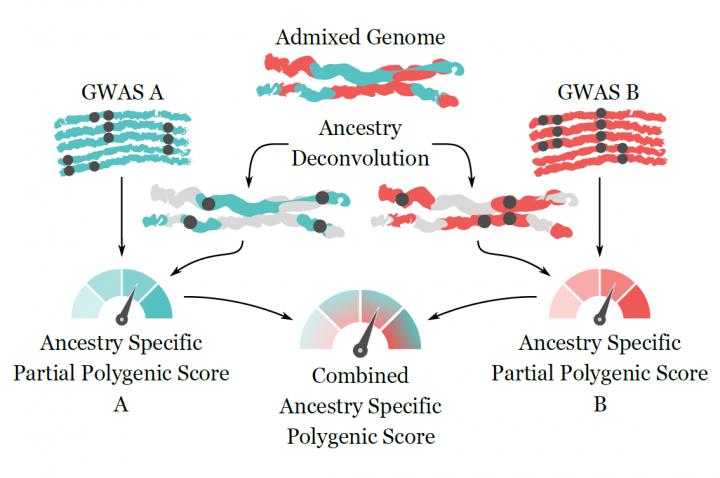
A new study in Nature Communications proposes a method to extend polygenic scores, the estimate of genetic risk factors and a cornerstone of the personalized medicine revolution, to individuals with multiple ancestral origins. The study was led by Dr. Davide Marnetto from the Institute of Genomics of the University of Tartu, Estonia and coordinated by Dr. Luca Pagani from the same institution and from the University of Padova, Italy.

“The information contained in our DNA is a mosaic of genetic instructions inherited from our ancestors, and in many societies one’s ancestors often come from the opposite corners of the world.” says Dr. Davide Marnetto, first author of the study. The contribution of one’s ancestry, or ancestries, to the total risk of developing a specific disease or presenting a given trait is a long standing question of medical genomics. Nevertheless, most of the genotype/phenotype association data come from relatively uniform populations, in order to have a simplified and clearer picture. But what can be done when dealing with individuals who derive their ancestry from two or more distantly related populations?

“The latest developments of personalized medicine needed an extra step to be applied to individuals with more diverse origins, and here we tried to combine knowledge from homogeneous populations into a model that could work for recently admixed individuals” continues Dr. Marnetto.

To separate the various genomic components of each individual, Marnetto and colleagues applied methods from molecular anthropology and population genomics. “This research is a welcomed example of deep synergy between evolutionary/population genetics framework and medically oriented large scale genomics science, which is one of the focuses of our institute.” says Dr. Mait Metspalu who is heading the institute of Genomics at the University of Tartu.

“Our work provides a solid proof of principle on the feasibility of using population genetic and molecular anthropology to boost the potential of personalized medicine. I hope our work can bring individuals of mixed ancestry one step closer to the benefits of personalized and predictive healthcare” concludes Dr. Luca Pagani, the research coordinator.

###

Media Contact
Davide Marnetto
[email protected]

Related Journal Article

http://dx.doi.org/10.1038/s41467-020-15464-w

Tags: Medicine/Health
Share12Tweet8Share2ShareShareShare2

Related Posts

Flame retardant BDE-209 targets molecularly linked to ulcerative colitis

July 6, 2026

Kidney transplant outcomes in older adults studied by German researchers

July 6, 2026

Salmonella protein SopB curbs early inflammation to slow disease progression

July 6, 2026

Multi-metal cooperation drives lung cancer chemoresistance, reversed by MiADMSA

July 6, 2026
Please login to join discussion

POPULAR NEWS

  • Detection of EDCs in Breast Milk and Infant Urine Up to Six Months Highlights Early Exposure Risks

    77 shares
    Share 31 Tweet 19
  • New Drug Candidate Developed at McMaster Shows Potential for Treating Brain Cancer

    58 shares
    Share 23 Tweet 15
  • Saying Goodbye to PGY-6: Pediatric Fellowship Realities

    103 shares
    Share 41 Tweet 26
  • KTU Researchers Explore Ultrasound’s Role in Enhancing Blood Flow Beyond Diagnostics

    53 shares
    Share 21 Tweet 13

About

We bring you the latest biotechnology news from best research centers and universities around the world. Check our website.

Follow us

Recent News

Flame retardant BDE-209 targets molecularly linked to ulcerative colitis

Ultra-high frequency particle impacts mimic rockbursts to shatter hard rock

Kidney transplant outcomes in older adults studied by German researchers

Subscribe to Blog via Email

Enter your email address to subscribe to this blog and receive notifications of new posts by email.

Join 83 other subscribers
  • Contact Us

Bioengineer.org © Copyright 2023 All Rights Reserved.

Welcome Back!

Login to your account below

Forgotten Password?

Retrieve your password

Please enter your username or email address to reset your password.

Log In
No Result
View All Result
  • Homepages
    • Home Page 1
    • Home Page 2
  • News
  • National
  • Business
  • Health
  • Lifestyle
  • Science

Bioengineer.org © Copyright 2023 All Rights Reserved.