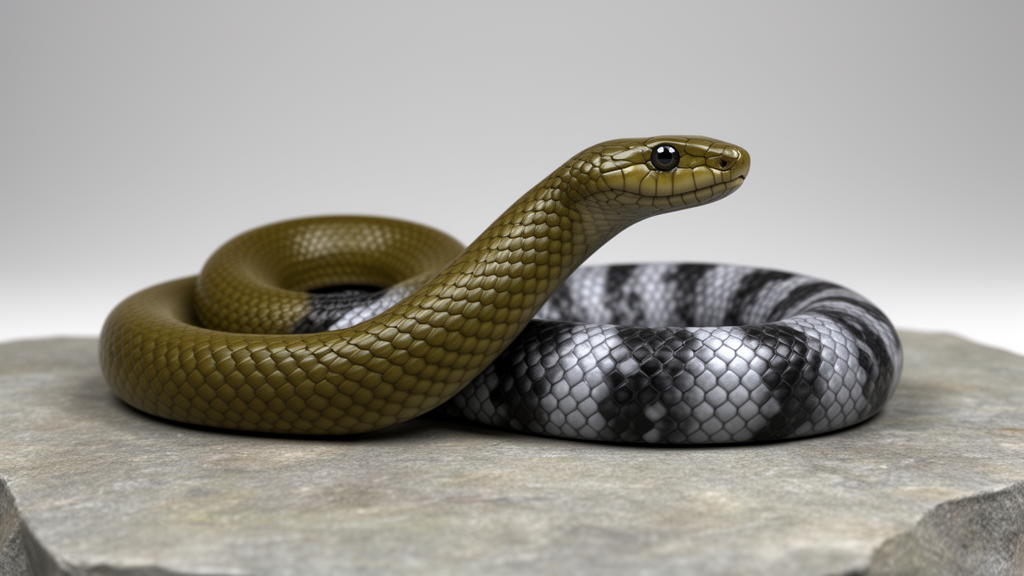
A genetic analysis confirmed that a morphologically intermediate snake from Andalusia, southern Spain, was a first-generation hybrid between Natrix astreptophora and N. maura. The study examined one putative hybrid and reference individuals from the two parental species using mitochondrial and nuclear DNA markers. The results support the hybrid identification and indicate that its mother was N. astreptophora, although the viability and occurrence of backcrosses or later hybrid generations remain unknown.
The genus Natrix comprises five species. Three are semiaquatic: N. astreptophora, N. helvetica and N. natrix, which were long assumed to be conspecific. The other two, N. maura and N. tessellata, are highly aquatic. A dated phylogeny using 430 genome fragments placed N. maura as sister to all other Natrix species, while N. tessellata was sister to a crown clade containing N. natrix, N. astreptophora and N. helvetica.
Genetic hybrids have been reported among most Natrix species, but crosses involving N. maura are rare. Genomic evidence has indicated past gene flow between N. maura and all other Natrix species except N. tessellata. Before the present analysis, only three putative hybrids with the sympatric N. astreptophora had been described on the basis of morphology. These three adults had been captured at separate sites in the Andalusian provinces of Huelva, Málaga and Sevilla and displayed combinations of external traits associated with the two presumed parental species.
Only one of those intermediate snakes had been sampled for genetic investigation. For the present study, the researchers collected scale tissue from that putative hybrid in Huelva, one N. maura from Huelva province and one N. astreptophora from Sevilla province. The snakes were released after sampling at their collection sites. Laboratory analysis targeted two mitochondrial DNA fragments, the cyt b gene and a segment comprising part of the ND4 gene plus adjacent DNA coding for transfer RNAs. Six nuclear loci with species-specific alleles—BDNF, Cmos, MC1R, NT3, PRLR and Rag-1—were also analysed, with nuclear sequences phased before parsimony networks were constructed.
The mitochondrial haplotypes of the two parental species were highly distinct, differing by 140 mutations in cyt b and 53 mutations in the ND4-plus-tRNA segment. The hybrid shared the N. astreptophora ND4-plus-tRNA haplotype, while its cyt b haplotype differed by one mutation step from the N. astreptophora haplotype. Because mitochondrial DNA is inherited maternally, these results identified N. astreptophora as the hybrid’s maternal species.
At all six nuclear loci, the putative hybrid contained alleles associated with both parental species. For BDNF, MC1R and NT3, the parental alleles were separated by three to 10 mutations, and the hybrid carried the same alleles as the respective parental individuals. At Cmos, one hybrid allele matched the N. astreptophora sample, while the second differed by one mutation step from each of the two N. maura alleles. At PRLR, the hybrid shared one allele with N. maura, while its other allele differed by three mutations from the N. astreptophora allele. At Rag-1, one hybrid allele matched N. maura, and the second differed by one mutation from the N. astreptophora allele.
The authors found no evidence of recombination in any of the six nuclear loci, which they described as suggestive of an F1 hybrid. The genetic findings therefore confirmed the sampled individual as a hybrid of N. astreptophora and N. maura. By contrast, the two other morphologically intermediate individuals were not genetically tested in this study. Earlier speculation that they were also F1 hybrids therefore was not assessed directly, and the study provides no genetic confirmation for either animal.
The authors noted that N. astreptophora and Coronella austriaca are among the two rarest snake species in Andalusia, whereas N. maura is very abundant there. They suggested that the scarcity of N. astreptophora may have facilitated mismatched mating because females of that species may have difficulty finding conspecific males. This remains a proposed explanation rather than a mechanism demonstrated by the genetic analysis, and the study did not directly test mate availability or reproductive behaviour.
A recently published fossil-calibrated molecular clock placed the divergence of N. maura from the other Natrix species in the early Miocene, at 21.5 million years ago. The confirmed hybrid shows that genetic exchange between these lineages is possible today, but the study does not establish whether hybridization is continuing broadly, whether backcrosses or later hybrid generations are viable, or how frequently such crosses occur. The authors also cited documented genetic exchange between N. tessellata and N. natrix, which diverged approximately three million years later.
Subject of Research: Genetic confirmation of a Natrix astreptophora × N. maura hybrid in Andalusia, Spain
Article Title: A genetically confirmed hybrid between Natrix astreptophora and N. maura , two deeply divergent and ancient snake species
Article References: Criado-Flórez, A., González de la Vega, J. P., Martínez del Marmol, G., & Fritz, U. (2025). A genetically confirmed hybrid between Natrix astreptophora and N. maura, two deeply divergent and ancient snake species. Herpetozoa, 38, 21-24. https://doi.org/10.3897/herpetozoa.38.e140551
Image Credits: AI Generated
DOI: 10.3897/herpetozoa.38.e140551
Keywords: Natrix astreptophora, Natrix maura, hybridization, mitochondrial DNA, nuclear loci, phylogenetics, Andalusia, snakes, genetic introgression, genetically, confirmed, hybrid
News Source: Juliet Wilcox. (October 21, 2026). Genetic analysis confirms first-generation Natrix astreptophora × N. maura hybrid in southern Spain. Scienmag.