A taxonomic study has described a new species of pricklenape agamid lizard from Menglian County in Pu’er, southwestern Yunnan Province, China, near the border with Myanmar. The species, named Acanthosaura aurantiogularis, was identified from three specimens using morphological comparisons and analysis of three mitochondrial genes.
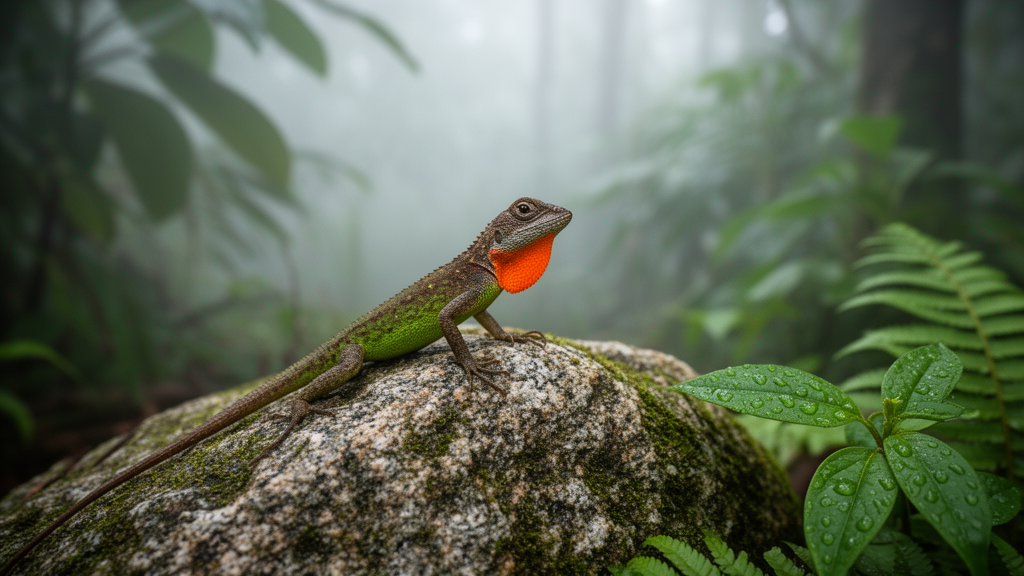
The new species is distinguished most visibly by a large, bright orange gular spot in adult males. Its dorsal surface is green, the oral cavity and tongue are pink-flesh colored, and the black eye patch is disconnected from the dark collar on the neck. The study brings the number of Acanthosaura species recorded in China to seven, according to the authors.
The type series consists of one male holotype and two female paratypes collected during a 2025 herpetological survey. The holotype, KIZ 61664, was collected in Fuyan Township, Yinggou Village, at an elevation of 1,154 m. The paratypes, KIZ 61665 and KIZ 55233, were collected near Mengma Waterfall in Mengma Township at 1,061 m. All three specimens were deposited in the Kunming Natural History Museum of Zoology at the Kunming Institute of Zoology, Chinese Academy of Sciences.
Researchers measured the specimens with digital calipers to the nearest 0.1 mm and recorded scale counts and coloration for comparison with museum specimens, literature descriptions and other Acanthosaura species. The holotype had a snout–vent length of 80.0 mm; the female paratypes measured 116.8 mm and 107.5 mm, with one complete tail measuring 195.0 mm. Liver tissue was collected from each specimen and preserved in 95% ethanol for molecular analysis.
For the genetic analysis, the cytochrome c oxidase subunit 1 (COI), cytochrome b (Cytb) and NADH dehydrogenase subunit 2 (ND2) genes were sequenced, aligned and analyzed using maximum-likelihood and Bayesian methods. Support was assessed with Ultrafast bootstrap, SH-aLRT and Bayesian posterior probability. The three Menglian specimens formed a strongly supported monophyletic group, with support of 100/100/1.00. This group was recovered as the sister lineage to Acanthosaura tongbiguanensis, also with 100/100/1.00 support.
Uncorrected genetic distances among the three new-species specimens were below 1%, compared with 8.2–8.3% in Cytb between the new species and A. tongbiguanensis. Distances from all other sampled congeners exceeded 14% across the three genes. The broader analysis recovered the A. lepidogaster complex as monophyletic with strong support and the A. crucigera complex as monophyletic with moderate support. The new species was placed within the A. crucigera complex, while relationships among the remaining species in that complex were largely unresolved in the sampled data.
Morphologically, the specimens share moderate-length post-orbital and occipital spines, a transverse gular fold and well-developed nuchal and dorsal crests with members of the A. crucigera complex, while coloration and scalation distinguish them from compared congeners. Diagnostic features include five or six enlarged nuchal crests separated from the dorsal crest, 41 enlarged middorsal crest scales, and 23 or 24 lamellae beneath the fourth toe. Compared with A. tongbiguanensis, the new species had fewer fourth-toe lamellae and fewer enlarged middorsal crest scales in Mann–Whitney U tests, both with p < 0.05, as well as a green rather than brown dorsal background and discontinuous eye and collar patterns.
The paratypes were collected at night near a stream about 2 m wide downstream from Mengma Waterfall, where they were observed resting on plant stems approximately 1 m above the ground. The waterfall was a tourist site but remained surrounded by well-preserved evergreen broadleaf forest. The species is currently known only from its type locality in Menglian County. Based on geographic proximity and continuous habitat, the authors expect it may occur across the border in northern Shan State, Myanmar, but this distribution has not been confirmed.
The description was the authors’ first attempt to combine available mitochondrial data for Acanthosaura in a single phylogenetic analysis. Molecular sampling remains incomplete, with A. bintangensis, A. phuketensis and A. titiwangsaensis lacking molecular data in the study, and the small type series prevented broader morphometric analysis. The authors also note that conflict and deforestation near the China–Myanmar border hinder biodiversity surveys, while additional sampling is needed to document the region’s herpetofauna and clarify relationships within the genus.
Subject of Research: Taxonomic description of a new Acanthosaura lizard species from Yunnan Province, China
Article Title: A new species of the genus Acanthosaura Gray, 1831 ( Reptilia , Lacertilia , Agamidae ) from the China-Myanmar border region in southwestern Yunnan Province, China
Article References: Wang, K., Lu, Z.-Y., Zhao, G.-G., Shi, W., Wan, R.-W., Zhu, N., Jin, J.-Q., & Che, J. (2026). A new species of the genus Acanthosaura Gray, 1831 (Reptilia, Lacertilia, Agamidae) from the China-Myanmar border region in southwestern Yunnan Province, China. ZooKeys, 1290, 319-337. https://doi.org/10.3897/zookeys.1290.195408
Image Credits: AI Generated
DOI: 10.3897/zookeys.1290.195408
Keywords: Acanthosaura, new species, taxonomy, pricklenape, Yunnan, China–Myanmar border, mitochondrial phylogeny, morphological analysis, agamid lizards, species, genus, Gray
News Source: Juliet Wilcox. (October 20, 2026). Morphological and mitochondrial evidence identifies a new orange-throated pricklenape lizard from Yunnan. Scienmag.