


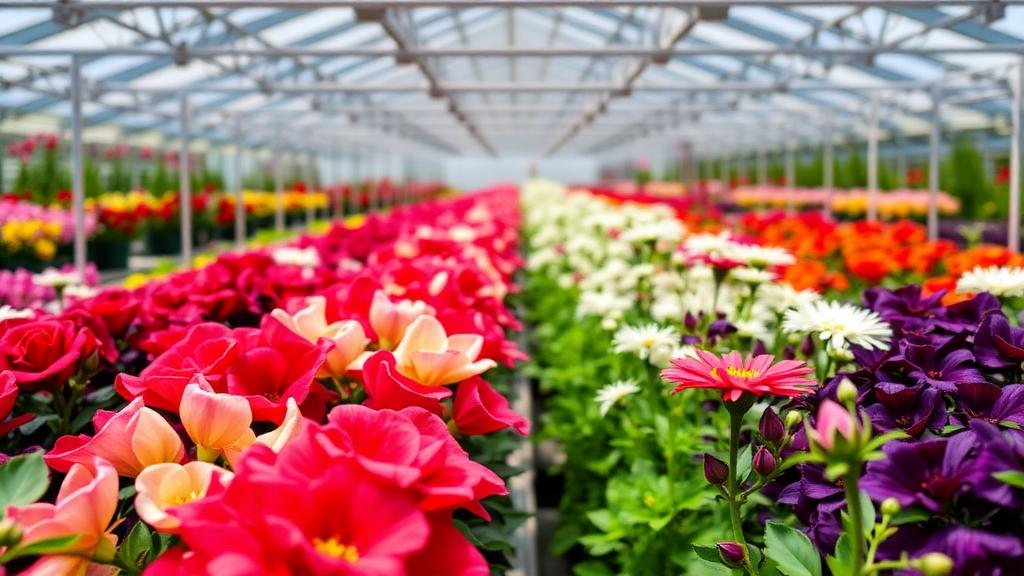
Flowers are big business. The world flower and ornamental plant market was valued at 43.09 billion US dollars in 2023 and is expected to reach 67.56 billion dollars by the end of 2028, growing at a compound annual rate of 9.7 percent. In Taiwan alone, the production value of ornamental plants and flowers reached 8.5 billion New Taiwan dollars in 2022. For growers, none of this revenue materializes unless their crops flower when the market needs them to, which is why a newly published review in the journal Botanical Studies takes a sweeping look at how nature and technology can be balanced to make ornamental plants bloom on schedule, in greater numbers and with better quality.
The review, written by Zhen-Rong Cai, Dewi Sukma and Ming-Tsair Chan, is not a single experiment but a synthesis of research spanning genetics, plant physiology, biotechnology and greenhouse engineering. Its central argument is that no one approach will be sufficient on its own. Traditional breeding, hormone treatments, genome editing and automated climate control each address part of the flowering puzzle, and the authors contend that combining them is the way forward for both quality and sustainability in a changing global economy.
At the heart of the biological story are the genes that decide when a plant switches from vegetative growth to flowering. Key regulators such as Flowering Locus T, known as FT, and CONSTANS, or CO, sit at the center of genetic circuits that respond to external signals including day length, temperature and hormones such as abscisic acid and gibberellins. These genes interact with environmental cues to ensure flowering occurs under favorable conditions. Late-flowering cultivars, by contrast, carry genetic traits that delay the transition, and this diversity is valuable to breeders because it allows the selection of varieties suited to particular climates or market windows. In roses, the continuous-flowering gene RoKSN is already a significant target in breeding programs designed to extend the blooming period.
Hormones offer a more direct physiological lever. Auxins promote cell elongation and differentiation while cytokinins drive cell division, and the two work together to support proper flower formation and maturation. The cytokinin analog BAP, which mimics natural cytokinins, has been shown to enhance flower formation, increase flower yields and improve bloom quality. Exogenous gibberellic acid application can accelerate the transition from vegetative to reproductive growth, leading to earlier flower production. In chrysanthemums, GA treatment can break dormancy and induce early flowering to meet specific market periods, and in roses GA treatments increased flower size and number. Mechanistically, gibberellin facilitates the transition by activating flowering-promoting genes such as LEAFY and interacts with the flowering-time gene SOC1, which integrates environmental signals to control flowering onset.
Environmental management remains just as decisive. Photoperiodism, the plant’s response to the duration of light, determines flowering time across species. Short-day plants such as chrysanthemums require extended periods of darkness to initiate flowering and naturally bloom in fall, a trait growers exploit for year-round production. Long-day plants need shorter nights, so supplemental lighting that extends day length can induce flowering and enable off-season production. Temperature is equally critical: vernalization, a period of prolonged cold, is required for certain plants to flower, and horticulturists apply artificial vernalization techniques, for example with tulip bulbs, to meet market demand and extend the growing season. Mature Phalaenopsis orchids are cultivated at ambient temperatures of 24 degrees Celsius during the day and 18 degrees at night to promote flowering initiation, while unfavorable temperatures can delay flowering or cause floral abnormalities. Water and nutrients matter too. Drought stress can promote flowering in petunias but reduces flower size, and controlled water-deficit strategies are used with poinsettias to promote earlier flowering. Adequate nitrogen and phosphorus are important for flower initiation, phosphorus deficiency can delay flowering and reduce flower number in marigolds, and balanced potassium fertilization in roses enhances flower color intensity and prolongs vase life.
Where the review turns distinctly modern is in its treatment of multi-omics and gene editing. Whole-genome sequencing, transcriptomics, proteomics and metabolomics together allow researchers to identify polymorphisms and markers linked to desired traits, profile proteins and their functions, and trace the metabolic pathways behind flower color, scent and stress responses. High-throughput phenotyping with automated equipment and imaging measures traits such as growth, flower number and stress responses at scale. Candidate genes identified this way can then be validated and manipulated with a growing toolkit: virus-induced gene silencing for transient knockdown, chimeric repressor gene silencing technology, RNA interference, CRISPR-based editing, or overexpression to boost gene function.
The proof-of-concept examples are striking. Researchers created blue carnations and roses by inserting genes for delphinidin pigment biosynthesis. Overexpression of a mutant ethylene receptor gene achieved early flowering in chrysanthemums, as did overexpression of the CmFTL3 gene. In petunia, overexpression of the NFL1 gene, similar to a tobacco LEAFY-like gene, promotes early flowering, and in the orchid Dendrobium Chao Praya Smile, overexpression of the DOAP1 gene induced early flowering, a particularly valuable result because orchids generally take a long time to exit their juvenile phase. A chimeric repressor of GtMYB3 modified blue-flowered gentian into transgenic lines with picotee phenotypes, reduced anthocyanin and increased flavone levels, opening possibilities for novel flower patterns. On the silencing side, the long noncoding RNA lncWD83 in roses enhances ubiquitination of the floral repressor RxMYC2L and thereby accelerates flowering time, and a newer technique called spray-induced gene silencing applies RNA solutions directly onto plant surfaces to trigger RNAi-mediated gene silencing, though the authors note further research is needed to refine silencing of floral repressors.
CRISPR/Cas9 editing occupies a special place in the review because of its precision and its potential to sidestep public concerns about genetically modified organisms. By targeting genes associated with flowering, the technology can adjust flowering time and modify floral structures: knocking out genes that inhibit flowering can lead to earlier blooming, while editing genes that promote flowering can delay it or alter floral characteristics. Silencing the PhTFL1 gene, a TERMINAL FLOWER-type flowering repressor, produced early flowering phenotypes in petunia, while ectopic expression of RoKSN, a TFL1 homolog, suppressed flowering in roses and extended the juvenile phase, which can actually support accelerated breeding. CRISPR can also knock out a gene without leaving any foreign DNA sequence, since self-crossing eliminates the selection marker in subsequent generations. For essential genes that cannot be deleted outright, the authors point to CRISPR inhibition, which uses a catalytically inactive dead Cas9 protein paired with a guide RNA to regulate transcription instead. The review also flags transgene-free frontiers such as base editing and prime editing, a method delivering mobile CRISPR/Cas9 RNA from roots to shoots and flowers without transgene integration, and a miniature CRISPR vector derived from tobacco rattle virus that delivers the compact RNA-guided TnpB enzyme ISYmu1 with its guide RNA.
Technology extends beyond the genome into the greenhouse itself. Smart systems combining sensors and automation precisely modulate lighting, temperature, humidity and nutrient uptake to create optimal conditions for flower initiation, increasing yield and quality. LED grow light systems deliver precise light spectra that can be managed in arrays to induce flowering of greenhouse-grown ornamentals, automated climate control has been used for synchronous flowering in orchids, and hydroponic systems with nutrient feedback allow precise nutrient supply. Looking ahead, the authors highlight artificial intelligence and the Internet of Things as transformative: AI-driven models have the potential to predict optimal planting times and adjust environmental variables in real time, machine learning models analyze historical data to predict the best flowering times, and IoT devices monitor soil moisture and nutrient levels to optimize irrigation and fertilization. Computer models that predict and optimize flower production based on environmental factors are already helping horticulturists determine ideal conditions for specific species.
The review is candid about the obstacles. Changing environmental conditions threaten the synchrony of flower production, as varying temperatures and unpredictable weather can disrupt plant growth and produce outputs that differ from crop to crop. Inherent genetic variability among species impedes the transfer and stabilization of desired traits, and limited funding and personnel restrict the pace of research and technology implementation. The authors call for adaptive strategies: resilient plant varieties, collaborative cross-disciplinary research combining genetics, environmental science and engineering, and greater investment, alongside sustainable practices such as organic techniques, improved water efficiency, reduced chemical inputs and the integration of beneficial microbes and natural repellents. Balancing technological enhancement with ecological considerations, they conclude, is essential to prevent adverse effects on ecosystems while realizing the cultural and economic value of ornamental crops in a changing world economy.
Subject of Research: A review of genetic, hormonal, environmental and technological factors controlling flowering in ornamental plants
Article Title: Balancing nature and technology: enhancing flowering in ornamental plants
Article References: Cai, Z.-R., Sukma, D., & Chan, M.-T. (2025). Balancing nature and technology: enhancing flowering in ornamental plants. Botanical Studies, 66(1), Article 41. https://doi.org/10.1186/s40529-025-00487-7
Image Credits: AI Generated
DOI: 10.1186/s40529-025-00487-7
Keywords: ornamental plants, flowering, FT gene, CONSTANS, gibberellins, CRISPR/Cas9, RNA interference, photoperiodism, vernalization, smart horticulture, AI, IoT
News Source: Juliet Wilcox. (October 29, 2026). Genes, Hormones and Smart Greenhouses: The New Science of Making Ornamental Plants Bloom on Demand. Scienmag.



