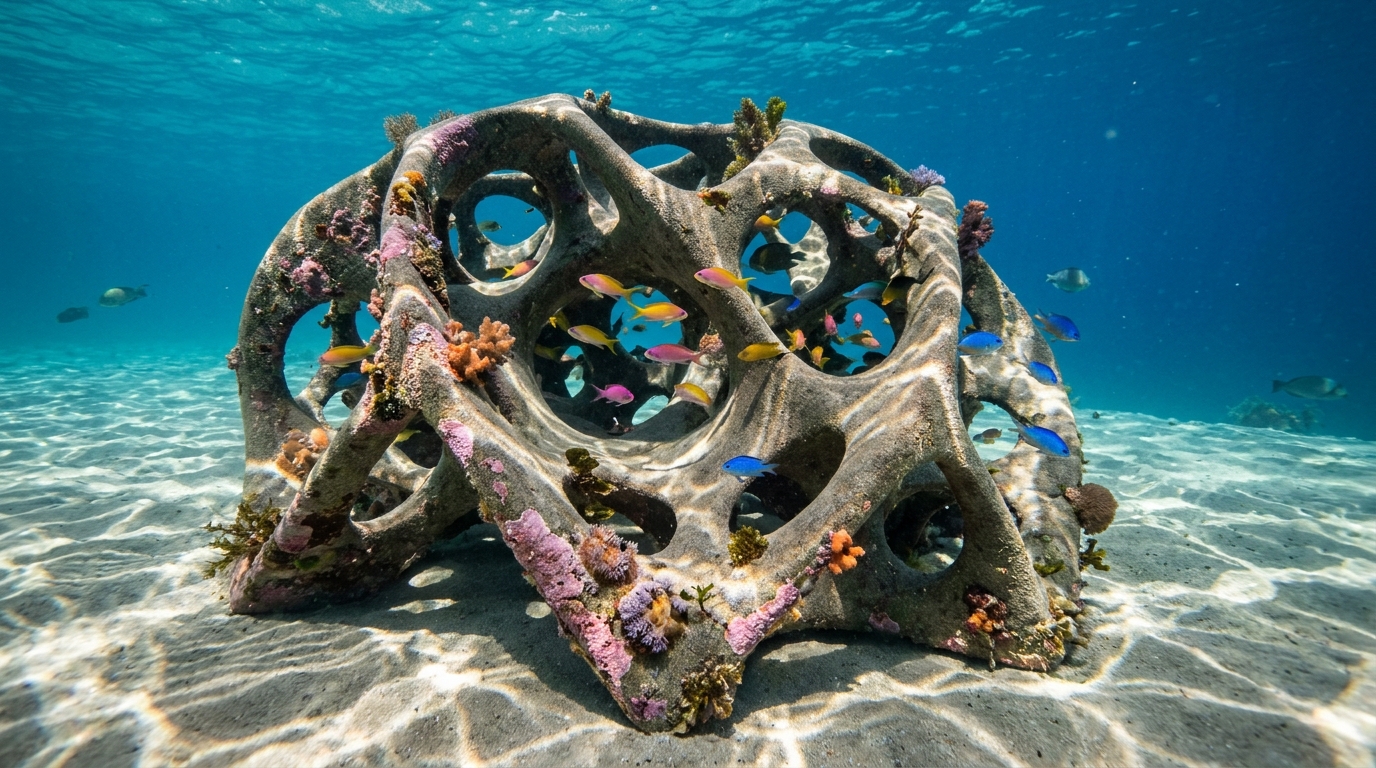
Researchers have developed an advanced generative design framework that couples Computational Fluid Dynamics with Bi-directional Evolutionary Structural Optimization to produce structurally stable artificial reefs featuring complex, biomimetic internal void networks. The study, published in the journal Architectural Intelligence by Ding Wen Bao, Jiacheng Yu, and Dan Luo, tackles longstanding structural and hydrodynamic limitations that have compromised traditional submerged artificial habitats. By establishing an iterative computational loop between fluid dynamics simulations and structural topology optimization, the research team enabled structural morphology to emerge directly from dynamic interactions with local ocean currents rather than conforming to predefined modular templates. This computational strategy systematically redistributes material in direct response to surrounding fluid forces, replacing rectilinear block profiles with fluid, organic forms. The resulting geometries achieve enhanced spatial heterogeneity and improved material efficiency while maintaining robust structural resistance against strong hydrodynamic forces in demanding underwater marine environments.
Since the 1950s, artificial reefs have been widely deployed across coastal zones to rehabilitate marine ecosystems that have suffered extensive biodiversity depletion and habitat loss from prolonged overexploitation, coastal alteration, and environmental pollution. Estuarine carrying capacities have declined primarily due to the loss of natural rocky reefs, seagrass meadows, and mangrove forests, prompting global interest in deploying man-made undersea structures. However, traditional artificial reef designs have historically remained rudimentary, predominantly relying on repetitive assemblies of simple rectilinear concrete blocks. In dynamic marine settings, these conventional structures face frequent operational failures, including displacement by severe currents, structural destruction during ocean storms, sediment burial, material degradation, and poor hydrodynamic behavior. Furthermore, their rigid rectilinear geometry sets them apart from the complex organic morphology of natural reefs, creating uniform, homogeneous interior spaces that fail to provide the diverse void architecture required to shelter varied marine species.
Hydrodynamic processes critically dictate both the long-term physical stability and the ecological restoration efficacy of submerged artificial reefs. As ocean currents encounter reef structures, they generate essential flow-field phenomena, notably upward deflection known as upwelling and turbulent recirculating wake vortices on the lee side. Upwelling forces deep, nutrient-laden waters toward upper layers, enhancing vertical water exchange, nutrient distribution, and primary biological productivity. This vertical circulation is particularly crucial in coastal mariculture zones, such as aquaculture areas off the Shandong Peninsula, where organic waste from uneaten feed and fish feces frequently triggers severe sediment oxygen depletion and seasonal bottom-water hypoxia. Effectively designed reefs mitigate these stagnant conditions by stimulating vertical mixing. Simultaneously, lee-side wake regions generate low-velocity recirculating eddies that offer sheltered microhabitats, shielding fish from strong currents, minimizing energy expenditure, concentrating plankton, and facilitating the settlement of coral larvae and sessile organisms.
To overcome the drawbacks of static reef designs evaluated only after form generation, the authors implemented an iterative coupling loop where Computational Fluid Dynamics directly drives Bi-directional Evolutionary Structural Optimization. In this workflow, fluid dynamic simulations compute the detailed surface pressure distribution acting across the reef body under ambient flow conditions. These local pressures are subsequently converted into nodal structural loads and imported into the topological optimization solver. The Bi-directional Evolutionary Structural Optimization algorithm then analyzes the structural behavior through finite element analysis, systematically removing inefficient material from low-stress zones while adding material to high-stress regions to optimize structural compliance. The revised three-dimensional geometry is re-inserted into the fluid dynamics solver to update the surrounding flow field. This continuous bidirectional cycle repeats until the hydrodynamic drag variation between consecutive iterations falls below two percent, ensuring structural and hydrodynamic convergence.
Numerical flow simulations were conducted within ANSYS Fluent using the finite volume method based on the Reynolds-Averaged Navier-Stokes governing equations and the Renormalization Group k-epsilon turbulence model. This turbulence formulation was specifically selected for its ability to simulate rotational and swirling flows by adjusting turbulent viscosity. To make the three-dimensional turbulent calculations computationally feasible, the authors introduced several foundational physical hypotheses: seawater was treated as an incompressible, viscous, Newtonian fluid under isothermal conditions, neglecting heat exchange effects. The ambient inflow was modeled as a steady-state current with a mean velocity of 0.8 meters per second, while water depth was assumed sufficiently great to disregard wind and wave interference near the seabed. Boundary conditions applied a stationary non-slip condition to the rigid seafloor, a uniform relative pressure at the downstream outlet, and a moving-wall condition with zero shear force along the upper surface.
Topological structural optimization was carried out within the Rhino 3D environment using the Ameba plugin, targeting minimum structural compliance with an evolution ratio of five percent and a three-filter radius. The structural domain was discretized into approximately 2,000 quadrilateral mesh faces, with 6,000 to 10,000 surface points sampled for fluid pressure to define external loads applied at face centers. Fixed boundary constraints were assigned to the lower corner supports, restricting translational movement across all three spatial axes. Material parameters were defined based on marine-grade concrete, with a Young’s modulus of 28.60 gigapascals, a Poisson’s ratio of 0.15, and a material density of 2,300 kilograms per cubic meter. Optimization setups explored target volume ratios of forty, sixty-three, and eighty percent, reflecting natural porosity ranges observed in biological coral and sponge structures to maintain adequate permeability while ensuring structural integrity.
To benchmark performance, the generative designs were evaluated against an optimized conventional pyramidal artificial reef documented in a 2023 study by Xue and colleagues. That benchmark structure had a height of 3 meters, a base side length of 3 meters, and a side slope angle of 85.2 degrees relative to the seabed. Prior hydrodynamic research established that an 85.2-degree slope angle generates the maximum volume of upwelling and back eddies per unit of reef volume among pyramidal designs. Under identical simulation conditions with an inflow velocity of 0.8 meters per second, this benchmark design exhibited a drag coefficient of 1.77, a total hydrodynamic drag force of 7,124.03 newtons, and an overturning moment of 9,797.12 newton-meters. This established baseline provided a rigorous standard to assess whether the proposed generative methodology could enhance ecological spatial quality while maintaining necessary mechanical resistance.
Geometric analysis demonstrated that the generative workflow produced reef forms with substantially greater surface curvature complexity and void diversity than the benchmark. Surface complexity was quantified using Gaussian curvature and mean curvature derived from principal curvatures, verifying smooth transitions between concave and convex structural regions. Furthermore, the authors introduced a quantitative spatial complexity index, defined as the ratio between total internal surface area and convex-hull volume. While the rectilinear benchmark reef recorded a spatial complexity index of 1.6, the three generative experimental outcomes achieved values of 5.2, 4.3, and 3.5, respectively. The higher index values and intricate surface curvatures indicate the formation of richly interconnected internal void networks, spanning narrow protective crevices to expansive semi-sheltered chambers. These diverse void spaces closely mimic natural reef formations, providing essential habitat niches that support species richness and protect marine organisms against predators and currents.
Hydrodynamic evaluation demonstrated that the generative reefs achieved smoother flow interactions and robust physical stability under hydrodynamic loading. Across optimization iterations, surface pressure on the upstream face steadily declined, and eddy viscosity contours revealed smaller back-eddy zones and lower turbulent viscosity compared to the large, high-pressure wake behind the benchmark. Physical deployment stability was verified using anti-slipping and anti-overturning safety factors, calculated from the reef submerged net weight, a seabed static friction coefficient of 0.5, concrete density of 2,000 kilograms per cubic meter, and seawater density of 1,025 kilograms per cubic meter. Although internal porosity slightly increased the drag coefficient over successive iterations, the resulting anti-slipping and anti-overturning safety factors remained well above unity across all reported configurations. These safety margins confirm that the generative geometries effectively balance fluid circulation with the physical resistance needed to prevent sliding or overturning on the seabed.
To confirm physical constructability, the authors fabricated a scaled prototype of their converged design using additive manufacturing. Iteration 3 of Experiment 3 was selected for fabrication, balancing a drag coefficient of 1.78 with high anti-slipping and anti-overturning safety factors of 15.25 and 13.46, alongside well-connected internal void networks. Mesh post-processing ensured watertight geometry, eliminated detached elements, enforced a minimum wall thickness of 25 millimeters, and restricted overhang angles to 60 degrees. The geometry was scaled to a 1:20 prototype and exported for binder-jet 3D printing in a cementitious composite at a 5-millimeter voxel resolution. The authors noted that while the framework successfully optimizes physical stability and fluid dynamics, living biological phenomena such as coral growth and long-term ecological adaptation currently lack closed-form mathematical equations, suggesting that future research should integrate multi-objective evolutionary algorithms to unite structural hydrodynamics with biological processes.
Subject of Research: Generative design and hydrodynamic optimization of artificial reefs
Article Title: Integrating computational fluid dynamics and topological optimization for generative design of artificial reefs
Article References: Bao, D. W., Yu, J., & Luo, D. (2026). Integrating computational fluid dynamics and topological optimization for generative design of artificial reefs. Architectural Intelligence, 5(1), Article 4. https://doi.org/10.1007/s44223-025-00109-z
Image Credits: AI Generated
DOI: 10.1007/s44223-025-00109-z
Keywords: artificial reefs, computational fluid dynamics, topology optimization, marine conservation, structural engineering, additive manufacturing, hydrodynamics, biomimetic design, Integrating, computational, fluid, dynamics
News Source: Denise Maddox. (November 7, 2026). Generative Design Combines Fluid Dynamics and Topology to Reshape Artificial Reefs. Scienmag.