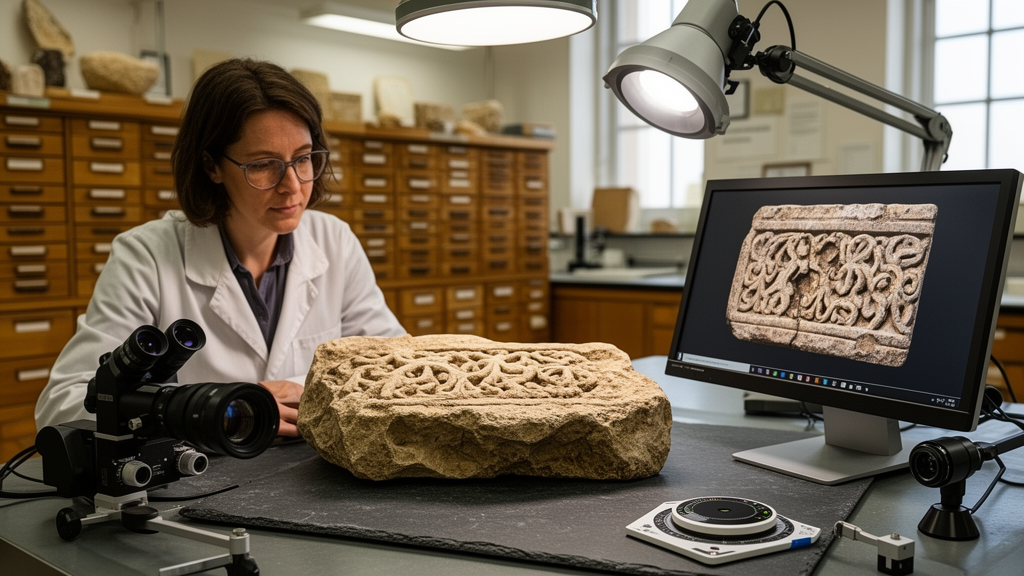
A computer vision framework developed to digitally repair damaged images of ancient cultural relics achieved a peak signal-to-noise ratio ranging from 30.8 decibels to 32.5 decibels and a structural similarity index between 0.942 and 0.956, while processing one hundred images in 72.3 seconds on an NVIDIA A100 graphics processing unit. Reported by researcher Peng Sun in Discover Artificial Intelligence, the study addresses long-standing challenges in cultural heritage conservation where physical artifacts such as bronze vessels, ancient calligraphy, historical paintings, and ceramic wares suffer from natural weathering, environmental erosion, mechanical fracture, and fading. Traditional restoration methodologies applied to two-dimensional digital captures have often struggled to simultaneously reconstruct broad structural losses and fine surface textures without causing blurriness or detail distortion. By integrating multi-level transformer blocks, dual-domain spectral convolutions, and an adversarial super-resolution pipeline, the newly proposed HAT-CNN-FCC-SRGAN architecture demonstrates that high visual fidelity, low perceptual divergence, and manageable computational overhead can be maintained across diverse artifact categories and varying severities of surface degradation.
Physical relics preserved in museum archives and archaeological repositories represent irreplaceable historical evidence, yet environmental exposure and handling over centuries frequently produce severe structural incompleteness, surface scratches, chromatic degradation, and micro-texture loss. While digital inpainting techniques have advanced substantially across mainstream computer vision applications, cultural relic imagery presents unique restoration bottlenecks that generic algorithms fail to navigate successfully. Standard convolutional and transformer architectures encounter three primary operational constraints when applied to historic artifacts. First, conventional single-transformer models exhibit quadratic computational scaling across long pixel sequences and lack multi-scale hierarchical feature grouping, making it difficult to capture long-range structural dependencies and maintain global coherence over large contiguous missing areas. Second, isolated spatial or frequency-domain transformations cannot simultaneously resolve repetitive global patterns and localized irregular details, frequently yielding unnatural boundaries or blurring fine decorative carvings. Third, traditional single-scale residual blocks utilized in resolution enhancement cannot concurrently capture high-frequency microscopic details and broad contextual features, leaving upscaled images with low perceptual sharpness and prominent visual artifacts.
To overcome structural disruption across large damaged regions, the research framework deploys the Hierarchical Atrous Transformer, designated as HAT, as the initial semantic reconstruction foundation. Rather than processing image pixels through an unvarying global attention matrix, HAT partitions incoming damaged images into multi-scale local windows and computes multi-head self-attention by projecting query, key, and value vectors while integrating learnable spatial bias terms. To expand the effective receptive field across broad missing regions without imposing prohibitive sequence lengths, the architecture incorporates atrous pyramid convolutional blocks with dilated sampling rates. This multi-level design allows the network to capture macroscopic compositional geometry, identify missing regions indicated by binary spatial masks, and synthesize coherent global semantic feature maps. By projecting semantic maps that establish geometric relationships between preserved contours and damaged segments, the HAT stage establishes a mathematically aligned structural skeleton that guides subsequent detail synthesis, preventing the spatial drift and anatomical inconsistencies frequently produced by unguided deep inpainting models.
Texture synthesis is conducted through a coordinated two-branch mechanism comprising the Dual Spectrum Transform Convolution module, or DSTC, and a Convolutional Neural Network coupled with Fourier Fully Connected layers, designated as CNN-FCC. The DSTC module processes the global semantic output through parallel frequency-domain pathways, combining a discrete Fourier transform branch that analyzes global periodic features across the entire image field and a discrete wavelet transform branch that extracts spatial frequency components to preserve sharp structural contours and clear edges. Operating in tandem with the DSTC global branch, the CNN-FCC network extracts localized spatial primitives. The input tensor is initially processed through convolutional downsampling layers to reduce spatial redundancy before entering fast Fourier transform blocks, where spatial features are mapped into the frequency spectrum, multiplied element-wise by parameterized frequency-domain convolution kernels, and mapped back to the spatial domain via inverse transforms.
Following dual-track structural and textural inpainting, the intermediate reconstructed image enters an enhanced Super-Resolution Generative Adversarial Network, termed SRGAN, to elevate spatial resolution and restore microscopic surface fidelity. Conventional residual blocks within baseline super-resolution networks rely on uniform convolution operations that often smooth over intricate artistic features. To resolve this limitation, the study introduces an Improved Multi-Scale Residual Block, designated as IMSRB, which incorporates parallel convolutional branches with three-by-three, five-by-five, and seven-by-seven receptive kernels linked through local residual skip connections and parallel bypass routes. Feature representations extracted across these distinct spatial scales are subsequently merged using global average pooling and a channel attention mechanism that adaptively weights individual feature channels according to informational importance. Within the adversarial framework, an eleven-layer convolutional discriminator featuring successive normalization, activation, and dense classification stages evaluates reconstructed outputs against pristine high-resolution references, directing generator optimization through joint L1 pixel loss, VGG-19 perceptual loss, and adversarial objective formulations.
Model training and empirical evaluation were conducted on a dedicated cultural relic dataset comprising 12,847 images collected from the public digital archives of twelve domestic and international museums, five major auction house catalogs, and archaeological journal repositories. The imagery encompassed three primary artifact classifications: bronze ware, ancient calligraphy and paintings, and ceramic artifacts, with all initial resolutions standardized to a minimum of 512 by 512 pixels. To emulate real-world preservation damage, synthetic free-form masks simulating four verified relic disease patterns—surface scratches, local missing sections, global blurring, and chromatic fading—were introduced across 30%, 35%, 20%, and 15% of the data samples, respectively. Mask coverage ranged between 10% and 50% of the total image surface area to represent minor to severe damage grades. The dataset was partitioned into training, validation, and testing subsets according to a 70:15:15 ratio with balanced category distributions, and models were optimized using the Adam algorithm with cosine learning rate annealing over 200 epochs.
Quantitative evaluations demonstrated clear performance advantages for the proposed framework over contemporary benchmark architectures across both separate sub-stages and integrated operations. In intermediate structure-texture inpainting evaluations on 256 by 256 pixel inputs, the HAT-CNN-FCC module attained a peak signal-to-noise ratio of 25.67 decibels and a structural similarity index of 0.921, outperforming baseline models including TLIAM-Net, GAN-T, and dynamic-radius fast marching methods. In super-resolution benchmarks against SRCNN, WGAN, and AMRMA, the modified SRGAN architecture registered pixel improvement rates of 91.2% under two-times magnification and 90.5% under four-times magnification, alongside an area under the receiver operating characteristic curve of 0.935 and rapid loss convergence within twenty training epochs. When evaluated as an integrated end-to-end framework against DCGAN, CMDPSOFS, and VAE-GAN across test collections, the complete model produced peak signal-to-noise ratios of 30.8 decibels on bronze artifacts, 31.3 decibels on calligraphy and paintings, and 32.5 decibels on ceramics, while establishing a lowest Fréchet Inception Distance of 3.21.
As synthetic damage severity expanded from light 10% to 25% masking up to severe 40% to 50% masking, peak signal-to-noise ratios dropped by an average of approximately 6.5 decibels across categories, yet structural similarity remained consistently above 0.92, verifying stability over extensive missing regions. Detailed statistical testing against the top-performing baseline, CMDPSOFS, confirmed statistically significant improvements in mean absolute error at 0.036 plus or minus 0.005, texture restoration completeness at 95.55% plus or minus 0.87%, and learned perceptual image patch similarity at 0.089 plus or minus 0.008. In comparative trials against modern general-purpose inpainting systems, the complete model outperformed LaMa, AOT-GAN, and DiffBIR in reconstruction accuracy, improving peak signal-to-noise ratio by 3.2 decibels, 1.9 decibels, and 1.1 decibels, respectively.
Ablation experiments established the distinct empirical contribution of each structural component within the cumulative processing pipeline. Introducing the atrous pyramid receptive field mechanism within the base transformer improved signal-to-noise ratio by 1.32 decibels and reduced Fréchet Inception Distance by 1.18 points. Adding the DSTC spectral module and CNN-FCC local branch supplied further respective gains of 1.78 decibels and 1.55 decibels, validating the complementary interaction between Fourier-wavelet dual-spectrum transforms and convolutional feature refinement. A parameter-matched control model lacking frequency-domain operations achieved a signal-to-noise ratio of only 23.15 decibels despite matching the parameter count of the full model, demonstrating that structural frequency-spatial co-design rather than mere network widening drove the observed performance enhancement.
Model scalability was confirmed by expanding the training dataset from 12,847 to 24,600 images, which elevated average signal-to-noise ratio to 32.3 decibels, structural similarity to 0.957, and texture completeness to 96.82%, alongside successful generalization tests on public benchmarks including Places2, CelebA HQ, and Paris StreetView. Nevertheless, the study highlights critical operational and methodological constraints. Generative adversarial networks inherently carry risks of generating visually plausible yet historically inaccurate details, particularly across sensitive cultural motifs, inscriptions, and ornamental patterns. Consequently, the authors conclude that deep-learning restoration systems must function strictly as assistive analytical instruments, requiring systematic regional verification by archaeological experts before reconstructed assets are utilized in academic scholarship or museum exhibition.
Subject of Research: Digital image restoration and super-resolution of damaged ancient cultural relics
Article Title: Construction of a digital restoration model for ancient cultural relics based on HAT-CNN-FCC-SRGAN
Article References: Sun, P. (2026). Construction of a digital restoration model for ancient cultural relics based on HAT-CNN-FCC-SRGAN. Discover Artificial Intelligence, 6(1), Article 1896. https://doi.org/10.1007/s44163-026-02702-1
Image Credits: AI Generated
DOI: 10.1007/s44163-026-02702-1
Keywords: ancient cultural relics, digital artifact restoration, computer vision, Generative Adversarial Network, Hierarchical Atrous Transformer, Dual Spectrum Transform Convolution, CNN-FCC, Fast Fourier Transform, Discrete Wavelet Transform, SRGAN, super-resolution reconstruction, Improved Multi-Scale Residual Block, peak signal-to-noise ratio, structural similarity index, Fréchet Inception Distance, learned perceptual image patch similarity, bronze ware restoration, ancient ceramics, cultural heritage preservation
News Source: Elena Sutton. (November 18, 2026). Computer Vision Framework Restores Damaged Ancient Relic Images With High Precision. Scienmag.