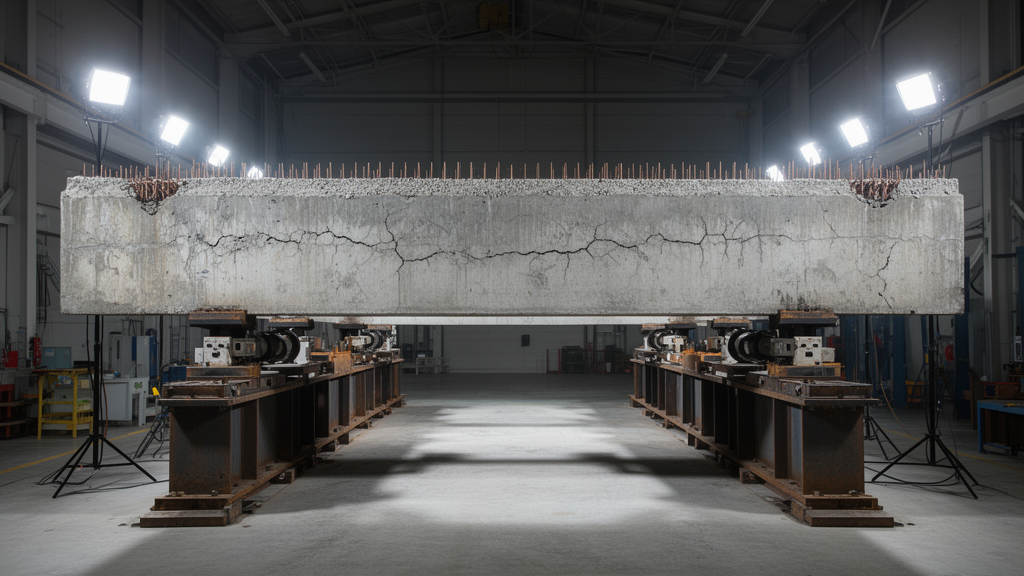
A recent study has provided a detailed investigation into the structural performance and numerical model accuracy of two 30-meter prestressed concrete (PSC) I-girders that were decommissioned after more than 40 years of service. As many infrastructure assets built in the latter half of the twentieth century approach the end of their design life, understanding their current structural capacity is critical for ongoing safety assessments. Researchers investigated two specific girders removed from the Guro Overpass and the Gunseong Bridge in South Korea, which had been in operation for 42 and 44 years, respectively. By combining full-scale four-point bending tests with sophisticated specimen-specific three-dimensional nonlinear finite element analysis, the research team sought to bridge the gap between design-stage material assumptions and the actual performance of aged infrastructure that has been subjected to environmental exposure, traffic loading, and time-dependent effects such as concrete creep, shrinkage, and prestressing steel relaxation.
The experimental program focused on evaluating structural response through a rigorous testing setup. After removing the girders as single members and transporting them to a testing facility, the team conducted detailed material characterization. Concrete cores and steel specimens were extracted from recovered segments to define the constitutive properties necessary for accurate simulation. The full-scale structural testing involved a four-point bending arrangement with supports placed to create a 29-meter support-center spacing, featuring a 6-meter constant-moment region at midspan. The researchers utilized a 5000-kilonewton hydraulic loading system, applying vertical loads in a displacement-controlled manner at a rate of 3 millimeters per minute. Throughout the testing phase, the team monitored vertical deflections, concrete strains at multiple depths in the web and compression zones, and tensile strains in the prestressing wires, while simultaneously mapping crack initiation and propagation until the point of physical test termination due to localized concrete crushing.
A key finding from the material characterization phase was the marked difference in concrete mechanical properties between the two girders, despite their similar service durations and identical design strengths. The mean longitudinal concrete core strength for the Guro Overpass girder was measured at 55.1 megapascals, which was 57 percent higher than the original design value, whereas the Gunseong Bridge girder strength was 33.3 megapascals, roughly 5 percent below its design value. Furthermore, the researchers observed significant scatter in these values, with longitudinal core standard deviations of 7.1 and 7.4 megapascals for the respective girder bodies. This variability emphasizes that relying on design-stage properties for condition assessment of aged structures is often inadequate. The results demonstrate that decades of environmental exposure and specific construction practices can result in widely divergent material conditions, requiring researchers and engineers to rely on site-specific material testing data when performing structural evaluations of decommissioned bridge members.
In the full-scale structural tests, the specimens displayed clear evidence of progressive flexural behavior. The first visible flexural cracks occurred at 400 kilonewtons for the Guro girder and 300 kilonewtons for the Gunseong girder. As loading continued, both specimens exhibited non-linear load-deflection responses, characterized by an initial linear stage followed by stiffness reduction due to cracking and progressive damage. The maximum recorded loads were 1043.9 kilonewtons for the Guro girder and 843.7 kilonewtons for the Gunseong girder, indicating that the Guro girder sustained approximately 24 percent higher loading at failure. The midspan deflections at test termination reached 229 millimeters for the Guro specimen and 270 millimeters for the Gunseong specimen. These findings illustrate the nuanced reality of long-term service performance, where simultaneous variations in geometry, material properties, and tendon profiles contribute to significantly different structural responses.
The differences in behavior were further elucidated through the measured strain responses. At the point of test termination, the top-concrete compressive strains reached approximately 1315 microstrain for the Guro girder and 637 microstrain for the Gunseong girder. Meanwhile, the prestressing wire tensile strains remained relatively similar at 3900 and 3826 microstrain, respectively. The divergence in concrete compression zone response while maintaining similar prestressing steel strain reflects the complex interaction between the section geometry and the varying concrete material properties within the compression region. These measurements highlight the importance of assessing the structure as a whole rather than relying solely on individual component indicators, as the degradation and performance of the concrete compression block can vary significantly even when the tensioning system displays similar behavior under load.
To complement the experimental data, the research team developed three-dimensional finite element models using ABAQUS/Standard software. The modeling strategy employed the Concrete Damaged Plasticity (CDP) formulation to represent concrete cracking, stiffness degradation, and compression damage, while modeling prestressing tendons with truss elements and assuming a perfect bond with the concrete via embedded constraints. Because residual prestress was not directly measurable in the aged members, initial tendon stresses were assigned as specimen-specific analytical conditions calibrated to the early cracking response observed during the experimental tests. The models were configured to capture the specific longitudinal profiles and anchorage locations of each girder. By treating each material region as homogeneous and incorporating the compressive and tensile stress-strain relations derived from the physical core tests, the researchers constructed a high-fidelity numerical counterpart to the physical test specimens.
The finite element models demonstrated a strong ability to reproduce the non-linear load-deflection behavior up to the point of test termination. The simulated response captured the initial linear behavior and the subsequent transition into post-cracking stiffness loss. When comparing the computed loads at the measured termination deflections, the models showed excellent agreement with the experimental data, with computed values exceeding measured ones by 6.5 percent for the Guro girder and 5.7 percent for the Gunseong girder. This indicates that the CDP formulation, when informed by specific material data, effectively simulates the structural behavior of long-term service girders. The computed tensile damage patterns initiation in the bottom flange and propagation into the web matched the observed flexural cracking progression, while the predicted compressive damage concentrated in the top concrete zones where experimental crushing was observed.
Despite the accuracy in capturing the main load-deflection trends, the study noted important limitations in the numerical approach. The models did not explicitly account for demolition-induced geometric discontinuities, such as cuts made during the recovery process, or for localized grout defects and severe material imperfections that influenced the final experimental failure stage. As a result, the numerical response continued to exhibit load-carrying capacity beyond the physical test termination. The researchers clarified that these analyses should be interpreted as tools for reproducing the measured non-linear response within the test range rather than as predictive models for absolute ultimate load capacity. This discrepancy between the physical damage caused by external factors and the idealized numerical representation is a critical factor for engineers to consider when using finite element analysis to assess the capacity of decommissioned infrastructure.
The study concludes that the gathered full-scale data provide a valuable reference for the ongoing refinement of numerical models used in bridge assessment. By pairing comprehensive experimental data with detailed non-linear modeling, the research demonstrates that it is possible to reconstruct the structural behavior of aged prestressed concrete girders with high fidelity, provided that specimen-specific information is used. While the findings cannot be generalized to all aged bridges due to the specific conditions of the two recovered girders, the research emphasizes the necessity of moving beyond simplified design-stage assumptions. Modern structural assessments must increasingly incorporate empirical evidence gathered from the actual structural components, as this approach reveals the complex spatial variability of properties that standard structural models might otherwise overlook.
Ultimately, this investigation illustrates the intricate balance between experimental measurement and analytical simulation in the context of structural health monitoring. The research underscores that even for identical design specifications, the physical history of a bridge girder—shaped by decades of environmental and mechanical loading—results in a unique structural signature. By establishing a robust workflow that integrates physical testing of recovered concrete and steel with advanced non-linear modeling, this study offers a methodological path forward for assessing the safety and residual capacity of the aging bridge stock, ensuring that maintenance and decommissioning decisions are grounded in the actual structural state of the assets.
Subject of Research: Structural engineering assessment of aged prestressed concrete bridge girders.
Article Title: Full-Scale Structural Behavior and Nonlinear Finite Element Model Assessment of PSC Bridge Girders Decommissioned After more than 40 Years of Service
Article References: Kim, H. (2026). Full-Scale Structural Behavior and Nonlinear Finite Element Model Assessment of PSC Bridge Girders Decommissioned After more than 40 Years of Service. International Journal of Concrete Structures and Materials, 20(1), Article 105. https://doi.org/10.1186/s40069-026-00976-4
Image Credits: AI Generated
DOI: 10.1186/s40069-026-00976-4
Keywords: Prestressed Concrete, Structural Engineering, Bridge Maintenance, Finite Element Analysis, Concrete Damaged Plasticity, Full-Scale Testing, Material Aging, Load-Carrying Capacity, Civil Infrastructure, Concrete Creep, Nonlinear Modeling, Infrastructure Degradation, Guro Overpass, Gunseong Bridge, Concrete Fatigue
News Source: Denise Maddox. (November 18, 2026). Aged Concrete Bridge Girders Reveal Complex Structural Behavior in Full-Scale Tests. Scienmag.