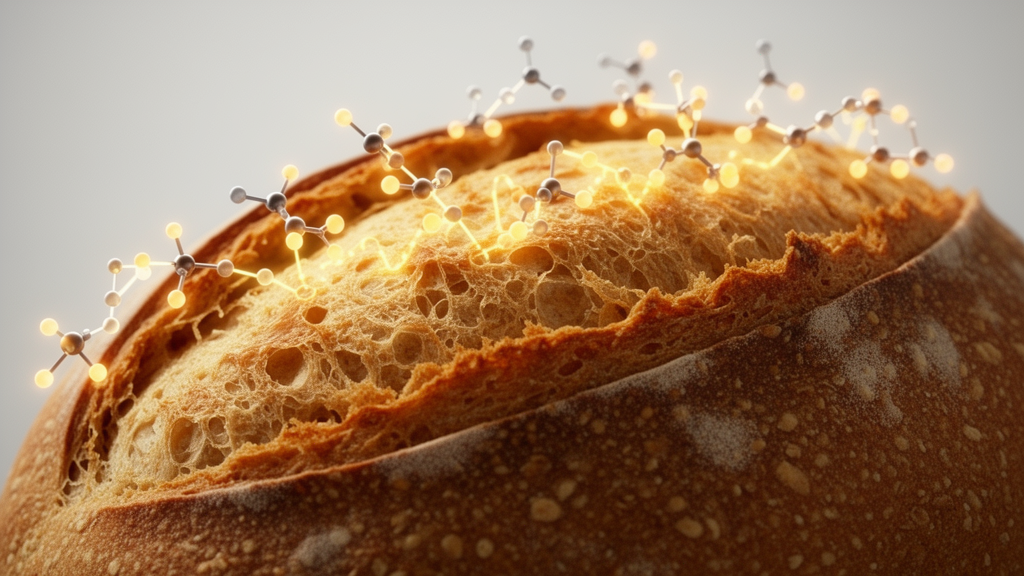
Modulating the composition of reducing sugars in whole-wheat lye bread significantly alters the formation of Maillard reaction products, crust color, texture, and non-volatile flavor metabolites. According to an investigation led by Jian Ma and colleagues published in Food Chemistry: X, pairing glucose with secondary reducing sugars such as xylose, galactose, or fructose redirects thermal degradation cascades during alkaline baking away from the profile produced by glucose alone. Rather than merely accelerating overall browning, different sugar combinations govern distinct reaction pathways. A binary glucose-xylose formulation accelerated thermal conversion toward advanced glycation end-products and intense roasted and burnt sensory notes, while a glucose-galactose formulation fostered heterocyclic aroma compounds such as alkylpyrazines alongside superior sensory harmony. These experimental insights demonstrate that non-volatile flavor profiles and physical properties in alkaline whole-grain bakery systems can be manipulated through targeted sugar formulation without relying on exogenous flavoring agents.
Whole-wheat lye bread has attracted increasing commercial and scientific interest as a functional staple combining the nutritional benefits of whole grains with the distinctive sensory qualities of traditional pretzel baking. The utilization of whole-wheat flour retains dietary fiber, B vitamins, and essential minerals including magnesium, iron, and zinc, while the customary absence of substantial added fats and sugars yields an appealing nutritional profile. Furthermore, the dense cereal matrix and elevated fiber levels can slow starch digestion, attenuating postprandial glycemic responses in consumers. Nevertheless, retaining the bran and germ fractions introduces complex volatile and non-volatile matrix components that frequently produce undesirable bitterness, astringency, and lipid oxidation off-flavors. These bran-associated notes often suppress consumer acceptance compared to conventional pretzel loaves produced from refined flour. Enhancing palatable roasted notes while diminishing bitter notes through controlled internal chemical reactions represents a central formulation hurdle in whole-wheat alkaline baking.
The sensory quality of baked bread is regulated through thermal reactions occurring during baking, primarily caramelization, lipid degradation, and the classic Maillard reaction. Among these pathways, the Maillard cascade serves as the dominant chemical driver of baked, nutty, and roasted sensory profiles. The reaction initiates when the active carbonyl group of a reducing sugar condenses with the unprotonated amino group of an amino acid, peptide, or protein. Aldose sugars yield Amadori rearrangement intermediates, whereas ketoses generate Heyns rearrangement intermediates. Although these early condensation products exhibit limited direct sensory activity, they represent critical branching nodes that dictate subsequent enolization, dehydration, fragmentation, and cyclization steps. These downstream cascades produce volatile aroma compounds such as pyrazines, pyrroles, and Strecker aldehydes, as well as non-volatile taste compounds, melanoidin polymers, and process-induced chemical safety markers such as acrylamide, 5-hydroxymethylfurfural, and carboxymethylated lysines.
To systematically investigate how reducing sugar structures regulate these pathways, researchers prepared experimental loaves using a standardized basic dough formulation consisting of 500 grams of whole-wheat flour, 8 grams of sodium chloride, 10 grams of instant dry yeast, and 300 milliliters of water. Four experimental sugar treatments were tested: a single glucose control containing 10 grams of glucose, and three binary systems containing 5 grams of glucose combined with 5 grams of D-galactose, D-xylose, or D-fructose. Ingredients were mixed at 24 degrees Celsius in a stand mixer to develop the dough, rested for 20 minutes, divided into 40-gram uniform portions, and proofed at 4 degrees Celsius for 30 minutes. The shaped dough pieces were stabilized at minus 18 degrees Celsius for 40 minutes before undergoing a 30-second immersion in a 3.5 percent aqueous sodium hydroxide solution. After draining, baking was executed at 220 degrees Celsius upper and 210 degrees Celsius lower temperatures for 15 minutes, followed by 60 minutes of room-temperature cooling prior to physical testing or flash-freezing in liquid nitrogen for metabolomic profiling.
Sensory profiling conducted with a trained 15-member sensory panel adhering to ISO 8589-2007 guidelines demonstrated that reducing sugar selections significantly modified perceived bread attributes on 9-point structured scales. Loaves formulated with glucose-fructose and glucose-galactose earned the highest intensities for roasted and caramel aromas, followed by glucose-xylose, with the glucose-alone control scoring lowest. However, the intensification of thermal aroma compounds did not always align with overall liking. Glucose-xylose and glucose-fructose treatments generated notably higher scores for burnt notes and persistent bitterness, reflecting excessive formation of late-stage thermal reaction products. In contrast, the glucose-galactose formulation achieved the highest ratings for flavor harmony and superior overall liking. This demonstrated that pairing glucose with galactose optimized flavor compatibility, balancing desirable roasted characteristics against the aggressive bitter attributes frequently associated with whole-wheat matrices.
Quantitative analytical evaluations confirmed that sugar reactivity directly dictated the yields of both early-stage and advanced thermal reaction products. The glucose-xylose formulation yielded the highest concentrations of all monitored process-related compounds, accumulating 135.648 micrograms per kilogram of acrylamide, 23.881 milligrams per kilogram of 5-hydroxymethylfurfural, 107.575 milligrams per kilogram of N-epsilon-carboxyethyllysine, and 123.489 milligrams per kilogram of N-epsilon-carboxymethyllysine. As a five-carbon pentose, xylose displays lower activation energy for initial amino condensation than six-carbon hexoses, accelerating transformation through 3-deoxyglucosone and reactive alpha-dicarbonyl intermediates into advanced glycation end-products. The glucose-fructose bread generated the second highest level of acrylamide at 113.773 micrograms per kilogram, yet produced relatively low amounts of 5-hydroxymethylfurfural. Spectrophotometric determination of model melanoidins at 420 nanometers similarly revealed that glucose-xylose yielded the greatest accumulation of high-molecular-weight brown pigments, directly explaining its intense burnt sensory impressions.
Physical measurements revealed that sugar selection altered both crust chromaticity and crumb mechanical properties. Tristimulus colorimetry showed that the glucose-fructose and glucose-xylose formulations produced significantly higher lightness values and yellowness values compared to the darker glucose-galactose crusts, which exhibited a lightness value of 44.37. Total color difference calculations indicated that fructose and xylose drove crust tonality toward a bright yellow-golden spectrum through distinct dehydration and caramelization pathways. Texture profile analysis demonstrated equally pronounced divergence in physical crumb resilience. The glucose control displayed the greatest crumb hardness at 26.155 newtons, along with maximum gumminess of 14.076 newtons and chewiness of 12.056 newtons. Conversely, the glucose-xylose formulation yielded a significantly softer bread structure with hardness measured at 15.297 newtons, gumminess at 7.664 newtons, and chewiness at 6.732 newtons, while retaining moderate cohesiveness and resilience without experiencing structural collapse.
Instrumental aroma fingerprints measured with a ten-sensor electronic nose system underscored the distinct volatile profiles generated across formulations. Discriminant responses were dominated by metal oxide sensors sensitive to sulfur compounds, nitrogen oxides, and small hydrocarbons. Principal component analysis of standardized sensor responses captured 94.5 percent of the total cumulative variance across the first two dimensions, segregating the formulations into distinct spatial clusters. The glucose-xylose loaves exhibited outstandingly high signal intensities on sensor W1W at 144.54, as well as on sensors W5S and W1S, signaling elevated outputs of reactive, sulfur-associated, and nitrogenous thermal volatiles. By comparison, the glucose-fructose formulation exhibited its highest individual response on sensor W2S at 117.32, which tracks oxygenated volatile organic compounds such as alcohols, aldehydes, ketones, and furan derivatives. Loaves produced with glucose-galactose occupied an intermediate, balanced coordinate space that reflected moderate aroma intensity.
Electronic tongue analysis using lipid-membrane taste sensors revealed corresponding structural shifts in non-volatile gustatory profiles, particularly across sourness, bitterness, astringency, sweetness, and umami dimensions. Loaves formulated with glucose alone produced the most pronounced sourness sensor response at minus 45.112 and the highest bitterness response at 9.111, alongside elevated astringency. In contrast, incorporating binary sugar systems substantially mitigated sourness and lingering aftertaste metrics. The glucose-xylose formulation produced the lowest sourness response at minus 51.953, the lowest astringency value at minus 1.631, and the highest overall sensor responses for sweetness and umami. The enhancement of umami signatures in xylose- and fructose-containing doughs reflects elevated accumulation or extractability of water-soluble amino acids, small peptides, and taste-enhancing Maillard intermediates generated during proofing and high-heat baking.
To comprehensively identify the low-molecular-weight chemical species driving these differences, untargeted metabolomic profiling was conducted using dual-column ultra-high-performance liquid chromatography coupled to high-resolution Orbitrap mass spectrometry. Chromatographic separation employed a hydrophilic interaction amide column for polar metabolites and a reversed-phase C18 column for non-polar constituents. The workflow detected 84,272 distinct metabolic features across sample extracts. Applying rigorous database matching against BiotreeDB annotated 4,919 discrete metabolites distributed across 13 chemical superclasses and 68 classes. Amino acids and related derivatives represented 32.26 percent of all annotated features, while lipid species accounted for 22.87 percent and phenylpropanoids constituted 13.82 percent. K-means clustering grouped differential metabolites into nine distinct behavioral profiles across the sugar formulations, confirming that substituting reducing sugars does not alter the food metabolome uniformly, but instead triggers discrete, system-specific biochemical adjustments.
Pairwise orthogonal partial least squares discriminant analysis coupled with univariate significance filtering prioritized the key chemical markers responsible for formulation divergence. Comparing glucose to glucose-galactose identified 218 significant differential metabolites, revealing an enrichment of roasted-flavor alkylpyrazines, including 2,5-dimethylpyrazine, 2,6-dimethylpyrazine, 2-ethylpyrazine, and 2,3-diethylpyrazine, alongside 2-acetylfuran. The galactose treatment was also characterized by elevated levels of reducing oligosaccharides such as maltotriose and 3-prime-galactosyllactose, as well as precursor dipeptides like leucyl-asparagine. Conversely, the glucose-xylose profile retained significantly lower residual amounts of amino acids, small peptides, and early Amadori products such as fructosamine. This simultaneous depletion of low-molecular-weight nitrogen donors and glucose-derived intermediates in xylose-containing dough indicated rapid precursor utilization and elevated kinetic turnover into late-stage melanoidin polymers and thermal heterocyclic products.
The study authors highlighted several methodological limitations inherent to the experimental scope. Because the untargeted metabolomic investigation was exploratory across high-dimensional feature spaces, false discovery rate correction was omitted during candidate screening to avoid excessive false negatives. Identified features remain putative candidate markers rather than definitively validated biomarkers, as chemical identities were not systematically confirmed against authentic chemical reference standards. Additionally, static endpoint metabolite abundance measurements cannot establish dynamic chemical reaction fluxes or prove direct mechanistic consumption. The authors concluded that future research integrating targeted absolute quantification of Maillard intermediates with comprehensive gas chromatography-mass spectrometry volatile profiling will be necessary to resolve the exact chemical reaction networks operating in functional whole-grain baking.
Subject of Research: Comparative metabolomics and sensory regulation of whole-wheat lye bread by reducing sugar systems
Article Title: Comparative metabolomics reveals the regulatory effects of different reducing sugar systems on non-volatile flavor compounds in whole-wheat lye bread
Article References: Ma, J., Li, T., Cao, R., Zhao, H., Li, X., Lu, J., Zhao, L., & Li, J. (2026). Comparative metabolomics reveals the regulatory effects of different reducing sugar systems on non-volatile flavor compounds in whole-wheat lye bread. Food Chemistry: X, 40, Article 104800. https://doi.org/10.1016/j.fochx.2026.104800
Image Credits: AI Generated
DOI: 10.1016/j.fochx.2026.104800
Keywords: Whole-Wheat Lye Bread, Maillard Reaction, Reducing Sugars, Untargeted Metabolomics, Electronic Nose, Electronic Tongue, Sensory Evaluation, Acrylamide, 5-Hydroxymethylfurfural, Alkylpyrazines, Food Chemistry, Texture Profile Analysis, Advanced Glycation End-Products, Flavoromics, Melanoidins, Xylose, Galactose, Fructose
News Source: Alan Morgan. (November 18, 2026). Reducing Sugar Systems Modulate Flavor and Maillard Pathways in Whole-Wheat Lye Bread. Scienmag.