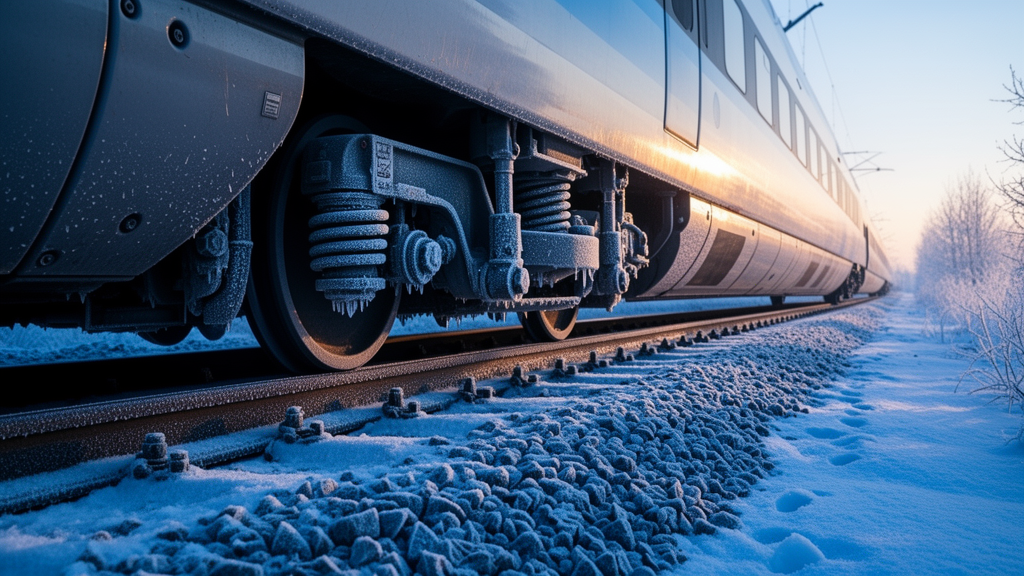
A detailed vehicle-track dynamics simulation has revealed that physical degradation in railway yaw dampers, particularly when compounded by severe sub-zero temperatures, critically undermines the hunting stability and passenger ride comfort of high-speed trains operating at speeds up to four hundred kilometers per hour and beyond. By incorporating a physics-based hydrodynamic parameter model of the yaw damper into a comprehensive multi-body rail vehicle framework, researchers evaluated how internal structural clogging and freezing service conditions jointly alter hydraulic damping forces. The numerical findings demonstrate that while modest single-factor flaws induce localized hunting within specific intermediate velocity windows, the combined presence of valve obstruction and extreme cold produces persistent, high-amplitude lateral vibrations across the entire operational speed range.
High-speed passenger trains rely on longitudinal yaw dampers installed between the bogie frames and the vehicle carbody to suppress lateral and rotational hunting instabilities that arise naturally from wheelset kinematics along steel rails. While emerging semi-active suspension designs utilizing electronically controlled or magnetorheological valves offer adaptive damping capabilities, they remain constrained by hardware complexity, sensor dependency, and transient control lag under small-amplitude, high-frequency excitations. Consequently, passive hydraulic dampers remain the prevailing mass-production solution for high-speed rolling stock. Conventional numerical railway simulations have historically approximated these passive units through simplified equivalent stiffness and damping elements using linear or piecewise parameters extracted from low-frequency bench tests, which fail to capture high-frequency fluid mechanics, thermal viscosity shifts, and progressive orifice clogging over extended operating cycles.
To overcome these predictive limitations, the researchers formulated an intricate physical parameter model that mirrors the complete internal architecture and fluid mechanics of a multi-chamber hydraulic yaw damper. The modeled unit consists of three interconnected fluid domains, comprising a compression chamber, a rebound chamber, and a reservoir chamber partially filled with gas to accommodate dynamic volumetric fluctuations. Unidirectional check valves mounted on the piston and basement regulate directional flow between the compression chamber and the adjacent volumes, while a primary damping valve assembly comprising a constant baseline orifice and three preloaded spring valves governs flow discharge into the reservoir. Governing macroscopic continuity formulations track instantaneous pressure changes and volumetric flow rates across each chamber, incorporating flow coefficients determined by instantaneous orifice geometry and flow regime. Furthermore, the model directly integrates equations of state accounting for oil compressibility, volumetric thermal expansion, entrained air fractions, and temperature-sensitive viscosity variations, ensuring mechanical responses mirror actual fluid behavior under fluctuating operational climates.
The hydrodynamic damper formulation was subsequently embedded into a nineteen-body railway vehicle dynamics model formulated under vehicle-track coupled dynamics theory. The structural representation encompasses a carbody, two independent bogie frames, four wheelsets, eight axle boxes with rotational degrees of freedom, and four traction motors linked to the bogie frames, accounting for full translational and rotational movements across all primary components. Wheel-rail contact geometry was established using measured LMB10N wheel tread profiles matched against standard CN60 rail cross-sections, with normal interaction forces calculated through Hertzian contact mechanics and tangential creep forces resolved using Kalker FASTSIM algorithm. Secondary lateral dampers and primary vertical suspension units were modeled through Maxwell viscoelastic formulations with piecewise nonlinear damping properties, while bump-stops were described using three-dimensional Kelvin-Voigt representations. Chinese high-speed railway track irregularity spectra served as spatial excitation inputs to reproduce representative track geometry deviations.
Rigorous verification of the integrated dynamics framework was conducted across two distinct validation tiers encompassing both isolated component testing and full-scale field measurements. Component-level calibration was achieved using an electro-hydraulic servo actuator test bench that applied controlled sinusoidal excitations across nominal damper installation lengths and mounting angles, incorporating series silent block end bushings possessing an equivalent joint stiffness of thirty-five thousand kilonewtons per meter. Simulated force-velocity curves, force-displacement loops, and dynamic stiffness and damping metrics demonstrated close agreement with experimental bench recordings across pre-unloading and post-unloading velocities of 0.01 and 0.1 meters per second, successfully reproducing asymmetric hysteresis loops. For system-level validation, numerical carbody lateral acceleration outputs were compared against field measurement data gathered from high-speed trains operating at three hundred kilometers per hour along the Harbin-Dalian Railway line in China. Frequency and time-domain acceleration comparisons under both healthy and degraded damper configurations demonstrated that calculated vehicle responses reliably mirrored physical line measurements within acceptable engineering tolerances.
Evaluating isolated damper performance under variable service states revealed that structural orifice constriction and ambient thermal reduction both substantially elevate internal resistance and dynamic stiffness. Structural degradation was simulated by reducing the nominal damping valve diameter from its original value down to 0.55 times the design diameter, while thermal states were evaluated between thirty degrees Celsius and negative thirty degrees Celsius. At a standard excitation amplitude of 2.0 millimeters and a frequency of 1.0 hertz, the peak damper force expanded from 8.44 kilonewtons under nominal conditions to 12.93 kilonewtons with a constricted valve, and to 13.37 kilonewtons when cooled to negative twenty degrees Celsius. When both degradation mechanisms were combined, the peak force escalated to 15.31 kilonewtons. Under smaller harmonic strokes of 1.0 millimeter, where high-speed trains predominantly operate, this stiffening effect was even more pronounced, exhibiting a 120.92 percent force increase under combined degradation compared to a 40.61 percent increase at larger amplitudes, because reduced fluid mobility and narrowed orifices generate extreme pressure differentials across the throttling stages.
When the degraded damper models were subjected to full vehicle simulations at four hundred kilometers per hour along tangent track with an initial lateral disturbance, the resulting dynamic mismatches destabilized the running gear. Under nominal suspension states, lateral carbody motions decayed smoothly toward stable equilibrium positions without sustained oscillations. However, reducing the ambient temperature to negative twenty degrees Celsius or constricting the damping valve diameter to 0.55 times nominal triggered carbody hunting motion, forcing lateral displacements into stable limit cycles with oscillation amplitudes of 8.14 millimeters and 8.89 millimeters, respectively. Under the compounded condition combining negative twenty degrees Celsius temperatures with constricted valve geometry, the carbody settled into an aggressive hunting state exhibiting lateral oscillation amplitudes reaching 15.83 millimeters.
Bifurcation analyses across varying forward velocities clarified the underlying non-linear mechanics governing this hunting onset. Under nominal operating conditions, the train maintained complete lateral stability up to five hundred and fifty kilometers per hour, with wheelset displacements converging smoothly to zero. Under isolated valve constriction or sub-zero cooling, the vehicle exhibited grazing bifurcation behavior, where lateral wheelset oscillations established stable limit cycles exceeding ten millimeters between approximately 102 and 442 kilometers per hour, forcing flange contact before regaining stability at speeds exceeding 470 kilometers per hour. In contrast, under the compounded extreme condition combining low temperature with valve clogging, the system underwent a subcritical bifurcation. In this severe state, wheelset displacement limit cycles failed to converge toward equilibrium at any simulated speed, maintaining persistent lateral oscillations even at low operating velocities and eliminating the upper stable running window observed during single-variable degradation.
Passenger comfort and ride quality metrics displayed severe deterioration that mirrored the severity of damper impairment during four hundred kilometer per hour runs over irregular track. Vehicle performance was quantified using the lateral Sperling index derived according to national standard GB/T 5599 alongside low-frequency root-mean-square lateral acceleration filtered between 0.5 and 2.0 hertz. Under pristine damper conditions, the lateral Sperling index remained at an optimal 2.04 with an acceleration value of 0.05 meters per second squared. However, when temperatures dropped to negative thirty degrees Celsius or when all four damper positions experienced valve constriction, the Sperling index surged to 3.55 and 3.60, breaching the qualified comfort limit of 3.0, while low-frequency accelerations reached 0.62 and 0.49 meters per second squared. Under extreme combined exposure, the Sperling index climbed to 4.07, representing severe passenger discomfort.
Operational safety assessments revealed that while dynamic degradation increases running risk, mechanical margins against catastrophic derailment remain within regulatory thresholds under standard wheel-rail geometry. At four hundred kilometers per hour on nominal track, the baseline derailment coefficient stood at 0.08 and the wheel unloading rate registered 0.24. As damper degradation expanded across more suspension positions and temperatures plummeted, these safety indices rose steadily. Under the most severe scenario involving negative thirty degrees Celsius weather alongside four constricted damping valves, the derailment coefficient increased substantially to 0.66. While this value represents an eightfold surge relative to nominal baseline conditions, it remained below the permissible regulatory safety threshold of 0.80.
Crucially, the research revealed an unexpected compensating mechanism arising from progressive wheel wear over accumulated service distances up to 170,000 kilometers. Field measurements indicated that operational wear concentrates across a forty-millimeter band around the nominal wheel rolling circle, forming a concave groove reaching depths of 0.45 millimeters at 90,000 kilometers and 0.72 millimeters at 170,000 kilometers. This profile alteration widened contact point scattering and steadily elevated equivalent contact conicity from a baseline of 0.12 up to 0.18, 0.20, and 0.26 across consecutive inspection intervals. This heightened conicity expanded the hunting stability margin, significantly mitigating lateral vibrations caused by slightly deteriorated yaw dampers. Under moderate damper degradation, the lateral Sperling index dropped from 3.67 on new wheels down to 2.46 on wheels worn to 170,000 kilometers, while derailment coefficients fell from 0.56 to 0.06. However, under the most extreme combined damper failures, severe ride comfort violations persisted regardless of wheel mileage, underscoring the indispensable necessity of targeted seasonal maintenance and timely damper overhauls for ultra-high-speed operations.
Subject of Research: Dynamic performance evolution and hunting stability of high-speed trains under degraded yaw damper conditions
Article Title: Dynamic performance evolution of high-speed trains considering different service states of yaw damper
Article References: Jiang, C., Ling, L., Ding, X., Li, H., & Zhai, W. (2026). Dynamic performance evolution of high-speed trains considering different service states of yaw damper. Results in Engineering, 32, Article 113889. https://doi.org/10.1016/j.rineng.2026.113889
Image Credits: AI Generated
DOI: 10.1016/j.rineng.2026.113889
Keywords: yaw dampers, high-speed trains, hunting stability, vehicle dynamics, damping valve clogging, low-temperature dynamics, Sperling index, derailment coefficient, wheel tread wear, equivalent conicity, bifurcation analysis, multibody simulation, limit cycle oscillations, wheel-rail contact, suspension engineering, railway safety, CR450 EMU
News Source: Denise Maddox. (November 18, 2026). Coupled Damper Degradation and Low Temperatures Trigger High-Speed Train Instability. Scienmag.