• HOME
  • NEWS
  • EXPLORE
    • CAREER
      • Companies
      • Jobs
    • EVENTS
    • iGEM
      • News
      • Team
    • PHOTOS
    • VIDEO
    • WIKI
  • BLOG
  • COMMUNITY
    • FACEBOOK
    • INSTAGRAM
    • TWITTER
Friday, May 15, 2026
BIOENGINEER.ORG
No Result
View All Result
  • Login
  • HOME
  • NEWS
  • EXPLORE
    • CAREER
      • Companies
      • Jobs
        • Lecturer
        • PhD Studentship
        • Postdoc
        • Research Assistant
    • EVENTS
    • iGEM
      • News
      • Team
    • PHOTOS
    • VIDEO
    • WIKI
  • BLOG
  • COMMUNITY
    • FACEBOOK
    • INSTAGRAM
    • TWITTER
  • HOME
  • NEWS
  • EXPLORE
    • CAREER
      • Companies
      • Jobs
        • Lecturer
        • PhD Studentship
        • Postdoc
        • Research Assistant
    • EVENTS
    • iGEM
      • News
      • Team
    • PHOTOS
    • VIDEO
    • WIKI
  • BLOG
  • COMMUNITY
    • FACEBOOK
    • INSTAGRAM
    • TWITTER
No Result
View All Result
Bioengineer.org
No Result
View All Result
Home NEWS Science News Chemistry

General descriptor sparks advancements in dye chemistry

Bioengineer by Bioengineer
May 14, 2020
in Chemistry
Reading Time: 2 mins read
0
IMAGE
Share on FacebookShare on TwitterShare on LinkedinShare on RedditShare on Telegram

SUTD collaborates with international researchers to move away from inefficient trial-and-error developments in dye chemistry and quantitatively design luminescent materials
IMAGE

Credit: SUTD

There is an ongoing demand in biological research to accelerate the development of fluorescent probes based on the photo-induced electron transfer (PET) mechanism. By modulating PET formations, these probes significantly change fluorescence intensities, allowing a convenient route to monitor analytes or environmental changes with high sensitivity, vivid visibility and excellent spatiotemporal resolution.

However, the quantitative design of fluorescence probes based on the PET mechanism continues to be a challenging task as dye chemistry is still largely based on trial-and-error.

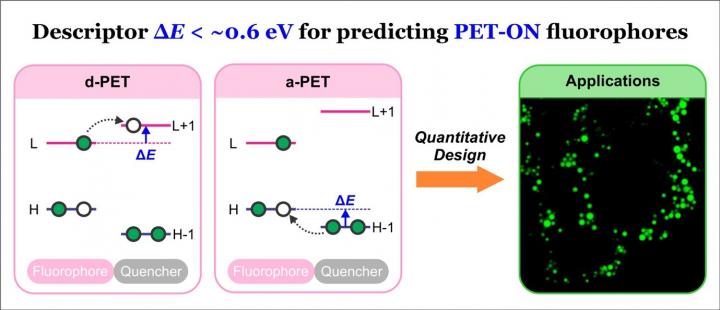
To address this challenge, an international team of researchers from the Singapore University of Technology and Design (SUTD), Dalian Institute of Chemical Physics in China (DICP), and Pohang University of Science and Technology (POSTECH) in South Korea have developed a theoretical descriptor, ΔE, to quantitatively design PET fluorescence probes (refer to image). Their research paper was published in ACS publications.

The team established the ΔE descriptor by performing quantum chemical calculations on around 140 existing PET probes and analysing the correlations between their electronic structures and their quantum yields, or otherwise known as the efficiency of generating fluorescence.

The researchers also demonstrated that the descriptor was applicable to several families of fluorophores such as BODIPY, fluorescein, and rhodamine derivatives. Based on the descriptor, they accurately predicted and successfully developed wash-free fluorescent stains of lipid droplets and mitochondria for live cell bioimaging.

They were also able to quantitatively design fluorophores with the aggregation induced emission properties. The establishment of this theoretical descriptor enables chemists and biologists to quantitatively search and design new PET-based fluorescence probes.

“Our research goal is to transform the dye chemistry from trial-and-error to molecular engineering, with the state-of-art research tools such as chemical big data and quantum chemical calculations. As we continue to closely work with dye chemists to achieve this goal, we will also be developing high-performance fluorescent materials along the way,” said Assistant Professor Liu Xiaogang from SUTD.

###

Media Contact
Jessica Sasayiah
[email protected]

Related Journal Article

http://dx.doi.org/10.1021/jacs.0c01473

Tags: BiochemistryBiomedical/Environmental/Chemical EngineeringChemistry/Physics/Materials SciencesMaterialsMolecular PhysicsResearch/DevelopmentTechnology/Engineering/Computer Science
Share12Tweet8Share2ShareShareShare2

Related Posts

Scientists Overcome Longstanding Challenge in Measuring Semiconductor Defects — Chemistry

Scientists Overcome Longstanding Challenge in Measuring Semiconductor Defects

May 14, 2026
Wall Design Highlights Deaf and Hard-of-Hearing Experience at #ASA190 — Chemistry

Wall Design Highlights Deaf and Hard-of-Hearing Experience at #ASA190

May 14, 2026

New Method Finds More Efficient Route Between Earth and Moon Than Ever Before

May 14, 2026

Unveiling the Unseen: Exploring the Boundaries of Two-Photon Vision

May 14, 2026
Please login to join discussion

POPULAR NEWS

  • Research Indicates Potential Connection Between Prenatal Medication Exposure and Elevated Autism Risk

    843 shares
    Share 337 Tweet 211
  • New Study Reveals Plants Can Detect the Sound of Rain

    729 shares
    Share 291 Tweet 182
  • Salmonella Haem Blocks Macrophages, Boosts Infection

    62 shares
    Share 25 Tweet 16
  • Breastmilk Balances E. coli and Beneficial Bacteria in Infant Gut Microbiomes

    58 shares
    Share 23 Tweet 15

About

We bring you the latest biotechnology news from best research centers and universities around the world. Check our website.

Follow us

Recent News

Unseen Hazards: How AI Agents’ Routine Tasks Can Spiral into Digital Disasters

Could Sea Squirts’ Nano-Packaging Unlock a New Era in Sea Forest Restoration?

Comprehensive Study Finds No Clear Association Between Common Antidepressant Use During Pregnancy and Autism or ADHD in Children

Subscribe to Blog via Email

Enter your email address to subscribe to this blog and receive notifications of new posts by email.

Join 82 other subscribers
  • Contact Us

Bioengineer.org © Copyright 2023 All Rights Reserved.

Welcome Back!

Login to your account below

Forgotten Password?

Retrieve your password

Please enter your username or email address to reset your password.

Log In
No Result
View All Result
  • Homepages
    • Home Page 1
    • Home Page 2
  • News
  • National
  • Business
  • Health
  • Lifestyle
  • Science

Bioengineer.org © Copyright 2023 All Rights Reserved.