• HOME
  • NEWS
  • EXPLORE
    • CAREER
      • Companies
      • Jobs
    • EVENTS
    • iGEM
      • News
      • Team
    • PHOTOS
    • VIDEO
    • WIKI
  • BLOG
  • COMMUNITY
    • FACEBOOK
    • INSTAGRAM
    • TWITTER
Friday, July 3, 2026
BIOENGINEER.ORG
No Result
View All Result
  • Login
  • HOME
  • NEWS
  • EXPLORE
    • CAREER
      • Companies
      • Jobs
        • Lecturer
        • PhD Studentship
        • Postdoc
        • Research Assistant
    • EVENTS
    • iGEM
      • News
      • Team
    • PHOTOS
    • VIDEO
    • WIKI
  • BLOG
  • COMMUNITY
    • FACEBOOK
    • INSTAGRAM
    • TWITTER
  • HOME
  • NEWS
  • EXPLORE
    • CAREER
      • Companies
      • Jobs
        • Lecturer
        • PhD Studentship
        • Postdoc
        • Research Assistant
    • EVENTS
    • iGEM
      • News
      • Team
    • PHOTOS
    • VIDEO
    • WIKI
  • BLOG
  • COMMUNITY
    • FACEBOOK
    • INSTAGRAM
    • TWITTER
No Result
View All Result
Bioengineer.org
No Result
View All Result
Home NEWS Science News Biology

Gel to fight rheumatoid arthritis

Bioengineer by Bioengineer
October 11, 2017
in Biology
Reading Time: 2 mins read
0
Share on FacebookShare on TwitterShare on LinkedinShare on RedditShare on Telegram
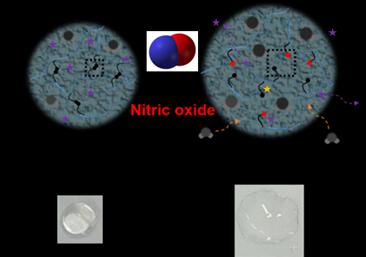
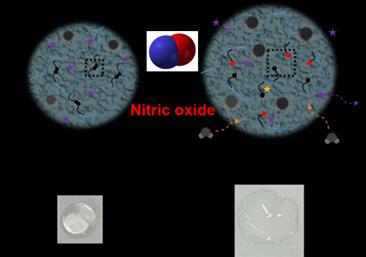
IMAGE

Credit: Park J. et al, Advanced Materials (2017)

IBS scientists at the Center for Self-Assembly and Complexity, within the Institute for Basic Science (IBS), invented a hydrogel to fight rheumatoid arthritis and other diseases. Published in Advanced Materials, this jelly-like material could be used to absorb extra fluids in swelling joints and release drugs.

Rheumatoid arthritis (RA) is a long-term disease that causes inflammation and deformity of the joints, and affects about 1% of the world population. In this autoimmune condition, the body's immune system attacks the soft tissue of the joints, leading to an accumulation of synovial fluid. While this clear fluid lubricates and nourishes the joints, its excess causes swelling and pain.

Immune cells at the inflamed joints are the predominant source of nitric oxide (NO), a gas with various physiological functions. "Nitric oxide is like a double-edge sword. It regulates inflammation and protects our body by killing external pathogens. However, when in excess, it is toxic and may cause RA, as well as other autoimmune diseases, cardiovascular diseases, and cancer," explains the group leader, KIM Won Jong. Current RA treatments are based on anti-inflammatory drugs that relieve pain and inflammation, but IBS scientists tried a more challenging approach by targeting NO itself. NO is a transient gas, which stays in circulation for less than 10 seconds, before binding to other molecules.

The research team developed a gel responsive to such fugitive molecules, using acrylamide as a base material and a new crosslinker to keep it in place. Unlike the monomeric form, polymeric acrylamide hydrogel has little toxicity and can contain a large amount of water. In addition, the cross-linking agent (NOCCL) forms bridges between the acrylamide molecules creating a net, which can trap drug molecules inside. When NO cleaves the NOCCL bridges, the gel changes its structure, frees the drug and absorbs new liquid.

Although this is a preliminary study, the team confirmed that NOCCL crosslinking agent can selectively and sensitively react with NO. The scientists are now working on a nano-sized hydrogel in a RA mouse model. Moreover, these type of hydrogels could be useful for other diseases characterized by overexpression of NO, or maybe even as environmental sensors, since NO is also a polluting gas emitted in vehicle exhaust.

###

Media Contact

Jung Gyu Kim
[email protected]
@IBS_media

http://www.ibs.re.kr/en/

Share12Tweet8Share2ShareShareShare2

Related Posts

Evolution-Inspired Biosensors Revolutionize Lipid Tracking in Real Time — Biology

Evolution-Inspired Biosensors Revolutionize Lipid Tracking in Real Time

July 2, 2026
New Study Reveals How to Reduce Risk of Dangerous Wildlife Encounters This Summer — Biology

New Study Reveals How to Reduce Risk of Dangerous Wildlife Encounters This Summer

July 2, 2026

Hepatic IFRD1 Alleviates Metabolic Dysfunction-Linked Steatohepatitis Through the GLUD1/α-KG Pathway

July 2, 2026

Intricate Food Webs Support Ecosystem Health and Stability

July 2, 2026
Please login to join discussion

POPULAR NEWS

  • Detection of EDCs in Breast Milk and Infant Urine Up to Six Months Highlights Early Exposure Risks

    77 shares
    Share 31 Tweet 19
  • Saying Goodbye to PGY-6: Pediatric Fellowship Realities

    103 shares
    Share 41 Tweet 26
  • New Drug Candidate Developed at McMaster Shows Potential for Treating Brain Cancer

    58 shares
    Share 23 Tweet 15
  • KTU Researchers Explore Ultrasound’s Role in Enhancing Blood Flow Beyond Diagnostics

    53 shares
    Share 21 Tweet 13

About

BIOENGINEER.ORG

We bring you the latest biotechnology news from best research centers and universities around the world. Check our website.

Follow us

Recent News

Steatosis Drives Liver Metastasis Diversity in CRC

Unlocking the Mysteries of Alzheimer’s Disease

Pensoft Introduces New Peer-Reviewed Journal of Regeneration to Advance Restorative Biology Across Species

Subscribe to Blog via Email

Enter your email address to subscribe to this blog and receive notifications of new posts by email.

Join 83 other subscribers
  • Contact Us

Bioengineer.org © Copyright 2023 All Rights Reserved.

Welcome Back!

Login to your account below

Forgotten Password?

Retrieve your password

Please enter your username or email address to reset your password.

Log In
No Result
View All Result
  • Homepages
    • Home Page 1
    • Home Page 2
  • News
  • National
  • Business
  • Health
  • Lifestyle
  • Science

Bioengineer.org © Copyright 2023 All Rights Reserved.