Credit: Jerome Waldispuhl
You may not think of yourself in this way – but in some ways your body is just a host for hundreds of trillions of microbes (including bacteria) that colonize us in fairly unique combinations in our guts, inside our various orifices and on the surface of our skin. These tiny creatures are essential to our survival – we couldn't digest anything without them, for instance.
Scientists are increasingly making links between the range of colonies of microorganisms that live on and within us, our lifestyle habits, and our health. Some suggest that diseases as varied as obesity, inflammatory bowel syndrome and autism may be linked to the microbes that we harbour. However, further research is needed to understand how our habits may encourage certain bacteria to either proliferate or decrease in number and how this may in turn affect our health.
A glut of gut information
Since 2012, when the American Gut project was first launched, close to 10,000 people from the USA, UK, Canada and Australia have sent in stool samples and information about their habits and health. But, given the sheer numbers and varieties of the kinds of microbes found in our bodies, (each of us acts as a home to hundreds of different kinds), it is proving difficult to determine which of them may be affected by particular aspects of our lifestyle (what we eat, what we drink, where we were born and live, etc.) and how, in turn, this may affect our health. That's where playing a new game, Colony B, comes in.
Jerôme Waldispühl, who teaches computer science at McGill University and led the group that created the game Colony B, describes how the game can help scientists better understand how particular microbes may be linked to our habits and ultimately our health:
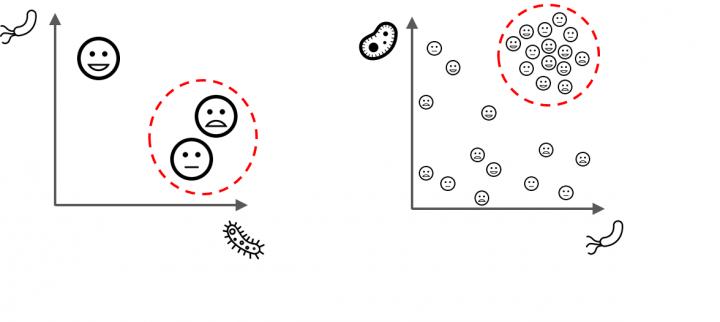
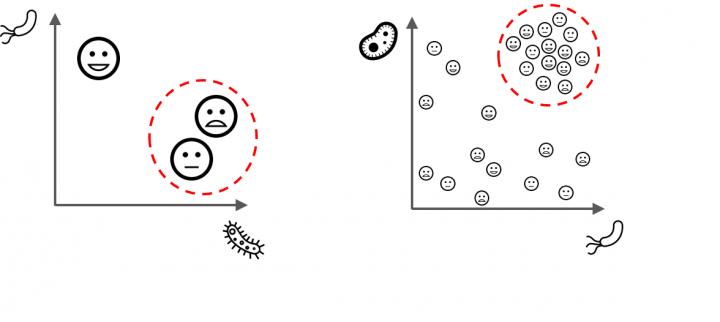
"Let's say that, thanks to the stool samples and information gathered by the American Gut project, we know the amount of microbes of type A and B found in several individuals. Some of these individuals may be healthier than others. If you plot this data on a graph, you might notice that sick participants have more of certain kinds of microbes and less of others than healthy participants. This suggests a possible relationship (either cause or consequence) between the composition of the microbial flora and health. But it remains difficult to determine which of these microbes (types A, B or some combination of the two) are important to human health – and that's where the game comes into play."
SEE GRAPHS BELOW
"In our game, players build colonies of certain types of bacteria by circling groups of dots. These dots represent people with similar bacterial profiles. Unlike computers, humans can do this intuitively and can quickly recognize when an image contains a cluster of dots. The computer can then, in turn, correlate this information with the survey data that has been gathered about the participants' lifestyles and health. As people play, they are, in effect, helping scientists identify which microbes may be related to various aspects of human health in ways that couldn't be done otherwise. We hope that they will have fun doing it."
###
To play Colony B: http://www.colonyb.com
For more information about the game: [email protected]
To learn more about how our microbes are related to our health, listen to a TED talk by Rob Knight, one of the co-founders of the American Gut Project – https://www.ted.com/talks/rob_knight_how_our_microbes_make_us_who_we_are?language=en
The research was funded by Genome Canada, Canadian Institutes of Health Research (CIHR), and Genome Quebec
Media Contact
Katherine Gombay
[email protected]
@McGillU
http://www.mcgill.ca