


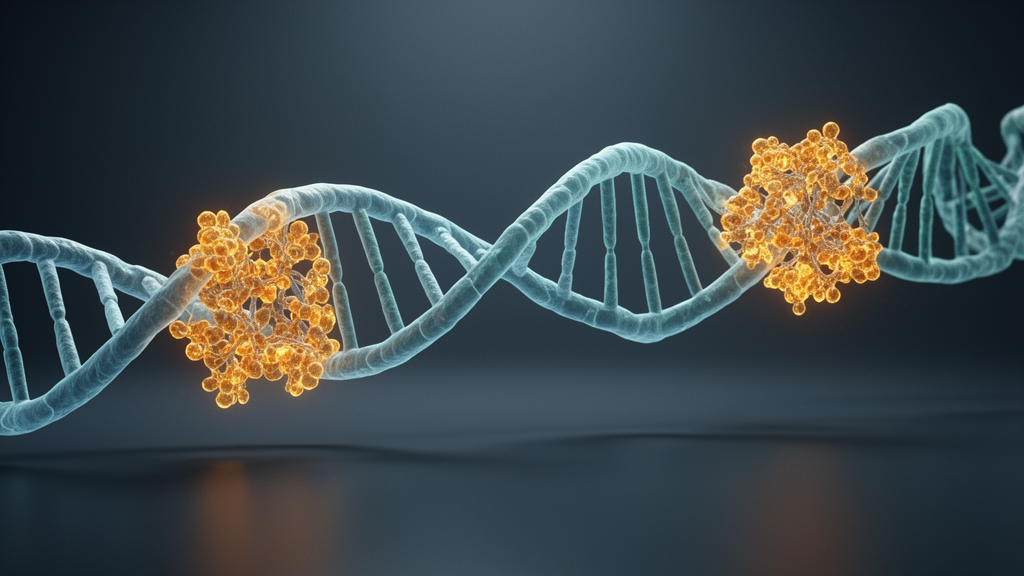
Hidden within the DNA of the bacteria that live in the human mouth, a four-stranded structure built from guanine-rich sequences may be doing far more than simply storing genetic information. A new computational survey has mapped tens of thousands of potential G-quadruplex motifs across 381 reference genomes of oral bacteria, spanning 150 genera, and found that these motifs are strikingly non-random in where they sit. Nearly 36 percent of the predicted motifs landed in promoter regions, the stretches of DNA just upstream of genes, even though those regions make up only about 10 to 15 percent of an average bacterial genome. The result is a 2.5 to 3-fold enrichment of G-quadruplex motifs near gene starts, a positional pattern that held consistently across phylogenetically diverse genera and that now points to a set of candidate loci where these unusual DNA structures might influence how oral bacteria switch their genes on and off.
G-quadruplexes, often abbreviated G4s, are non-canonical DNA secondary structures in which four guanine bases pair through Hoogsteen hydrogen bonding to form planar G-quartets that stack into a stable four-stranded arrangement. The canonical motif consists of four runs of at least three consecutive guanines separated by loops of variable length, and the structures are stabilized by monovalent cations, particularly potassium, which coordinates between stacked quartets. In eukaryotes, G4s have been extensively characterized as regulatory elements: more than 700,000 potential G4-forming sequences have been identified in the human genome, with significant enrichment in promoters, 5-prime untranslated regions and telomeres, and dedicated helicases exist to resolve them during replication and transcription. In bacteria, by contrast, understanding of G4 biology remains comparatively nascent, although individual studies have linked promoter G4s to gene expression changes in Escherichia coli, virulence gene regulation in mycobacteria, and pilin antigenic variation in Neisseria species.
The new study, published in Frontiers in Genetics, took advantage of the human oral microbiome as a model system at community-wide scale. The oral cavity harbors roughly 700 bacterial species organized into complex biofilm communities, and its residents span an enormous range of GC content, from 23 to 75 percent, and genome sizes from 0.8 to 9.5 megabases. That variation matters because G4 formation requires clustered guanine tracts, so the probability of finding four G-runs within a window rises steeply with GC content. The wide GC range across oral bacteria gave the researchers the statistical leverage to separate G4 occurrence explained purely by nucleotide composition from deviations beyond compositional expectation. Using the prediction tool g4predict with a minimum of three G-quartet stacks and a maximum loop length of seven nucleotides, the team identified 48,234 G4 motifs across the dataset.
The distribution of those motifs was highly uneven. Sixty-three genomes, 16.5 percent of the total, contained no predicted G4 motifs at all, and every one of those G4-free genomes had GC content below 45 percent. No genome with GC content above 50 percent was devoid of G4s. At the other extreme, the most G4-rich genome, that of Actinomyces dentalis, harbored 2,210 motifs. Among genomes with at least one G4, the median count was 37 and the mean was 151.7, a heavily right-skewed distribution. G4 density ranged from 0.0003 to 0.63 motifs per kilobase, spanning four orders of magnitude. The relationship between density and GC content was strongly exponential, with GC content alone explaining 80.5 percent of the variance in log G4 density, and adding phylum explained a further 3.3 percent, whereas genome size added only 0.3 percent.
Because promoter regions were so heavily over-represented among the motif locations, the researchers next asked which kinds of genes carry promoter G4s. Functional enrichment analysis across 11 categories revealed significant enrichment in all of them, but with markedly different effect sizes. The strongest enrichments were seen for signal transduction genes and virulence factors, each 2.4-fold, transcription regulators at 2.3-fold, mobile genetic elements at 2.3-fold, and transport systems at 2.2-fold. Housekeeping functions such as translation, replication and DNA repair showed comparatively modest enrichment, between 1.3 and 1.4-fold. This hierarchy, strongest for regulatory and environmental response genes and weakest for core housekeeping functions, indicates that promoter G4 motifs are preferentially associated with particular functional classes of genes. The authors are careful to stress, however, that these are genomic associations; whether G4 structures at these promoters actually influence expression of the downstream genes remains to be tested experimentally.
A central methodological contribution of the study lies in how it handled the question of whether some genomes carry more G4s than their sequence composition alone would predict. The researchers compared observed motif counts against expected counts obtained by predicting motifs in randomized versions of each genome that preserved its dinucleotide composition. The results were sobering. Of the 318 genomes with at least one G4, 44.3 percent fell within the expected range, 16.7 percent were enriched and 8.2 percent strongly enriched, while 23.9 percent were depleted and 6.9 percent strongly depleted. Notably, the over-representation of G4 motifs in low-GC genomes that a simpler analytical expectation had suggested disappeared entirely once dinucleotide composition was preserved, and when expected counts were recomputed from randomizations preserving composition within 1-kilobase windows, only 16 of 83 significantly enriched genomes remained enriched. The authors therefore interpret their observed-to-expected ratios as enrichment relative to the stated null model rather than as direct evidence of evolutionary selection.
Even so, a small set of genomes did remain enriched after controlling for local composition, and several of them belong to organisms with documented roles in human disease. Helicobacter pylori showed 8-fold enrichment with 41 G4s at 38.5 percent GC, and Prevotella melaninogenica, Prevotella scopos, Capnocytophaga leadbetteri and Capnocytophaga sputigena showed enrichments of roughly 11 to 19-fold. Comparing genomes with the highest observed-to-expected ratios against those in the expected range revealed a functional shift as well: mobile genetic element genes were 3.2-fold enriched among promoter G4 genes in outlier genomes, while transcription and transport genes were proportionally less abundant there. In the genomes with the highest G4 enrichment, promoter G4 motifs were thus more often located upstream of genes involved in genome plasticity than upstream of transcription and transport genes.
The study also examined how promoter G4 motifs fare over evolutionary time by comparing orthologous promoters across 35 genera containing three or more species. The picture that emerged is one of inheritance combined with rapid turnover. Promoter G4 motifs were shared among congeneric species more often than expected by chance, with 3,461 species pairs observed against 1,922 expected, but their sharing declined sharply with increasing phylogenetic distance, declining in 7 of 9 genera with sufficient data. Only 79 orthogroup-genus pairs reached a conservation score of 0.5, meaning the promoter G4 was present in a majority of congeneric species, and just one, a BolA family protein gene in Kingella, carried a promoter G4 in all species of a genus. Among larger genera, the maximum was 0.75, for an NADH:flavin oxidoreductase and a phosphoglycerate dehydrogenase in Actinomyces, where the G4 sat at the same aligned position in 56 of 80 alignable comparisons of orthologous promoters.
Crucially, the sequence-level comparison showed that G4-forming sequences were kept intact no more often than other G-rich runs in the same promoters, with retention rates of 43.1 percent for G4 motifs against 42.8 percent for other GGG runs. Where a G4 was absent from an alignable orthologous promoter, the aligned sequence was a single G substitution away from a canonical motif in 19.4 percent of cases, compared with 1.6 percent in unrelated promoters, suggesting that many absences arise from small mutational steps. G4 motifs in genomes enriched relative to randomized genomes were, if anything, retained less often than those of their congeners. The authors conclude that promoter G4 motifs behave as inherited but evolutionarily labile features, and that they found no evidence that the G4-forming sequence itself is maintained by purifying selection over the divergence times sampled.
The researchers acknowledge several limitations. G4 formation in vivo depends on factors not modeled in the survey, including supercoiling, potassium concentration, molecular crowding and G4-resolving helicases, and would need confirmation with approaches such as G4-seq, BG4 immunoprecipitation or G4-stabilizing ligands. Orthologous promoters of distant congeners often could not be aligned, the functional classification relied on keyword matching, only canonical three-tetrad motifs were considered, and the choice of null model itself changed the apparent dependence of enrichment on GC content. Within those bounds, the survey establishes the first community-wide atlas of G4 distribution in a defined microbial habitat and identifies a concrete set of candidate loci, including the few promoters that retain a G4 in most species of a genus, such as arc in Actinomyces, where future experiments can test whether these four-stranded DNA structures genuinely regulate transcription in oral bacteria, and whether G4-stabilizing small molecules might one day modulate virulence gene expression in oral pathogens.
Subject of Research: Computational mapping of G-quadruplex DNA motifs across oral bacterial genomes and their promoter enrichment and evolutionary turnover
Article Title: Genome-wide distribution and putative regulatory roles of G-quadruplex motifs in oral bacteria
Article References: Wang, Y., Fu, Z., Gao, P., & Chen, Y. (2026). Genome-wide distribution and putative regulatory roles of G-quadruplex motifs in oral bacteria. Frontiers in Genetics, 17, Article 1961845. https://doi.org/10.3389/fgene.2026.1961845
Image Credits: AI Generated
DOI: 10.3389/fgene.2026.1961845
Keywords: G-quadruplexes, oral bacteria, promoters, comparative genomics, GC content, gene regulation, virulence genes, evolutionary turnover, orthologous promoters, microbiome, Frontiers in Genetics, computational biology
News Source: Juliet Wilcox. (October 28, 2026). G-quadruplex motifs cluster near gene starts across oral bacterial genomes. Scienmag.



