• HOME
  • NEWS
  • EXPLORE
    • CAREER
      • Companies
      • Jobs
    • EVENTS
    • iGEM
      • News
      • Team
    • PHOTOS
    • VIDEO
    • WIKI
  • BLOG
  • COMMUNITY
    • FACEBOOK
    • INSTAGRAM
    • TWITTER
Friday, August 28, 2026
BIOENGINEER.ORG
No Result
View All Result
  • Login
  • HOME
  • NEWS
  • EXPLORE
    • CAREER
      • Companies
      • Jobs
        • Lecturer
        • PhD Studentship
        • Postdoc
        • Research Assistant
    • EVENTS
    • iGEM
      • News
      • Team
    • PHOTOS
    • VIDEO
    • WIKI
  • BLOG
  • COMMUNITY
    • FACEBOOK
    • INSTAGRAM
    • TWITTER
  • HOME
  • NEWS
  • EXPLORE
    • CAREER
      • Companies
      • Jobs
        • Lecturer
        • PhD Studentship
        • Postdoc
        • Research Assistant
    • EVENTS
    • iGEM
      • News
      • Team
    • PHOTOS
    • VIDEO
    • WIKI
  • BLOG
  • COMMUNITY
    • FACEBOOK
    • INSTAGRAM
    • TWITTER
No Result
View All Result
Bioengineer.org
No Result
View All Result
Home NEWS Science News Biology

Fungus from Arrakis: New species named after Dune’s giant worms

Bioengineer by Bioengineer
November 30, 2023
in Biology
Reading Time: 2 mins read
0
Tulostoma shaihuludii and a ‘Shai-Hulud’
Share on FacebookShare on TwitterShare on LinkedinShare on RedditShare on Telegram

A new species of stalked puffball, a gasteroid fungus, has been named after the ‘Shai-Hulud’ sandworms of Frank Herbert’s iconic science fiction novel series ‘Dune.’
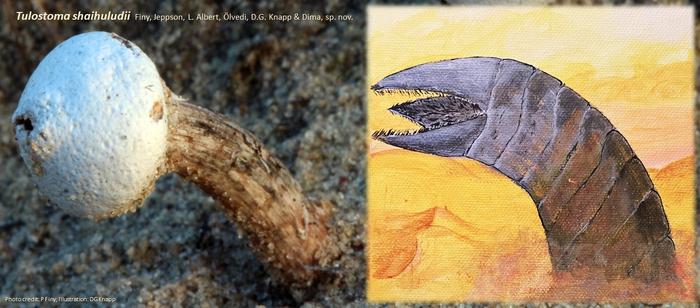
Tulostoma shaihuludii and a ‘Shai-Hulud’

Credit: Photo by Péter Finy; illustration by Dániel G. Knapp

A new species of stalked puffball, a gasteroid fungus, has been named after the ‘Shai-Hulud’ sandworms of Frank Herbert’s iconic science fiction novel series ‘Dune.’

Discovered in Hungary, the new species, Tulostoma shaihuludii, is one of four new species in the genus Tulostoma that were discovered and published in the journal MycoKeys. The other species are Tulostoma dunense, Tulostoma hungaricum, and Tulostoma sacchariolens​​.

Researchers chose the name due to the worm-like appearance of the species’ fruiting body, coupled with the sandy habitat of the Pannonian Steppe, where it was discovered.

The team consisted of Péter Finy (Eötvös Loránd University, Hungary), Mikael Jeppson (University of Gothenburg, Sweden), Dániel G. Knapp (Linnaeus University, Sweden), Viktor Papp (Hungarian University of Agriculture and Life Sciences, Hungary), László Albert (Hungarian Mycological Society, Hungary), István Ölvedi (Hungarian Mycological Society, Hungary), Károly Bóka (Eötvös Loránd University, Hungary), Dóra Varga (Eötvös Loránd University, Hungary), Gábor M. Kovács (Eötvös Loránd University, Hungary), and Bálint Dima (Eötvös Loránd University, Hungary).

These discoveries have been particularly significant due to Hungary’s steppe vegetation on sandy soil being identified as a hotspot for the stalked puffballs in Europe. The research team conducted a comprehensive taxonomic revision of gasteroid fungi in Hungary, contributing to the understanding of this group’s diversity.

The discovery of Tulostoma shaihuludii demonstrates the intricate connections between species and their habitats. It also highlights the importance of geographic isolation in the emergence of new species, as seen in the case of Tulostoma dunense, which is closely related to North American species but distinctly different, as revealed by genetic analysis​​.

Original source:

Finy P, Jeppson M, Knapp DG, Papp V, Albert L, Ölvedi I, Bóka K, Varga D, Kovács GM, Dima B (2023) Exploring diversity within the genus Tulostoma (Basidiomycota, Agaricales) in the Pannonian sandy steppe: four fascinating novel species from Hungary. MycoKeys 100: 153-170. https://doi.org/10.3897/mycokeys.100.112458 


Journal

MycoKeys

DOI

10.3897/mycokeys.100.112458

Article Title

Exploring diversity within the genus Tulostoma (Basidiomycota, Agaricales) in the Pannonian sandy steppe: four fascinating novel species from Hungary

Article Publication Date

29-Nov-2023

Share12Tweet8Share2ShareShareShare2

Related Posts

Genetic study identifies barley hotspots for inherited cold-stress resilience

Genetic study identifies barley hotspots for inherited cold-stress resilience

August 28, 2026
One Health Lessons from Pteropus medius: Nipah Spillover, Microbiota, and Antimicrobial Resistance

One Health Lessons from Pteropus medius: Nipah Spillover, Microbiota, and Antimicrobial Resistance

August 28, 2026

Beijing’s Chaoyang District Urban Parks Provide Refuges for Diverse Birdlife

August 28, 2026

Unexpected Cardiac Tumor Diagnosed as Histiocytosis in Case Report

August 28, 2026

POPULAR NEWS

  • Electrothermal Strategy Boosts Toluene Oxidation Using Manganese-Cobalt Composite Oxide Monolith

    29 shares
    Share 12 Tweet 7
  • Retraction: Study Examining Graphene Oxide/Nanozirconia Effects on Geopolymer Concrete Strength and Durability

    29 shares
    Share 12 Tweet 7
  • Mitochondria-Targeted Therapy Shows Promise Against Intervertebral Disc Degeneration

    29 shares
    Share 12 Tweet 7
  • MD-VAE Embeds Concepts in Variational Autoencoders Using Multiple Decoders

    29 shares
    Share 12 Tweet 7

About

We bring you the latest biotechnology news from best research centers and universities around the world. Check our website.

Follow us

Recent News

Electrothermal Strategy Boosts Toluene Oxidation Using Manganese-Cobalt Composite Oxide Monolith

Retraction: Study Examining Graphene Oxide/Nanozirconia Effects on Geopolymer Concrete Strength and Durability

Mitochondria-Targeted Therapy Shows Promise Against Intervertebral Disc Degeneration

Subscribe to Blog via Email

Enter your email address to subscribe to this blog and receive notifications of new posts by email.

Join 85 other subscribers
  • Contact Us

Bioengineer.org © Copyright 2023 All Rights Reserved.

Welcome Back!

Login to your account below

Forgotten Password?

Retrieve your password

Please enter your username or email address to reset your password.

Log In
No Result
View All Result
  • Homepages
    • Home Page 1
    • Home Page 2
  • News
  • National
  • Business
  • Health
  • Lifestyle
  • Science

Bioengineer.org © Copyright 2023 All Rights Reserved.