A narrative review in IMAFungus synthesizes evidence that autophagy coordinates membrane biogenesis, organelle turnover, stress signaling, pathogenic development and host interactions in fungi. The review concentrates on pathogenic species, drawing on plant pathogens, human pathogens, entomopathogenic fungi and selected model yeasts, while noting that much of the direct molecular evidence comes from the rice blast fungus Magnaporthe oryzae. It is a synthesis of previously reported studies rather than a new experimental or clinical investigation.
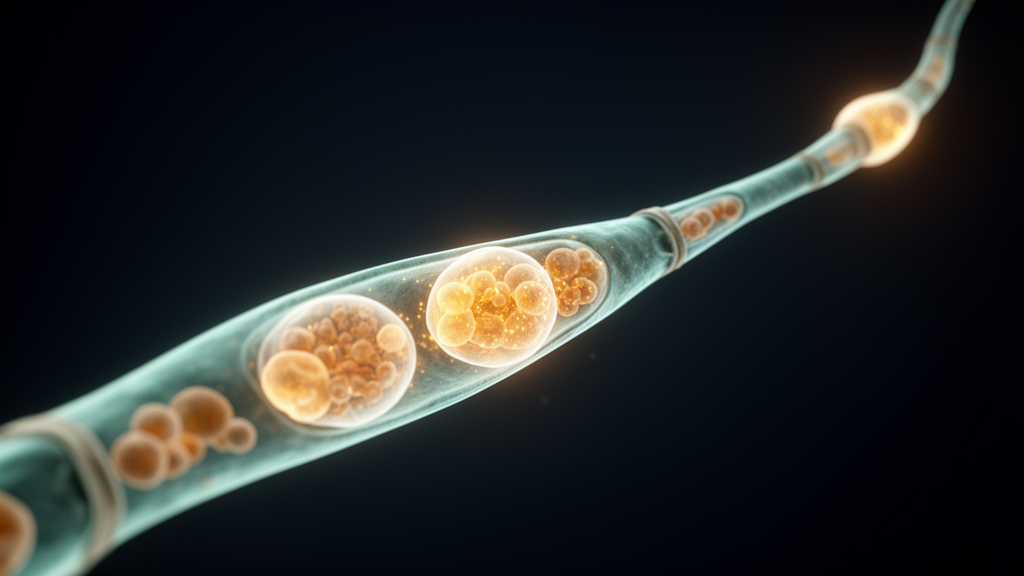
At the cellular level, fungal macroautophagy uses a conserved network of more than 40 ATG-family proteins to sequester cytoplasmic material in a double-membrane phagophore and deliver it to the fungal vacuole for degradation. In yeast and most filamentous fungi, autophagosome assembly is concentrated at a single phagophore assembly site, unlike the multiple ER-associated omegasomes described in mammalian cells. BAR-domain proteins help generate the sharply curved isolation membrane, while branched actin forms a cage around the assembly site that restricts uncontrolled membrane diffusion. After autophagosomes close, molecular motors transport them along microtubules to the vacuole, a particularly demanding task in polarized hyphae where autophagosomes may travel dozens of micrometers.
Membrane lipid signaling and vesicle-trafficking systems add further control over maturation and vacuolar fusion. In M. oryzae, the oxysterol-binding protein-related proteins MoOrp1 and MoOrp2 interact with MoAtg8, localize to the phagophore assembly site and enrich phosphatidylinositol-4-phosphate on autophagosomal membranes. A double gene knockout blocked autophagic flux and was associated with loss of appressorial turgor and host penetration. In Fusarium graminearum, TRAPPIII interacts with the autophagy transmembrane protein FgAtg9 through FgTrs85 and TRAPPC13 while also activating FgRab1 as a guanine nucleotide exchange factor, linking autophagosome biogenesis with ER-to-Golgi and endosome-to-Golgi transport during reproduction and infection.
Trafficking also helps determine which proteases reach the vacuole. The retromer protein MoVps35 in M. oryzae binds the serine protease MoPrb1 on endosomes and directs it into the vacuole, where MoPrb1 assists in localizing MoPep4. Genetic analyses assigned distinct functions to these proteases: MoPrb1 supports degradation of macroautophagy cargo associated with infection structures, and its mutation was linked to failed appressorium development, whereas MoPep4 regulates microautophagy, including peroxisomal degradation, without being required for virulence under the tested conditions. These results indicate that vesicle sorting can differentiate among autophagic pathways.
Selective autophagy remodels organelles and storage reserves in ways that support fungal growth and virulence. Quantitative proteome-turnover analysis in Komagataella phaffii found that changing carbon and nitrogen sources remodeled up to 90% of the pre-existing proteome, with Atg9-dependent bulk autophagy operating alongside cargo-specific pathways. Peroxisomes were cleared through Atg30- and Atg11-dependent pexophagy, while mitochondria underwent slower Atg32-dependent mitophagy. In M. oryzae, the MoDnm1–MoMdv1–MoFis1 complex regulates mitochondrial and peroxisomal fission; disruption impaired mitophagic clearance, conidiation, appressorium-mediated penetration and full virulence.
For lipid droplets in Metarhizium robertsii and Beauveria bassiana, morphological observations indicate partial engulfment by isolation membranes or sequestration through microlipophagy. Deletion of ATG8 homologs was associated with impaired droplet use, conidial germination and host infectivity. Autophagy is also regulated through RNA modifications, transcription and protein modification. In M. oryzae, the m5C methyltransferase Ncl1 modifies specific sites in atg5 and the 3′ untranslated region of atg16, increasing transcript stability and supporting Atg5–Atg16 translation; Pmk1-MAPK phosphorylation and Smt3-dependent SUMOylation also stabilize Ncl1.
The clearest direct link between external stress sensing and autophagy described by the review occurs during appressorium development. The cell-wall-integrity MAP kinase MoMps1 directly phosphorylates the autophagy protease MoAtg4, which processes Atg8 before its lipid modification, and the reported interaction can adjust autophagic flux independently of TOR signaling. The Wee1-family kinase MoSwe1 also coordinates cell-cycle arrest, autophagy and localized cell-wall remodeling during penetration-peg formation. Deletions of ATG genes in Cryptococcus neoformans and Aspergillus fumigatus have also been associated with hypersensitivity to Congo red and echinocandins, supporting a broader association between autophagy and cell-wall stress, although the direct biochemical evidence for MoMps1–MoAtg4 signaling is concentrated in M. oryzae.
At the developmental and host-interaction scale, the review links autophagy to programmed conidial death in M. oryzae. As an appressorium develops, maternal spore cells undergo extensive autophagy, transfer degraded material toward the appressorium and eventually collapse; core ATG mutations can prevent this death and associated transfer. The review also describes lipid peroxidation and ferroportin-1-related iron release as coupled processes, but much of this evidence comes from one fungal model. In C. neoformans, loss of Sgl1 was associated with blocked GFP-Atg8 trafficking, accumulation and extracellular release of ergosteryl-glucoside derivatives, and Mincle-dependent inflammatory responses that cleared the pathogen from lungs in the reported mouse infection model. These experimental results do not establish a clinical intervention.
The review presents Cordyceps militaris as a model for linking host manipulation to multicellular development. During infection, the horizontally transferred trehalase CmTreH1 depletes host trehalose, while the review reports induction of the orexigenic neuropeptide HemaP, hyperphagia and formation of a lipid- and glycogen-rich “fatty pupa.” After host takeover, bulk autophagy, lipophagy and glycophagy are proposed to mobilize nutrients for primordium and fruiting-body growth. Direct functional characterization of core autophagy genes in C. militaris has only begun, so the analogy with the better-characterized FOX-factor program in Sclerotinia sclerotiorum remains a hypothesis. Separately, the review describes Ebselen derivatives reversibly inhibiting the Atg4 catalytic cysteine and reports activity in plant and human fungal models; these findings are preclinical and do not establish a clinical antifungal treatment.
Subject of Research: Review of autophagy in fungal development, pathogenicity and host interactions
Article Title: Autophagy as a multi-scale architect of fungal development and pathogenicity: membrane dynamics, multilayer regulation, and cell wall integrity crosstalk
Article References: Wang, F., Li, J., Chen, H., Zheng, Q., Wei, T., Feng, K., & Chen, B.-X. (2026). Autophagy as a multi-scale architect of fungal development and pathogenicity: membrane dynamics, multilayer regulation, and cell wall integrity crosstalk. IMA Fungus, 17, Article e196033. https://doi.org/10.3897/imafungus.17.196033
Image Credits: AI Generated
DOI: 10.3897/imafungus.17.196033
Keywords: fungal autophagy, membrane remodeling, cell wall integrity, fungal pathogenesis, Magnaporthe oryzae, Cryptococcus neoformans, organelle turnover, antifungal targets, Cordyceps militaris, vesicle trafficking, Autophagy, multi-scale
News Source: Drew Townsend. (October 20, 2026). Fungal autophagy coordinates membrane remodeling, stress responses and pathogenic development. Scienmag.