Every day, animals rise, become active, and eventually settle into sleep, all guided by an internal timing system that operates largely independently of external cues. Scientists have long known that this circadian clock, a network of neurons generating rhythms of roughly twenty-four hours, sits at the heart of these daily cycles. What has remained far less clear is how the clock’s rhythmic output is actually delivered to the brain circuits that control behavior. A new study from the University of Geneva, published in Current Biology, now maps one of these transmission pathways in remarkable detail, showing how signals from the biological clock reach a well-known wake-promoting center of the insect brain through the neurotransmitter dopamine.
The research, conducted in the fruit fly Drosophila melanogaster, addresses a fundamental gap in neuroscience. The circadian clock does more than govern sleep and wakefulness; it also modulates physiological functions such as body temperature and hormone production across the animal kingdom. Yet identifying the specific neurons that carry the clock’s instructions to downstream brain regions, and understanding the mechanisms by which the clock exerts influence over those circuits, has proven difficult. The Geneva team, led by Emi Nagoshi of the Section of Biology in the university’s Faculty of Science, turned to the fruit fly precisely because its nervous system, while capable of generating complex behaviors, is compact enough to be mapped genetically with precision.
Using genetic mapping of the connections between neurons, the researchers identified the nerve cells that lie directly downstream of the biological clock neurons in the fly brain. This step was crucial, because knowing which cells receive the clock’s output is the prerequisite for understanding how temporal information is converted into neural activity. The team then applied imaging techniques capable of measuring neuronal activity, and these measurements revealed something striking: the activity of the downstream circuit varies throughout the day, rising and falling in step with the fly’s internal rhythm rather than remaining constant.
The connection the researchers uncovered links the clock neurons to a population of neurons that produce dopamine, a chemical messenger that allows neurons to communicate with one another and that is well known for its role in motivation, movement, and arousal across species. In the fly, the dopaminergic neurons identified in this study project to the mushroom body, a brain structure with a distinguished history in neuroscience research. The mushroom body is involved in learning and memory, but it also participates in the regulation of sleep, and its activity contributes to promoting wakefulness during the day.
The circuit operates through a logic of inhibition and release. According to Blanca Lago Solis and Rafael Koch, a postdoctoral researcher and a research associate in Emi Nagoshi’s group, the clock neurons inhibit the dopaminergic neurons, which in turn stimulate neurons in the mushroom body. “We observed that the clock neurons inhibit these dopaminergic neurons, which in turn stimulate neurons in the mushroom body. This brain region plays a role in learning, memory and the regulation of sleep, and its activity contributes to promoting wakefulness during the day,” the researchers explained. When the clock neurons are actively suppressing the dopaminergic cells, the wake-promoting signal to the mushroom body diminishes. When that inhibition is lifted, the dopaminergic neurons fire more strongly, the mushroom body receives a more powerful stimulus, and wakefulness is promoted.
This push-and-pull arrangement gives the biological clock a direct channel through which it can inform a behaviorally relevant brain circuit about the time of day. Rather than the clock issuing a simple on-or-off command, the circuit modulates the strength of a wakefulness signal in a rhythm that tracks the twenty-four-hour cycle. The result is a mechanism by which abstract temporal information, generated by molecular oscillators inside clock neurons, is translated into graded neuronal activity that coordinates a complex behavior: the alternation of sleep and wakefulness across the day.
The study’s findings carry significance beyond the fly brain. Dopamine’s role in promoting wakefulness is a theme that recurs throughout biology, and the Geneva work highlights how central this neurotransmitter is to the interface between circadian timing and behavioral state. By showing that clock neurons regulate dopaminergic signaling to the mushroom body through rhythmic transcription involving the gene Pka-C1, the study, titled Circadian control of dopaminergic signaling to the mushroom body regulates sleep through rhythmic Pka-C1 transcription in Drosophila, demonstrates that the clock’s influence extends deep into the molecular machinery of the circuits it controls, shaping not only which neurons are active but how their chemical messages are delivered.
Why does this matter for human health? Disruptions of the circadian clock are associated with a range of sleep disorders and alterations in brain function. Shift work, jet lag, and irregular light exposure all desynchronize the internal clock from the external world, and the consequences extend from poor sleep to broader impairments in cognition and mood. A better understanding of the fundamental mechanisms by which the clock communicates with arousal circuits could ultimately help explain how disturbances in biological rhythms affect the brain, and may point toward strategies for mitigating those effects.
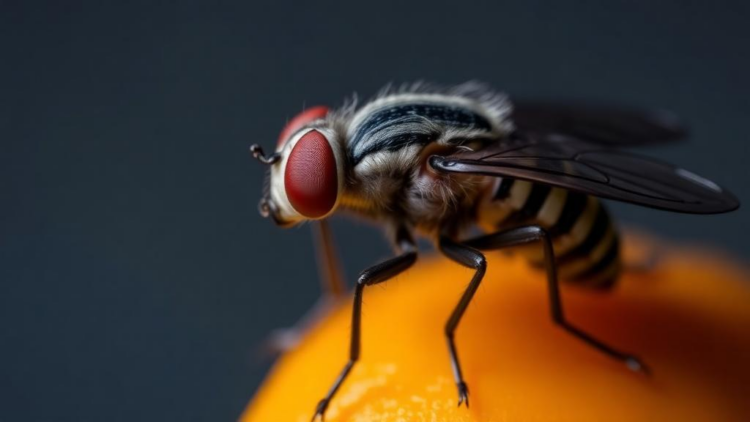
There is also a methodological lesson in the Geneva team’s approach. By combining genetic mapping of neuronal connections with live measurements of neural activity, the researchers were able to trace a complete pathway from clock to behavior in a way that would be extraordinarily difficult in larger animals. The fruit fly, the small vinegar fly long attracted to ripe fruit in laboratories around the world, once again proves its worth as a model organism: its circadian clock, its dopaminergic neurons, and its mushroom body all have counterparts whose principles illuminate biology far beyond the species in which they were first described.
As research continues, the circuit described by Nagoshi and her colleagues offers a concrete framework for asking the next generation of questions: how other clock outputs reach other brain regions, how the rhythm of dopaminergic signaling is maintained across the day and night, and how similar clock-to-circuit architectures might operate in the mammalian brain. For now, the study stands as a clear demonstration that the biological clock does not merely keep time; it actively transmits that time to the circuits that decide when an animal sleeps and when it wakes, one dopamine signal at a time.
Subject of Research: Circadian clock regulation of dopaminergic signaling and sleep-wake cycles in Drosophila
Article Title: How the biological clock regulates phases of wakefulness
Article References: How the biological clock regulates phases of wakefulness. (n.d.). Original publication
Image Credits: AI Generated
DOI: Not provided
Keywords: circadian clock, Drosophila melanogaster, dopamine, mushroom body, sleep regulation, wakefulness, neural circuit, University of Geneva, Current Biology, Pka-C1, neuroscience, biological rhythms
Cite Scienmag News
APA MLA Chicago
Cassandra Pierce. (October 4, 2026). Fruit Fly Study Reveals How the Biological Clock Drives Daily Wakefulness. Scienmag. https://scienmag.com/fruit-fly-study-reveals-how-the-biological-clock-drives-daily-wakefulness/
Cassandra Pierce. “Fruit Fly Study Reveals How the Biological Clock Drives Daily Wakefulness.” Scienmag, 4 October 2026, https://scienmag.com/fruit-fly-study-reveals-how-the-biological-clock-drives-daily-wakefulness/. Accessed 4 October 2026.
Cassandra Pierce. “Fruit Fly Study Reveals How the Biological Clock Drives Daily Wakefulness.” Scienmag. October 4, 2026. https://scienmag.com/fruit-fly-study-reveals-how-the-biological-clock-drives-daily-wakefulness/
Copy citation Download RIS
Tags: biological clock and sleep regulationbiological rhythmsbrain regions involved in wakefulnesscircadian clockcircadian rhythm researchcircadian rhythm transmission mechanismsCurrent Biologydopaminedopamine signaling in wakefulnessDrosophila melanogasterDrosophila melanogaster circadian pathwaysfruit fly neuroscienceinternal biological timing systemsmolecular mechanisms of circadian controlmushroom bodyneural circuitneural circuits controlling sleep and wakefulnessNeuroscienceneuroscience of circadian influence on behaviorPka-C1sleep regulationsleep-wake cycle neural pathwaysUniversity of Genevawakefulness