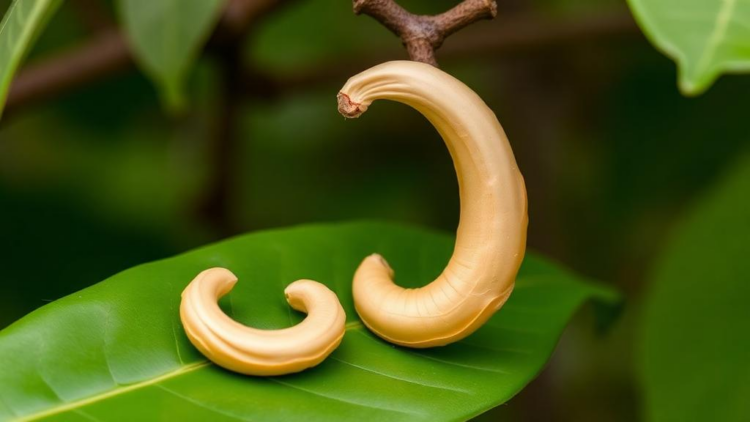
The cashew tree, Anacardium occidentale, is one of the tropics’ most valuable nut crops, cultivated across millions of hectares from Brazil to India and West Africa. Yet the wild relatives that share its native range in Brazil have long puzzled botanists. Among them is cajuí, Anacardium humile, a smaller, shrubby plant of the Cerrado savanna and coastal restinga vegetation that produces miniature versions of the familiar cashew apple and nut. For decades, the two have been treated as distinct species, separated mainly by plant stature and fruit size. A new study published in Plant Biosystems now challenges that assumption, presenting morphological, molecular, cytogenetic, and genome size evidence that fails to draw a clear line between the cultivated giant and its wild diminutive cousin.
The research, led by Acalene Gonçalveis-Oliveira and Andrea Pedrosa-Harand of the Federal University of Pernambuco together with colleagues at the Federal University of Piauí, the State University of Campinas, and collaborators, examined cashew germplasm collected from the Cerrado and restinga biomes of Northeastern Brazil. In total, twenty-four accessions of A. occidentale and two of A. humile were characterized. The team asked a deceptively simple question: does size matter? If the two species are truly separate, their differences should show up not only in the field but also in their DNA sequences, their chromosomes, and the amount of DNA packed into their nuclei. What the researchers found instead was a striking lack of differentiation at every level they probed.
The morphological analysis was the first hint that species boundaries in this group are blurrier than textbooks suggest. When the team measured and scored traits across the accessions, the variability they observed extended beyond the supposed limits of each species. Characters traditionally used to distinguish A. occidentale from A. humile overlapped so extensively that individual plants could not be reliably assigned to one species or the other on morphology alone. In practical terms, the only consistent difference appeared to be the size of the fruits and pseudofruits, the fleshy swollen stalk that is eaten as the cashew apple, with domesticated accessions producing the larger structures that farmers have selected over centuries.
To test whether genetics told a different story, the researchers sequenced selected regions of both nuclear and chloroplast DNA. From the nucleus they used the internal transcribed spacer, or ITS, a standard workhorse of plant phylogenetics, and from the plastid genome they analyzed four noncoding regions: matK, trnL-F, ycf1, and rps16. These markers were chosen because they evolve quickly enough to resolve relationships among closely related species, and ycf1 in particular has been flagged in earlier work as one of the most informative plastid DNA barcodes for land plants. If A. occidentale and A. humile were reproductively isolated lineages, their sequences should have sorted into separate, well-supported clades.
They did not. The molecular analyses revealed no clear genetic separation between the two species. Instead, the accessions formed an unresolved clade, a tangle of relationships in which individuals of both species were intermingled without any pattern that would allow a researcher to identify a plant’s species from its DNA alone. The team also constructed haplotype networks, an approach that visualizes how DNA variants are shared among individuals, and again found no exclusive grouping by species. The raw ITS sequences generated in the study have been deposited in public databases, allowing other researchers to scrutinize and extend the analysis.
One possible explanation for such genetic ambiguity is that the two species differ in ways that standard DNA barcodes cannot detect, for example in chromosome structure or total genome size. To rule this out, the team turned to cytogenetics. They performed chromosome counts and fluorescent banding on twelve accessions of A. occidentale and two of A. humile, using the fluorochromes chromomycin A3 and DAPI to mark GC-rich and AT-rich heterochromatin respectively, and applied fluorescent in situ hybridization to physically map ribosomal RNA genes on the chromosomes. The results revealed remarkable chromosomal stability across all accessions examined.
Every plant analyzed had the same chromosome number, 2n = 40, and the same banding pattern: CMA-positive, DAPI-negative bands located in the terminal regions of the short arms of three chromosome pairs. Fluorescent in situ hybridization showed one pair of 5S ribosomal DNA sites and three pairs of 35S ribosomal DNA sites, the latter co-localizing with the CMA-positive bands. This karyotype was identical in both species, offering no cytogenetic evidence whatsoever for a hidden genomic divide. Such uniformity is notable in a genus that includes species with quite different growth habits and habitats, and it echoes findings of karyotypic stability reported in other woody plant lineages.
Genome size measurements added a final layer of evidence. Using flow cytometry, a technique that estimates nuclear DNA content by measuring the fluorescence of stained nuclei as they pass through a laser, the researchers determined the 1C genome size of the accessions. The values were strikingly similar across all plants, with a mean of 0.44 picograms per 1C nucleus, equivalent to roughly 435 million base pairs. There was no significant variation either within or between the two species, and no evidence of polyploidy, the whole-genome duplication that frequently accompanies plant domestication and speciation. The cashew genome, small by plant standards, appears to have remained essentially constant regardless of whether the plant is a towering cultivated tree or a squat savanna shrub.
So why do the two forms look so different if their genomes are so alike? The authors outline three hypotheses that could explain the pattern. The first is incomplete lineage sorting, a phenomenon in which recently diverged species have not yet had time for their gene lineages to sort cleanly into separate genealogies, so that shared ancestral genetic variants persist in both. The second is hybridization with introgression, meaning that the species may have exchanged genes through interbreeding, homogenizing their genomes even as selection maintained differences in plant architecture and fruit size. The third, and perhaps the most provocative, is that A. occidentale and A. humile are not separate species at all, but a single biological species in which domesticated accessions simply exhibit larger fruits and pseudofruits as a consequence of human selection.
The implications reach well beyond academic taxonomy. Cashew breeding programs depend on wild germplasm as a reservoir of genetic diversity for traits such as drought tolerance and disease resistance, and conservation strategies in the Cerrado and restinga biomes require a clear understanding of which units of diversity are worth protecting. If the wild cajuí is merely the wild end of a continuum that includes the domesticated cashew, then its genetic resources are not a side branch but an integral part of the crop’s gene pool, and the species delimitations used in germplasm banks and botanical gardens may need revision. The authors are careful to note that their sampling, particularly of A. humile, was limited, and they call for expanding the analysis to more accessions and more genomic markers before any formal taxonomic conclusion is drawn. Even so, the study stands as a vivid reminder that in plant evolution, the biggest differences we see with our eyes are sometimes the smallest differences in our DNA.
Subject of Research: Species delimitation and genetic diversity of cashew and cajuí in Northeastern Brazil
Article Title: Does size matter? Morphological and genetic similarities between cashew (Anacardium occidentale) and cajuí (A. humile)
Article References: Gonçalveis-Oliveira, A., Nascimento, T., Barroso, P. A., da Silva-Luz, C. L., da Costa Silva, S., & Pedrosa-Harand, A. (2026). Does size matter? Morphological and genetic similarities between cashew (Anacardium occidentale) and cajuí (A. humile). Plant Biosystems, 160(4), Article 225. https://doi.org/10.1007/s44473-026-00205-6
Image Credits: AI Generated
DOI: 10.1007/s44473-026-00205-6
Keywords: Anacardium occidentale, Anacardium humile, cashew, cajuí, Cerrado, restinga, cytogenetics, flow cytometry, genome size, phylogeny, species delimitation, Anacardiaceae
Cite Scienmag News
APA MLA Chicago
Juliet Wilcox. (October 4, 2026). Cashew and Its Wild Cerrado Cousin May Be One and the Same Species. Scienmag. https://scienmag.com/cashew-and-its-wild-cerrado-cousin-may-be-one-and-the-same-species/
Juliet Wilcox. “Cashew and Its Wild Cerrado Cousin May Be One and the Same Species.” Scienmag, 4 October 2026, https://scienmag.com/cashew-and-its-wild-cerrado-cousin-may-be-one-and-the-same-species/. Accessed 4 October 2026.
Juliet Wilcox. “Cashew and Its Wild Cerrado Cousin May Be One and the Same Species.” Scienmag. October 4, 2026. https://scienmag.com/cashew-and-its-wild-cerrado-cousin-may-be-one-and-the-same-species/
Copy citation Download RIS
Tags: AnacardiaceaeAnacardium humileAnacardium occidentaleAnacardium occidentale and Anacardium humileBrazilian biomes and native cashew speciescajuíCashewcashew tree species comparisonCerradoCerrado savanna cashew plantscytogeneticsflow cytometrygenetic diversity of cashew germplasmgenome sizegenome size in cashew plantsimplications for cashew breeding and conservationmolecular and cytogenetic analysis of cashew speciesphylogenyplant morphology and species classificationplant species delimitation using molecular evidencerestingaspecies delimitationtaxonomy of wild and cultivated cashewwild versus cultivated cashew