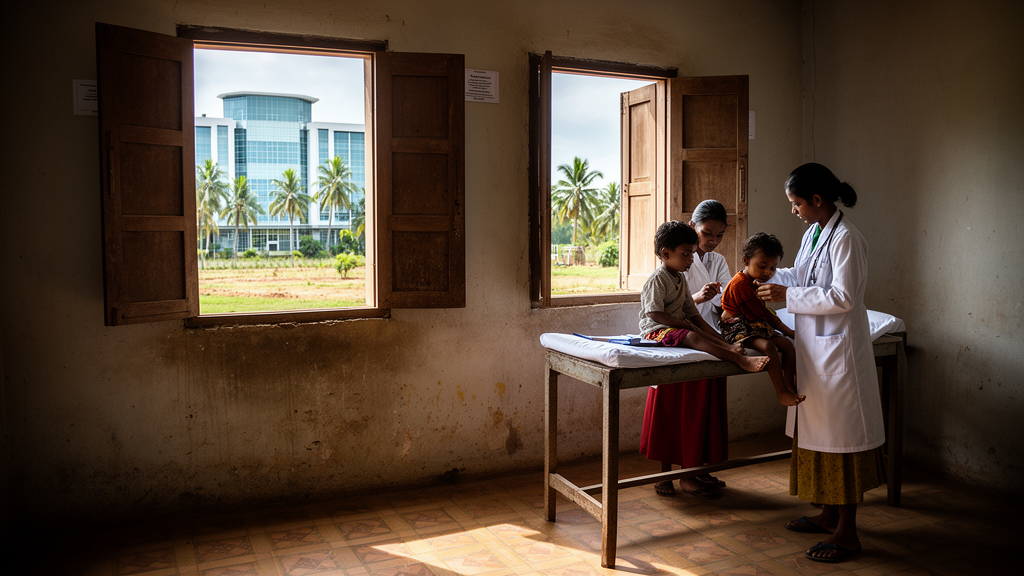
A small family health center serving roughly 11,500 people in a rural, post-conflict village in Sri Lanka's Northern Province has evolved over fourteen years into a nationally recognized training hub and internationally connected research platform, according to a community case study published in Frontiers in Medicine. The facility in Kondavil, Jaffna District, now operates a 10,000-participant community cohort built on electronic health records, a biobank holding more than 6,000 bio-samples, and a partnership with the United Kingdom's National Institute for Health and Care Research through the DIGIPATHS program, which supports digitally integrated care pathways for multiple long-term conditions in primary care. The authors, a team from the University of Jaffna and the Provincial Department of Health Service, document how the center generated more than 20 peer-reviewed publications and became the national training center for Family Medicine, all without high-cost infrastructure.
The report is descriptive rather than experimental, so it documents a transformation process rather than testing the model against a comparison population. Sri Lanka's Northern Province endured three decades of armed conflict that displaced communities, disrupted social cohesion, weakened institutional capacity and eroded trust in public systems. Post-conflict recovery unfolded alongside demographic ageing, rising non-communicable diseases, workforce shortages and economic instability, pressures that the COVID-19 pandemic magnified by disrupting routine care and worsening chronic disease morbidity.
Sri Lanka presents what the authors call a paradox: despite universal free healthcare and strong public health achievements, disparities persist in primary care access, continuity and quality, particularly in historically marginalized regions such as the Northern Province. National reforms, including the World Bank-funded Primary Health Systems Strengthening Project, emphasize people-centered care, continuity and digital integration, but implementation at the frontline level remains challenging. The authors argue that facility-based or disease-specific interventions are insufficient in such contexts, and that what is required is a system-oriented, relational and learning-driven approach integrating service delivery, community participation, education and research.
The case study uses an implementation case study design informed by participatory action research principles, documenting a progressive, multi-phase transformation between 2012 and 2026 rather than evaluating a static, single-time intervention. Evidence was synthesized from several administrative, clinical and research data streams: monthly clinic attendances, electronic health record registry entries and community health worker household visit logs; participatory reflection logs documenting reflection and action cycles from regular joint meetings involving clinicians, community health workers, academic leads and community representatives; and programmatic evaluations including more than 20 peer-reviewed papers, doctoral dissertations and subnational policy evaluation reports generated through the platform. All embedded research initiatives and sub-projects operated under formal ethical review and approval by the Ethics Review Committee of the Faculty of Medicine, University of Jaffna, with participants providing written informed consent.
The model rests on three conceptual foundations woven together into a single operational system rather than applied sequentially. Family Medicine provided the clinical and ethical foundation, with its principles of continuity, comprehensiveness, person-centeredness and contextual care. The authors report that this continuity proved critical for managing multi-morbidity and psychosocial distress rooted in conflict-related adversity, enabling holistic management of acute illness, chronic disease, mental health, geriatric care and preventive services within enduring doctor-family-community relationships.
Community-Oriented Primary Care extended Family Medicine beyond individual clinical encounters to encompass defined population responsibility, shifting from reactive, facility-based care toward proactive, community-responsive primary care through systematic community profiling, participatory needs assessment and iterative service planning. Participatory action research functioned as the system-learning engine, enabling cyclic reflection, action and adaptation that transformed routine service delivery into a source of continuous improvement and ethical knowledge generation, with patients, community health workers, students, clinicians and researchers acting as co-creators of knowledge. Community health workers formed the operational bridge between households, the health center and the wider health system.
Recruited through participatory community processes, they functioned as community representatives with clearly defined roles aligned with World Health Organization guidance while adapted to post-conflict realities. Their documented work included subfertility care, connecting communities with primary health care services, home-based follow-up for older adults, medication adherence support for chronic disease patients, maternal and child health outreach, cancer screening awareness and early identification of psychosocial distress. During the COVID-19 pandemic, their role expanded to risk communication, monitoring of vulnerable households and linkage to a 24-hour helpline, which the authors present as evidence of system resilience.
Patient and Public Involvement and Engagement, alongside Community Engagement and Involvement, were embedded as foundational mechanisms rather than consultative or time-limited activities, operationalized through structured community engagement forums and the community health worker network so that service design, delivery and evaluation were co-produced with communities. The transformation unfolded in three documented phases. From 2012 to 2016, the foundation phase focused on service reliability and clinical practice, establishing Family Medicine clinics at Kondavil and conducting initial clinical profiling of acute and chronic local disease burdens, with clinical encounter logs and baseline community audits as evidence.
From 2017 to 2021, the integration phase centered on community-oriented primary care and community mobilization, marked by the recruitment and deployment of community health workers, the launch of patient and public involvement forums, and the emergency COVID-19 response including the 24-hour helpline and household monitoring, documented through outreach logs, community feedback logs and epidemic response records. From 2022 to 2026, the expansion phase established the digital infrastructure and global research capacity: the 10,000-participant electronic health record community cohort, the biobank of more than 6,000 bio-samples, and the launch of international partnerships such as NIHR DIGIPATHS, evidenced through electronic health record databases, biobank registries, peer-reviewed publications and grant awards. Education became a core function of the center, with learning occurring within real-world primary care contexts rather than isolated academic settings.
The documented training portfolio includes undergraduate medical education for University of Jaffna students, clinical teaching for students from SingHealth Duke-NUS universities, allied health and nursing education and training, MD Family Medicine training with the center recognized as a Center of Excellence, and PhD and post-doctoral research training. Continuous professional development was embedded within service delivery, covering doctors and nurses, family medicine team training, cardio-metabolic, renal and chronic disease care, and leadership and digital skills. Capacity building extended beyond individuals to research governance, data management and digital epidemiology.
On the research side, demonstrated service reliability, community trust and ethical governance enabled mixed-methods and implementation studies on atrial fibrillation and cardiovascular risk, alongside collaborations spanning digital health, water and environmental health research, cancer prevention, reproductive and subfertility care and cardiovascular disease prevention, reflecting community-identified priorities. The authors situate their findings within comparable models globally. They draw parallels with Iran's khaneh behdasht model, staffed by behvarz community health workers, which embeds multidisciplinary primary health teams within rural communities and is associated with improved early non-communicable disease detection, preventive screening and continuous follow-up among underserved populations.
Brazil's Estratégia Saúde da Família demonstrated that decentralizing primary care through team-based family health units significantly reduces preventable hospitalizations and bridges health equity gaps, and the authors report that their findings reinforce that localized adaptations of family medicine frameworks yield similar operational efficiencies in South Asian health systems. Post-conflict primary care reconstruction experiences in Rwanda and Cambodia suggest that health system strengthening serves a dual purpose, expanding essential service delivery while restoring social cohesion and public trust in civic institutions. The authors also acknowledge limitations: as a descriptive implementation case study, observations concerning community trust, patient empowerment and service acceptability rely predominantly on qualitative feedback, administrative records and reflective logs rather than controlled trials; the adaptive nature of participatory action research made it infeasible to establish a parallel control population or non-intervention baseline facility for statistical comparison; and long-term health economic metrics and longitudinal clinical outcome tracking were beyond the study's scope.
Generalizability is further constrained by context. The center benefited considerably from its close institutional proximity to the Faculty of Medicine at the University of Jaffna, which provided academic leadership, clinical support and human resources, and replicating the framework in remote primary care settings lacking embedded university support may present distinct challenges. The authors emphasize that the model offers a flexible framework rather than a rigid template, and that the transformation was not the result of a single intervention but of intentional integration of Family Medicine, community-oriented primary care and participatory action research with involvement and engagement embedded throughout.
Future efforts, they write, should focus on multi-center implementation trials to evaluate scalability across other Sri Lankan provinces, integrating digital health registers, formalizing bidirectional referral pathways and conducting rigorous cost-effectiveness analyses to inform national health policy. The transferable principles they identify are phased development, embedded learning systems, co-production with communities and integration of service, education and research at the primary care level, particularly relevant for health systems in fragile, underserved or transitioning contexts. In an era of growing global interest in people-centred and digitally enabled primary care, the case study illustrates, in the authors' view, that resource-limited settings can lead innovation rather than merely adapt it.
Subject of Research: Development of a community-oriented family health center integrating family medicine, community-oriented primary care and participatory action research in post-conflict Northern Sri Lanka
Article Title: Case Report: From concept to care and knowledge translation: developing a community-oriented family health center in a resource-limited post-conflict setting in Sri Lanka
Article References: Vethanayagam, A. S., Subaschandren, K., Parthipan, K., Kannathasan, S., & Pathirana, S. (2026). Case Report: From concept to care and knowledge translation: developing a community-oriented family health center in a resource-limited post-conflict setting in Sri Lanka. Frontiers in Medicine, 13, Article 1895556. https://doi.org/10.3389/fmed.2026.1895556
Image Credits: AI Generated
DOI: 10.3389/fmed.2026.1895556
Keywords: primary health care, family medicine, community health workers, Sri Lanka, post-conflict health systems, participatory action research, community-oriented primary care, digital health, COVID-19, Jaffna, patient and public involvement, health workforce
News Source: Ophelia Keating. (October 25, 2026). From village clinic to global research hub in post-conflict Sri Lanka. Scienmag.