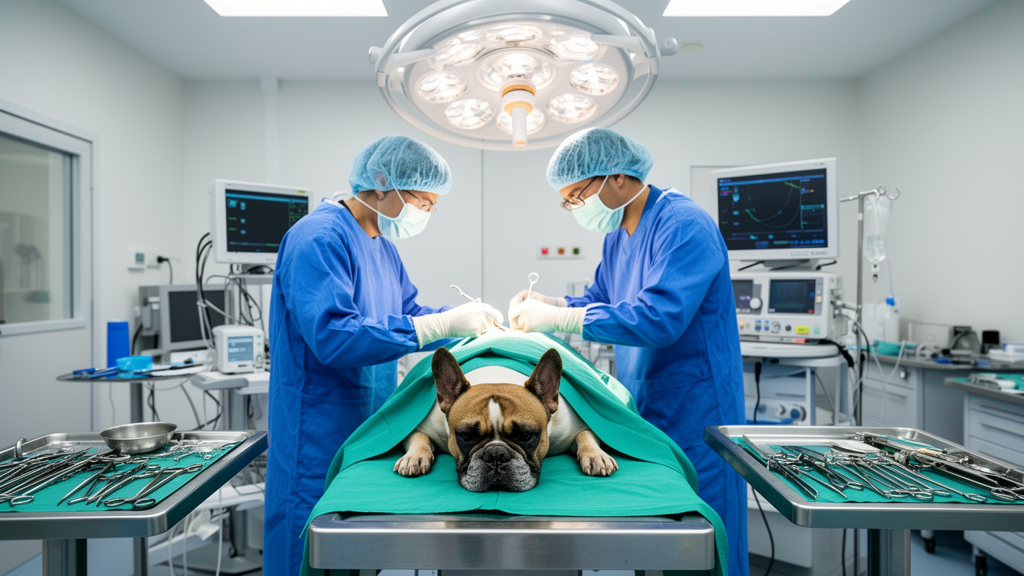
The number of soft tissue surgeries performed on cats and dogs at a single UK veterinary university referral hospital rose sharply over a decade, and the animals arriving on the operating table changed just as dramatically. A retrospective review of healthcare administration data from the Queen Mother Hospital for Animals at the Royal Veterinary College compared two one-year periods, 2008 and 2018, and found that the total soft tissue caseload grew from 659 procedures across both species in 2008 to 1,001 in 2018. Behind those headline figures sits a striking shift in which breeds were being referred and which operations they needed, with the French Bulldog emerging as the single most consequential change in the canine caseload.
The study, published in the journal Companion Animal Health and Genetics, was led by Alex James Currie of the Royal Veterinary College, together with Dan Gerard O’Neill and Daniel Brockman. The team used electronic theatre logs, in which a theatre nurse documented every episode of care requiring an operating theatre, and restricted the analysis to episodes handled by the soft tissue surgery referral service, whether by direct external referral or internal referral. An episode of care was defined as a procedure or set of procedures performed on a patient during a single period of anaesthesia. Episodes with missing breed, age or procedure data were excluded, leaving 512 dogs and 147 cats in the 2008 cohort and 803 dogs and 198 cats in 2018.
The French Bulldog’s rise was the most dramatic single change in the dataset. Only four French Bulldogs underwent soft tissue surgery at the hospital in 2008, but by 2018 that figure had reached 83, a 2,075 percent increase that made the breed the most common dog presenting for soft tissue surgery that year. The procedure with the greatest change in frequency was surgery for brachycephalic obstructive airway syndrome, the condition in which flattened facial conformations obstruct breathing. Sixteen such operations were performed in 2008 compared with 131 in 2018, an increase of 818.8 percent. In 2008 the most frequent breed undergoing airway surgery was the unspecified Bulldog, accounting for six of the sixteen cases, but by 2018 the French Bulldog dominated, with 58 of the 130 procedures recorded in the detailed results table.
The authors link this surge directly to the breed’s exploding popularity in the UK. French Bulldogs were reported to be the most popular pure-bred breed based on Kennel Club registration statistics as of 2018, and the most common pure-bred dog in the UK aged under one year in 2019. There is a substantial evidence base showing strong breed predisposition to obstructive airway disease in French Bulldogs, and the median age of French Bulldogs undergoing surgery at the hospital in 2018 was just 26 months. The authors note that this young presenting age could reflect both high demand for puppies of the breed and a very short predicted lifespan for those that are purchased. They also caution that the referral centre took specific steps to organise and promote itself as a specialist centre for brachycephalic patient care, which may have increased the proportion of airway surgeries referred there relative to other centres.
Not every change in the canine caseload traced back to breed fashion. The overall dog caseload rose by 65 percent across the decade, and the demographic profile of surgical patients shifted in measurable ways. Dogs in 2018 were significantly older at surgery, with a median age of 73 months compared with 60 months in 2008, and significantly lighter, with a median bodyweight of 16.5 kilograms against 22.7 kilograms a decade earlier. They were also significantly more likely to be neutered. The authors suggest that some increases in procedures such as cutaneous and subcutaneous mass excision and splenectomy may be partially explained by the development of an enhanced oncological service at the centre, while growth in cholecystectomies and adrenalectomies may reflect an extended emergency and critical care service. The decline in exploratory laparotomies, they propose, may partly reflect improved pre-operative diagnostic imaging reducing the need for open exploration without a definitive plan.
The feline caseload told a different story, driven less by breed trends than by technological change. The greatest increase in feline surgical procedure frequency was subcutaneous ureteral bypass surgery, which went from zero procedures in 2008 to 27 in 2018. The authors explain this confidently by the timeline of the technology itself: the use of a subcutaneous ureteral bypass device to manage feline ureteral obstruction was first described in 2011, with subsequent studies reporting on larger numbers of cases. The rise in cardiopulmonary bypass surgery in cats, from two procedures in 2008 to nine in 2018, is similarly straightforward to account for, because the referral centre is one of only a handful globally to perform such surgeries and has invested considerable resources into growing the service. Among cat breeds, the Ragdoll showed the greatest change, rising from a single case in 2008 to eight in 2018, an 800 percent increase, although the Domestic Short Hair remained by far the most frequently presented breed in both years.
Feline patients also aged between the two study periods. The median age of cats undergoing soft tissue surgery rose significantly from 60 months in 2008 to 71.5 months in 2018, and cats in 2018 were significantly more likely to be neutered. Their median bodyweight, at 4.0 kilograms in 2008 and 4.3 kilograms in 2018, did not differ significantly. The most frequently performed feline procedure shifted from wound management surgery, with 21 cases in 2008, to subcutaneous ureteral bypass in 2018. In dogs, the most frequent procedure moved from wound management surgery, with 61 cases in 2008, to obstructive airway surgeries, which accounted for 130 procedures, or 16.2 percent of the 2018 canine caseload, performed at a median age of 27.5 months.
The authors are careful about what a single-centre study can and cannot show. They emphasise that the case load at any one referral centre is affected by many factors, including local population demographics, local socioeconomic conditions, the number and profile of other nearby referral centres, institutional staffing and clinical interests, the willingness of local first opinion veterinarians to refer cases, institutional capacity, pricing structures and research aims. Because of this complexity, they advise that extrapolation of findings from any single institution to other veterinary hospitals should be carried out with caution, although they suggest the overall patterns of change are likely to hold more widely. They also note that a complete explanation of the causal factors behind the changing caseload sits outside the scope of the study.
The study also confronts the limitations of the healthcare administration data on which it relies. Theatre log entries were made by veterinary nurses based on verbal instruction or written notes from veterinary surgeons, creating the possibility of data entry errors, and the authors detected inconsistencies in clinical coding and typographical errors that required cleaning before analysis. Clinical coding could also be incomplete: the codes for exploratory celiotomy and exploratory thoracotomy describe entry into a body cavity but fail to record any procedures performed after entry, meaning the frequency of specific surgeries carried out within the cavities may be underestimated. The proportion of canine episodes of care excluded during data cleaning also varied significantly between 2008 and 2018, which may have affected the results. The authors recommend that future recording of such data should capture the full extent of procedures performed and call for validation studies to investigate the full extent of data accuracy.
Despite these caveats, the authors argue that healthcare administration data, considered alongside patient presenting age and wider available population data, can give veterinary organisations a better evidence base for planning. Changing breed profiles matter because different breeds carry strongly different disease risks, and the demand for dogs with extreme conformations, such as flattened faces and protruding eyes, has reshaped the population of animals needing referral care. The authors note that public demand to own French Bulldogs remains high despite work to inform the public of the breed’s high healthcare needs and welfare issues, and they argue that planning and investment are required to ensure the surgical referral services of the future are equipped to manage a growing number of diseases linked to brachycephaly in dogs. They propose that future work should collect such data at a national level across multiple hospitals, with improved accuracy in recording, so that veterinary practices can forecast future service demands and ensure the personnel, skills and equipment needed for these animals are available in time.
Subject of Research: Changing trends in referral soft tissue surgery for cats and dogs at a UK veterinary teaching hospital between 2008 and 2018
Article Title: Lessons from changing soft tissue surgical referral trends for cats and dogs in a UK veterinary university teaching hospital between 2008 and 2018
Article References: Currie, A. J., O’Neill, D. G., & Brockman, D. (2025). Lessons from changing soft tissue surgical referral trends for cats and dogs in a UK veterinary university teaching hospital between 2008 and 2018. Companion Animal Health and Genetics, 12(1), Article 10. https://doi.org/10.1186/s40575-025-00147-w
Image Credits: AI Generated
DOI: 10.1186/s40575-025-00147-w
Keywords: veterinary surgery, soft tissue surgery, French Bulldog, brachycephalic obstructive airway syndrome, referral caseload, healthcare administration data, Ragdoll, subcutaneous ureteral bypass, dog breeds, cat breeds, Royal Veterinary College, VetCompass
News Source: William Thompson. (October 29, 2026). French Bulldogs Drive a Decade of Dramatic Change in Veterinary Referral Surgery at a UK Hospital. Scienmag.