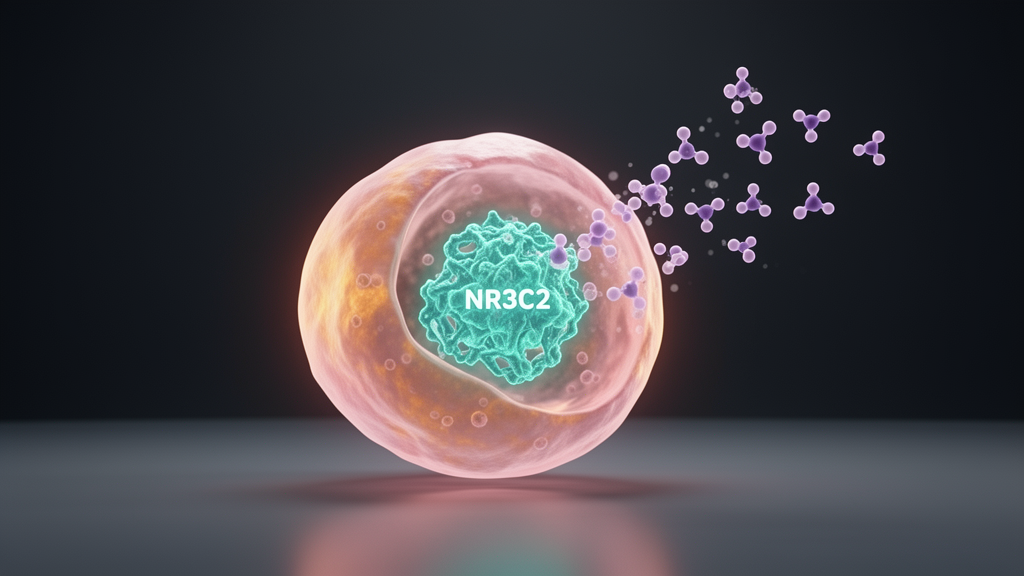
Linalool, a terpene found in lavender, rosewood, bergamot, and other essential oils, has emerged as an unexpected lead in laboratory studies of gastric cancer. A new open-access study published in Cell Division on 18 May 2026 reports that linalool suppresses the growth, migration, and invasion of gastric cancer cells in culture and slows transplanted tumor growth in nude mice. The researchers traced this effect to a specific molecular route: the compound physically binds to and stabilizes a protein called NR3C2, the mineralocorticoid receptor, protecting it from proteasomal degradation. Restored NR3C2 then activates transcription of a second gene, NFKBIZ, which reins in NF-κB signaling, an inflammatory pathway long implicated in driving gastric tumors. The work, led by Ying Hu and Shunfeng Chen with colleagues at institutions affiliated with China Pharmaceutical University and Nanjing Jiangning Hospital of Chinese Medicine, combines cell-line experiments, mouse xenografts, and tissue samples from 42 gastric cancer patients.
Gastric cancer remains a formidable global health problem, with nearly one million new cases and more than 650,000 deaths each year according to figures cited in the study. Patients often present with no symptoms or only vague complaints such as weight loss, abdominal pain, or nausea, which delays diagnosis. Although endoscopic biopsy with pathological examination is the diagnostic gold standard, its cost, invasiveness, and specialized requirements have limited its use in widespread screening. Current treatment spans endoscopic resection for early disease, adjuvant chemotherapy for stage 1B or higher, and sequential regimens for advanced cancer, yet five-year survival remains poor. The authors argue that these realities make new therapeutic candidates and early screening strategies urgently needed.
The experimental findings begin with straightforward cell biology. In CCK-8 assays, linalool inhibited the viability of two gastric cancer cell lines, AGS and HGC-27, in a dose-dependent manner, with the effect plateauing at higher concentrations; the team selected 100 micromolar for subsequent work. At that concentration, 24-hour treatment significantly suppressed colony formation, reduced the number of cells migrating or invading through Transwell chambers, and increased apoptosis as measured by TUNEL staining. In nude mice injected subcutaneously with AGS cells, oral linalool at 200 milligrams per kilogram, given every three days once tumors reached roughly 100 cubic millimeters, significantly inhibited tumor volume and weight over a 21-day course compared with vehicle controls.
Selectivity data offer some reassurance, though they come from the same preclinical setting. Linalool at 25 to 100 micromolar did not significantly reduce the viability of GES1, a normal human gastric mucosal epithelial cell line, while inhibition appeared only at 150 and 200 micromolar. In the mice, body-weight changes did not differ significantly between treated and vehicle groups, and hematoxylin-eosin staining revealed no obvious pathological damage in heart, liver, lung, or kidney tissue. The authors conclude that, under their dosing conditions, linalool was well tolerated, while noting that pharmacokinetic analyses and dose optimization will be required to determine clinically relevant concentrations.
The mechanistic hunt centered on NR3C2. Cross-screening differentially expressed genes from the GSE26942 gastric cancer dataset, which includes 205 tumor tissues and 12 adjacent normal tissues, against predicted protein targets of linalool yielded 16 intersecting genes. Within the resulting interaction network, NR3C2 stood out with a negative log2 fold change in tumors, and an analysis using the Kaplan-Meier Plotter database indicated that gastric cancer patients with high NR3C2 expression had better overall survival. NR3C2 expression was significantly higher in GES1 cells than in the AGS and HGC-27 cancer lines, and linalool treatment raised NR3C2 protein levels in the cancer cells in a dose-dependent manner.
Three independent biochemical assays supported a direct physical interaction. In a drug affinity-responsive target stability assay, NR3C2 in lysates treated with 100 micromolar linalool retained more protein after Pronase digestion than lysates treated with the DMSO vehicle. A cellular thermal shift assay showed that linalool significantly increased the thermal stability of NR3C2 across a gradient of temperatures from 43 to 61 degrees Celsius. A pull-down assay using a biotin-linalool probe enriched NR3C2 from cell lysates, and that enrichment dropped when excess free linalool was added as a competitor. Finally, a cycloheximide chase showed that linalool slowed the decline of NR3C2 protein after new protein synthesis was blocked, prolonging its half-life, and the proteasome inhibitor MG132 produced a similar effect, pointing to inhibition of proteasome-dependent degradation as at least part of the mechanism.
Functional rescue experiments then tested whether NR3C2 is required for the drug’s action. Two independent shRNA-mediated knockdowns of NR3C2 consistently blunted linalool’s effects in vitro: colony formation, migration, and invasion increased, and the drug’s pro-apoptotic effect weakened. In mice bearing tumors from NR3C2-knockdown AGS cells, exogenous inhibition of the receptor accelerated tumor growth despite linalool treatment, producing larger tumor volumes and weights. Knocking down NR3C2 also reduced luciferase activity driven by the NFKBIZ promoter and lowered NFKBIZ mRNA levels, while ChIP-qPCR showed that an anti-NR3C2 antibody enriched NFKBIZ promoter fragments, consistent with NR3C2 binding that promoter region and activating transcription.
Downstream, the pathway converged on NF-κB. Linalool lowered the protein levels of p65 and phosphorylated p65 and reduced NF-κB luciferase activity, changes that NR3C2 knockdown partially reversed. Notably, the suppression did not follow the classic route: IκBα and phospho-IκBα levels and the nuclear-to-cytoplasmic distribution of p65 were unchanged. Instead, the effect showed up as reduced p65 phosphorylation and diminished transcription of NF-κB target genes such as CCND1 and BCL2. Overexpressing NFKBIZ in NR3C2-deficient cells restored the suppression of p65 and p-p65, lowered NF-κB transcriptional activity, inhibited colony formation, migration, and invasion, increased apoptosis, and slowed xenograft growth. Conversely, knocking down NFKBIZ reactivated NF-κB signaling and weakened linalool’s anticancer effects, and the NF-κB inhibitor SC75741 reversed those changes.
Clinical tissue analysis lent correlative support. In 18 paired tumor and adjacent samples, RT-qPCR showed NR3C2 and NFKBIZ expression significantly higher in adjacent normal tissue than in tumors, with a substantial positive correlation between the two in tumor tissue. Western blotting revealed higher p65, p-p65, IL-1β, and IL-8 levels in tumors, consistent with NF-κB activation and inflammatory signaling. Immunohistochemistry across all 42 patients, scored by blinded pathologists using the immunoreactive system, found lower NR3C2 and NFKBIZ scores in tumors, and low expression of either marker was significantly associated with higher T stages and more advanced pTNM stages. These are associations from a single-center cohort of surgical cases, none treated with radiotherapy or chemotherapy, so they cannot establish causation.
The authors position the work as the first experimental evidence for an antitumor role of NR3C2 in gastric cancer and as a delineation of the NR3C2/NFKBIZ/NF-κB axis underlying linalool’s effects. Prior studies cited in the paper reported linalool’s antiproliferative activity in prostate, lung, breast, and colon cancer models, and reduced NR3C2 or NFKBIZ expression in colorectal, bladder, and liver cancers. The study, published open access in Cell Division, volume 21, article number 15, frames linalool as a candidate lead compound whose mechanism merits further preclinical development rather than as a ready treatment for patients.
Subject of Research: Preclinical research on linalool targeting NR3C2 to suppress NF-κB-mediated gastric cancer progression
Article Title: Linalool targets NR3C2 to inhibit NF-κB-mediated gastric cancer progression
Article References: Hu, Y., Chen, S., Wang, Y., Liu, L., Zhang, C., Chen, H., Duanmu, Y., Su, Z., & Ma, J. (2026). Linalool targets NR3C2 to inhibit NF-κB-mediated gastric cancer progression. Cell Division, 21(1), Article 15. https://doi.org/10.1186/s13008-026-00188-y
Image Credits: AI Generated
DOI: 10.1186/s13008-026-00188-y
Keywords: linalool, gastric cancer, NR3C2, NFKBIZ, NF-κB signaling, mineralocorticoid receptor, xenograft mouse model, proteasomal degradation, essential oils, tumor inflammation, Cell Division, preclinical study
News Source: Nathaniel Bowman. (October 29, 2026). Fragrance Compound Linalool Slows Gastric Cancer by Stabilizing NR3C2 Protein. Scienmag.