• HOME
  • NEWS
  • EXPLORE
    • CAREER
      • Companies
      • Jobs
    • EVENTS
    • iGEM
      • News
      • Team
    • PHOTOS
    • VIDEO
    • WIKI
  • BLOG
  • COMMUNITY
    • FACEBOOK
    • INSTAGRAM
    • TWITTER
Monday, October 5, 2026
BIOENGINEER.ORG
No Result
View All Result
  • Login
  • HOME
  • NEWS
  • EXPLORE
    • CAREER
      • Companies
      • Jobs
        • Lecturer
        • PhD Studentship
        • Postdoc
        • Research Assistant
    • EVENTS
    • iGEM
      • News
      • Team
    • PHOTOS
    • VIDEO
    • WIKI
  • BLOG
  • COMMUNITY
    • FACEBOOK
    • INSTAGRAM
    • TWITTER
No Result
View All Result
Bioengineer.org
No Result
View All Result
Home NEWS Science News Chemistry

Formate dehydrogenase reduces carbon dioxide to formic acid

Bioengineer by Bioengineer
May 18, 2020
in Chemistry
Reading Time: 3 mins read
0
IMAGE
Share on FacebookShare on TwitterShare on LinkedinShare on RedditShare on Telegram

A giant leap for artificial photosynthesis research!
IMAGE

Credit: Research Center for Artificial Photosynthesis, Osaka City University

Professor Yutaka Amao of the Osaka City University Artificial Photosynthesis Research Center and Ryohei Sato, a 1st year Ph.D. student of the Graduate School of Science majoring in Physics and Chemistry, reveal that the catalyst formate dehydrogenase reduces carbon dioxide directly to formic acid.

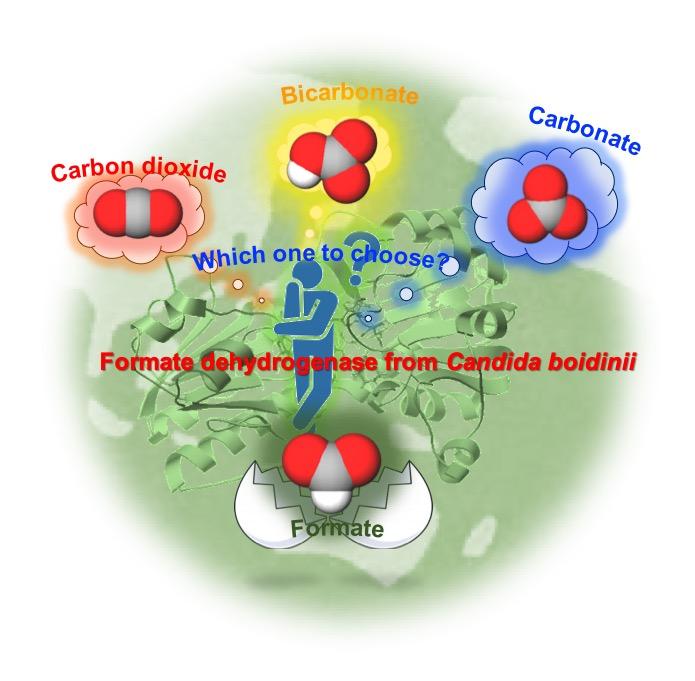
The development of an effective catalyst is an important step in creating an artificial photosynthesis system that uses sunlight to convert carbon dioxide into organic molecules. Formate dehydrogenase (FDH) is a catalyst that accelerates the reaction of converting carbon dioxide (CO2) into formic acid (hydrogen energy storage medium etc.) However, until now the details of how this happened were unclear. The research group dissolved FDH in a liquid solution and carbon dioxide was then blown into the solution for the reaction event.

In liquid, carbon dioxide exists in two additional forms other than itself – biocarbonate ion and carbonate ion. Until now, it was not known which of these three forms is reduced and converted into formic acid. By changing the amount of each type of carbon dioxide in the liquid solution and controlling them precisely the group found that carbon dioxide itself is directly reduced to formic acid after investigating their reaction with FDH.

The results of this research were published in the New Journal of Chemistry published by the Royal Society of Chemistry (RSC).

With the development of science and technology, it is necessary to prepare for the next generation by promptly solving the serious problems of today, namely global warming due to greenhouse gases, processing of large amounts of industrial waste, and the depletion of fossil energies such as oil and coal. It is essential to build an energy recycling system with a low environmental impact and to develop an energy conversion system that effectively uses greenhouse gases such as carbon dioxide. CO2 has a reduction target set on a global scale. It is possible to regulate and reduce CO2 emissions, but how to use this as a raw material and convert it into useful substances is also an important issue. These are the circumstances that have drawn attention to artificial photosynthesis technology that uses solar energy to convert carbon dioxide into a usable fuel. This research group aims to dramatically improve the catalyst “formate dehydrogenase”, which promotes the reaction of converting carbon dioxide into formic acid (fuel, chemical products, energy storage medium). It is known that carbon dioxide exists in a liquid as biocarbonate ion (HCO3-) and carbonate ion (CO3-) in addition to itself. However, when a reaction in the solution is catalyzed by formate dehydrogenase, it was unclear which of the 3 forms of CO2 was reduced to formic acid.

By changing the amount of these three forms of CO2 in the liquid solution and controlling them with formate dehydrogenase, This study showed that they are reduced to formic acid only when the carbon dioxide ratio is large, as shown in the figure to the right. When the carbon dioxide in the solution was changed to a bicarbonate and carbonate, it was not reduced to formic acid.

We believe that this discovery will guide us in the development and design of catalysts that will help bring about an artificial photosynthesis system that efficiently converts carbon dioxide into organic molecules.

###

Media Contact
Kaori Nishimae
[email protected]

Original Source

https://www.osaka-cu.ac.jp/en/news/2020/formate-dehydrogenase-reduces-carbon-dioxide-to-formic-acid

Related Journal Article

http://dx.doi.org/10.1039/D0NJ01183E

Tags: BiochemistryChemistry/Physics/Materials SciencesEnergy/Fuel (non-petroleum)Industrial Engineering/Chemistry
Share12Tweet8Share2ShareShareShare2

Related Posts

Soft Flexible Framework Material Could Improve Solid-State Battery Design

Soft Flexible Framework Material Could Improve Solid-State Battery Design

October 5, 2026
Fermented Fish Mint Emerges as a Powerful Shield for Meat Proteins

Fermented Fish Mint Emerges as a Powerful Shield for Meat Proteins

October 5, 2026

Clove-Derived Flame Retardant Gives Polyester Fabrics a Fire-Resistant, Eco-Friendly Coat

October 5, 2026

Castor Plant Chemistry Shows Surprising Anti-Inflammatory Power in Lab Tests

October 5, 2026
Please login to join discussion

POPULAR NEWS

  • Alloys That Shrink Their Own Grains: New PIX Mechanism Refines Metals With Heat Alone

    Alloys That Shrink Their Own Grains: New PIX Mechanism Refines Metals With Heat Alone

    29 shares
    Share 12 Tweet 7
  • Endurance Exercise Reshapes the Liver in Males and Females Through Distinct Molecular Routes

    29 shares
    Share 12 Tweet 7
  • Single Transcription Factor PU.1 Rapidly Converts Fibroblasts into Macrophage-Lineage Cells

    29 shares
    Share 12 Tweet 7
  • New Scale Measures How Ready Nurse Educators Really Are for the AI Era

    29 shares
    Share 12 Tweet 7

About

We bring you the latest biotechnology news from best research centers and universities around the world. Check our website.

Follow us

Recent News

Alloys That Shrink Their Own Grains: New PIX Mechanism Refines Metals With Heat Alone

Endurance Exercise Reshapes the Liver in Males and Females Through Distinct Molecular Routes

Single Transcription Factor PU.1 Rapidly Converts Fibroblasts into Macrophage-Lineage Cells

Subscribe to Blog via Email

Success! An email was just sent to confirm your subscription. Please find the email now and click 'Confirm' to start subscribing.

Join 85 other subscribers
  • Contact Us

Bioengineer.org © Copyright 2023 All Rights Reserved.

Welcome Back!

Login to your account below

Forgotten Password?

Retrieve your password

Please enter your username or email address to reset your password.

Log In
No Result
View All Result
  • Homepages
    • Home Page 1
    • Home Page 2
  • News
  • National
  • Business
  • Health
  • Lifestyle
  • Science

Bioengineer.org © Copyright 2023 All Rights Reserved.