• HOME
  • NEWS
  • EXPLORE
    • CAREER
      • Companies
      • Jobs
    • EVENTS
    • iGEM
      • News
      • Team
    • PHOTOS
    • VIDEO
    • WIKI
  • BLOG
  • COMMUNITY
    • FACEBOOK
    • INSTAGRAM
    • TWITTER
Sunday, October 4, 2026
BIOENGINEER.ORG
No Result
View All Result
  • Login
  • HOME
  • NEWS
  • EXPLORE
    • CAREER
      • Companies
      • Jobs
        • Lecturer
        • PhD Studentship
        • Postdoc
        • Research Assistant
    • EVENTS
    • iGEM
      • News
      • Team
    • PHOTOS
    • VIDEO
    • WIKI
  • BLOG
  • COMMUNITY
    • FACEBOOK
    • INSTAGRAM
    • TWITTER
  • HOME
  • NEWS
  • EXPLORE
    • CAREER
      • Companies
      • Jobs
        • Lecturer
        • PhD Studentship
        • Postdoc
        • Research Assistant
    • EVENTS
    • iGEM
      • News
      • Team
    • PHOTOS
    • VIDEO
    • WIKI
  • BLOG
  • COMMUNITY
    • FACEBOOK
    • INSTAGRAM
    • TWITTER
No Result
View All Result
Bioengineer.org
No Result
View All Result
Home NEWS Science News

For controlling tsetse flies, fabric color matters

Bioengineer by Bioengineer
December 12, 2019
in Science News
Reading Time: 2 mins read
0
IMAGE
Share on FacebookShare on TwitterShare on LinkedinShare on RedditShare on Telegram

IMAGE

Credit: Prof. Steve Tor, Liverpool School of Tropical Medicine


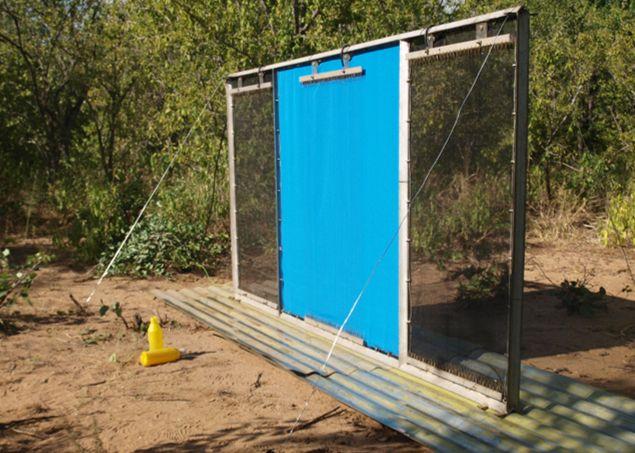
Tsetse flies infest an estimated 10 million square kilometers of sub-Saharan Africa and their bites transmit trypanosome parasites that cause disease in humans and in animals. This week in PLOS Neglected Tropical Diseases, researchers report that they have engineered an improved colored fabric for the insecticide-treated targets used to control tsetse, based on an understanding of how flies see color.

Tsetse targets are traditionally made from large panels of black or blue-dyed cotton fabric, sometimes flanked by netting. The target is coated in insecticide so that flies are attracted and once they make contact with it, they are then dosed and killed. Recently it has been realized that polyester targets are lighter, last longer, and hold insecticide better, but some blue polyesters are not as effective in attracting tsetse as cotton equivalents, even though their color may appear similar to a human eye.

In the new work, Roger Santer of Aberystwyth University, and colleagues calculated how a fly’s photoreceptors would respond to a variety of colored fabrics to determine the attractive properties of color from a fly’s-eye-view. They then deliberately engineered a polyester fabric to be more attractive based upon those principles and tested its effectiveness against savannah tsetse flies. In contrast to traditional assumptions, the new fabric was violet to a human eye rather than blue.

The team compared catches of various polyester targets to a standard one constructed from black cotton. They found that targets made from blue polyesters could be just as effective as black cotton ones, indicating that these modern materials are useful in savannah tsetse control. However, they also found that their new violate polyester attracted approximately 50% more female tsetse than either the traditional black cotton or a typical blue polyester, demonstrating its effectiveness.

“Our results demonstrate that photoreceptor-based models can be used to engineer fabrics with greater attractiveness to tsetse and show that the violet fabric developed in this study is both robust and effective for targets against savannah species,” the researchers say.

###

In your coverage please use this URL to provide access to the freely available paper: http://journals.plos.org/plosntds/article?id=10.1371/journal.pntd. 0007905

Citation: Santer RD, Vale GA, Tsikire D, Torr SJ (2019) Optimising targets for tsetse control: Taking a fly’s-eye-view to improve the colour of synthetic fabrics. PLOS Neglected Tropical Diseases 13(12): e0007905. https://doi.org/10.1371/journal.pntd.0007905

Funding: No specific funding was received for this work.

Competing Interests: The authors have declared that no competing interests exist.

Media Contact
Roger Santer
[email protected]

Related Journal Article

http://dx.doi.org/10.1371/journal.pntd.0007905

Tags: BiologyBiomedical/Environmental/Chemical EngineeringBiotechnologyDisease in the Developing WorldEntomologyInfectious/Emerging DiseasesMedicine/HealthPublic Health
Share12Tweet8Share2ShareShareShare2

Related Posts

Tiny Dye Trick Reveals Hidden Catheter Errors in Preterm Babies

Tiny Dye Trick Reveals Hidden Catheter Errors in Preterm Babies

October 4, 2026
Lightweight AI Spots Grapevine Virus From Drone Hyperspectral Images

Lightweight AI Spots Grapevine Virus From Drone Hyperspectral Images

October 4, 2026

Spray-Coated Self-Stratifying Fibers Supercharge Triboelectric Nanogenerators

October 4, 2026

Lactate Tags a Tumor Suppressor and Fuels Liver Cancer Growth

October 4, 2026
Please login to join discussion

POPULAR NEWS

  • Alloys That Shrink Their Own Grains: New PIX Mechanism Refines Metals With Heat Alone

    Alloys That Shrink Their Own Grains: New PIX Mechanism Refines Metals With Heat Alone

    29 shares
    Share 12 Tweet 7
  • Endurance Exercise Reshapes the Liver in Males and Females Through Distinct Molecular Routes

    29 shares
    Share 12 Tweet 7
  • Single Transcription Factor PU.1 Rapidly Converts Fibroblasts into Macrophage-Lineage Cells

    29 shares
    Share 12 Tweet 7
  • New Scale Measures How Ready Nurse Educators Really Are for the AI Era

    29 shares
    Share 12 Tweet 7

About

We bring you the latest biotechnology news from best research centers and universities around the world. Check our website.

Follow us

Recent News

Alloys That Shrink Their Own Grains: New PIX Mechanism Refines Metals With Heat Alone

Endurance Exercise Reshapes the Liver in Males and Females Through Distinct Molecular Routes

Single Transcription Factor PU.1 Rapidly Converts Fibroblasts into Macrophage-Lineage Cells

Subscribe to Blog via Email

Enter your email address to subscribe to this blog and receive notifications of new posts by email.

Join 85 other subscribers
  • Contact Us

Bioengineer.org © Copyright 2023 All Rights Reserved.

Welcome Back!

Login to your account below

Forgotten Password?

Retrieve your password

Please enter your username or email address to reset your password.

Log In
No Result
View All Result
  • Homepages
    • Home Page 1
    • Home Page 2
  • News
  • National
  • Business
  • Health
  • Lifestyle
  • Science

Bioengineer.org © Copyright 2023 All Rights Reserved.